Marcellus’s collection
Remarkably Bright CreaturesMarcellus’s collection is both a private hoard and an imperfect archive: a den full of human-made things gathered by an octopus who cannot explain where they came from or what they mean. Its most consequential pieces—a woman’s earring and a key matching one Tova Sullivan lost—make the collection a material link between the aquarium and the sea, where Erik Sullivan’s remains lie. As Marcellus tries to guide Tova and Cameron Cassmore toward a truth they have not recognized, the collection becomes not just a record of what he has found but a measure of what he cannot tell them.
Contents and Origins
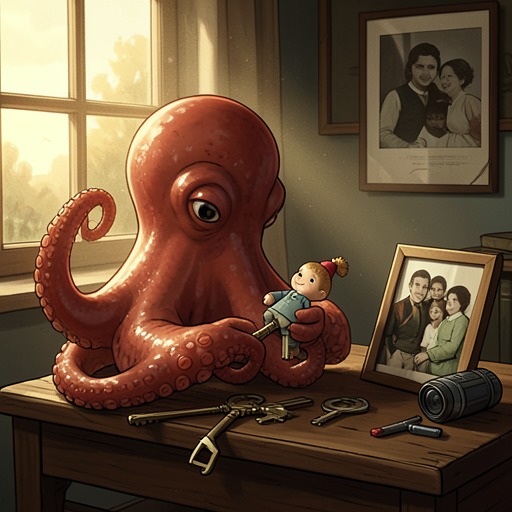
The collection includes small objects gathered from the environment around Marcellus’s tank. When Cameron and Tova watch him search the sand, he uncovers a teardrop-shaped silver earring about an inch wide and sweeps it into his den. Tova recognizes the gesture as part of a pattern: Marcellus has previously dug up and returned her lost house key. She calls him a treasure hunter, though Cameron remains skeptical of how much the octopus understands.
The key has a deeper history for Marcellus. Before his capture, when he was very young, he held an exact copy of it. He found that key attached to a circular ring on the sea floor, among objects left behind by a human body: a rubber sneaker sole, a vinyl shoelace, and several plastic buttons. The remains themselves had disappeared, but these manufactured fragments endured beneath rocks. Marcellus connects the key to the person Tova mourns and later wishes he could have gathered the other objects too, so he might have returned the whole assemblage to her.
A Hidden Archive in the Tank
Marcellus searches his collection repeatedly, considering whether any of its contents might help Tova and Cameron understand what they have missed. The objects, however, do not arrange themselves into an explanation that the humans can read. His attempt to use them as clues comes to nothing, even as he recognizes that the pair have been working together for weeks without seeing the connection he sees.
The collection is not a neat display. It spills out of Marcellus’s den in a sloppy, disorganized heap, and he fears it will be exposed the next time the tank is cleaned. Its disorder carries practical danger for him, but also reflects the limits of his communication: he can gather, preserve, and move objects, yet cannot state their history in human language. Near the end of his life, that limitation feels especially pressing. He fears leaving the story unfinished and persists in trying to make the humans realize what the objects mean.
The Collection and the Sea
The collection’s significance depends on the contrast between the aquarium and the sea. In the tank, found objects become Marcellus’s guarded possessions and possible messages; in the depths, their original context is a scattered trace of a life lost to the water. Tova’s grief gives the returned key an emotional destination, while Marcellus’s memory of finding its twin supplies a connection she does not yet have.
After Tova releases him, Marcellus swims from the rocks toward the deep water. He returns to the depths where, as a juvenile, he found the key, and where the long-dissolved remains of Erik rest. The collection thus joins two kinds of keeping: Marcellus’s intimate preservation of objects in captivity and the sea’s physical retention of fragments after bodies and stories have largely vanished.
Narrative Significance
The collection makes Marcellus’s intelligence visible through action rather than explanation. The earring’s discovery, his earlier return of Tova’s key, and his careful consideration of the hoard as a possible source of clues show him treating objects as meaningful connections between people and events. Yet those same objects expose the gap between what he understands and what he can make the humans understand. They are evidence to him, but without the right context they remain merely lost things to the others.
As a result, the collection is at once a store of memory and a fragile means of communication. Its scattered contents preserve traces that the sea has not erased, but they cannot by themselves resolve the human story Marcellus hopes to finish. Their force comes from the conjunction of physical survival, his imperfect efforts to interpret and return them, and Tova’s grief—an intimate history held in objects too small to speak for themselves.