Marcellus’s declining health
Remarkably Bright CreaturesMarcellus’s declining health turns the approach of death from an abstract limit into a sequence of physical costs: a pump housing harder to unscrew, a short journey that drains his strength, and a body that Tova Sullivan finds pale, dry, and weak. Though he remains determined to act, his failing condition sets the terms of his final efforts and draws Tova into an urgent act of care.
Age and Prognosis
At the aquarium, Terry Bailey explains that Marcellus is very old for a Giant Pacific octopus. His age makes his continued vigor striking, but not reassuring: after Marcellus is in especially bad shape one morning, Terry says that he and Dr. Santiago are unsure how much longer he has and that he might have only weeks or days left. The estimate is uncertain, but its narrow range gives the decline an immediate horizon. Terry’s description of Marcellus as a feisty old animal determined to outrun his lifespan captures the tension between his persistent will and the limits of his body.
This prognosis also changes the meaning of Marcellus’s remaining time. His later narration does not treat the warning as a distant possibility. As he works to remove the pump housing, he feels what he calls The Consequences arriving faster than before, and concludes that he does not have much time left. The account provides no exact medical diagnosis or timetable beyond Terry’s estimate; instead, it makes deterioration legible through what Marcellus can still manage, and how much each action now costs.
Strength, Captivity, and the Last Effort
The pump housing has become increasingly difficult for Marcellus to unscrew. He persists, working himself halfway through the gap, but the effort brings on the physical consequences he has been feeling more quickly in recent days. His body constrains even the mechanics of escape: getting out requires patience and exertion, and he begins the next stage already weakened. The narrow gap is not simply a route between tanks; it measures the effort his declining body must spend to continue acting.
Marcellus nevertheless enters the Wolf eels’ enclosure to retrieve a heavy ring. He searches through the sand at the base of a plant, brushing the object with the suckers at the tip of his arm before securing it in the thick part of his arm. The wolf eels watch, but do not approach. Even the return to his own tank saps him; he says he is weakening by the day and rests in his den to gather stamina for what he calls his last trip. The sequence gives his determination a concrete cost: the ring is recovered, but the effort leaves him with less strength for what comes next.
Tova Finds Him
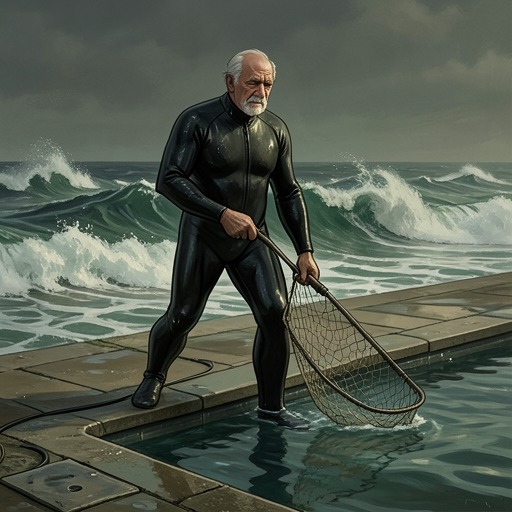
When Tova Sullivan discovers Marcellus on the hard tile floor near the door, his condition is visible at once. He is pale, his brilliant eye appears diminished and cloudy, and his skin is sticky and dry. Tova touches his mantle gently, as one might check a sick child, and Marcellus winds an arm around her wrist, over the faded, ghostlike ring of the silver-dollar scar. His weak squeeze is both a response to her touch and a measure of how little force he can summon.
Tova tries to lift him back to his tank, but the attempt strains her back and sends pain through her lower spine. She cannot simply carry him; instead, she tells him to stay and hurries to the supply closet. There she fills her yellow mop bucket with several gallons of water from his tank, using an old milk jug, and returns to wet his skin with a cloth. His blink reassures her that he has not yet gone, and he gives one of his strange, humanlike sighs. The scene places two aging bodies within the same act of care: Tova’s movement is painful, but she adapts her familiar cleaning tools and keeps tending to him.
The Meaning of Diminishing Time
Marcellus’s earlier account of having spent 1,329 days in captivity establishes the long duration of his confinement, while his later account emphasizes how sharply his remaining strength has narrowed. The evidence does not present captivity as a medical explanation for his decline; rather, it sets extended confinement beside his age and his acute awareness that time is running out. His knowledge of his limits does not make him passive. He continues to plan, cross the gap, and retrieve the ring, but he can no longer treat these acts as effortless or repeatable.
That contrast gives his declining health its particular force. The aquarium’s routines include Tova’s nightly mopping, and she is herself a seventy-year-old worker with a curved back; when she finds Marcellus, the same laboring body that cleans the floors must improvise a way to keep him wet. His failing condition is therefore not conveyed only as an individual prognosis. It changes what he can do, makes each remaining effort consequential, and brings Tova’s practical care into the foreground without erasing either creature’s physical limits.