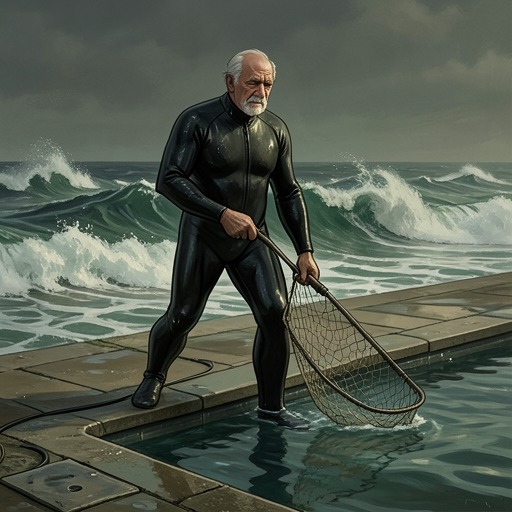
Marcellus's nighttime escapes to forage
Remarkably Bright CreaturesMarcellus’s nighttime escapes turn captivity into a carefully timed contest between appetite, ingenuity, and survival. He finds a way out through a gap beside the pump, explores the aquarium for food, and must return to the water within eighteen minutes. His account makes each escape both a practical routine and a risk: a single failed door prop leaves him suffering The Consequences, while the secret passage and the treasures he hides in his den remain beyond the knowledge of the people who care for the tank.
The Route Out and the Time Limit
Near the top of his enclosure, the pump enters through a hole in the glass. Marcellus can fit a tentacle into the narrow space between the pump housing and the glass, unscrew the housing, and let the pump float into the tank. The resulting opening is only about as wide as two or three human fingers. Its smallness is no obstacle to him: he can shape his body to pass through, then slide down the glass into the pump room behind the tank.
Getting out of the water starts a clock. Marcellus has worked out that he can remain on land for eighteen minutes before The Consequences take hold; the aquarium’s plaque does not give visitors this information. His limit is knowledge acquired through experience, not a posted rule. The narrow exit therefore offers freedom only under a precise condition: he must navigate his excursion and get back into the water before his body begins to fail.
Food, Choices, and a Failed Shortcut
Once in the pump room, Marcellus must choose between staying among the nearby tanks and opening the door to the hallway and main tank. The first option is easier to reach but offers an unsatisfying menu. Wolf eels are out of the question because of their teeth; Pacific sea nettles are too spicy, and yellow-bellied ribbon worms too rubbery. Bay-blue mussels do little for him, while Sea cucumbers are tempting enough that he has to restrain himself, since taking too many could attract Terry Bailey’s attention.
The hallway and main tank promise better foraging, but the heavy door costs precious minutes to open on the way out and reopen on the return. Marcellus once tried to solve the problem by propping it with the stool from beneath his tank. With the extra time, he raided a bucket of fresh halibut chunks Terry had left under the main tank’s hatch, apparently as food for the sharks the following morning. Marcellus enjoyed an unusually pleasant evening and returned with his gut full. But the stool had not held the door open. The time he spent forcing it open left him in danger, and the episode taught him that a propped door could not be trusted.
The Consequences and the Return
As his time out of water runs short, The Consequences become physical and unmistakable. Marcellus’s limbs slow, his vision blurs, and his mantle grows heavy and droops toward the floor. His flesh turns a flat brownish gray. Crawling across the pump-room concrete, he can no longer feel its cold; his suckers fumble as he climbs the glass. Partway through the gap, his tentacles are numb. At that point he considers, briefly, the possibility of not returning, but the water takes him in and he recovers.
Back in the tank, sight sharpens and color returns. Marcellus coils a tentacle around the pump, replaces it, and screws the housing back into place through the crack. He swims to his den with strength restored and the halibut still in his stomach. There, the pounding of his three hearts registers as relief: he has survived a risk that his own curiosity and appetite helped create. The excursion’s reversal—from a leisurely feast to an immediate threat to his life—shows why the eighteen-minute limit matters more than the apparent ease of slipping through the glass.
Repetition, Secrecy, and the Hidden Collection
The failed door experiment does not end Marcellus’s excursions. He says that he has pushed the boundaries of his freedom on other occasions, but never again relies on the extra time he hoped to gain by propping the door. The escape is thus not a single break from captivity but a recurring practice, adjusted by experience. He keeps the gap itself secret: Terry does not know about it, and Marcellus wants no one else to find out.
The excursions also connect to his hidden collection. On Day 1,319, Marcellus reports finding Tova Sullivan’s house key on the floor near the place where she keeps her belongings while cleaning. He recognizes something familiar about it, takes it despite knowing he should not, and carries it back to the tank. In his den, he hides the key in a deep pocket in the hollowed rock, a recess beyond the reach of even thorough tank cleaners. The key joins an assortment that includes marbles, plastic superheroes, a solitaire ring, cards, a driver’s license, a barrette, a tooth, and single earrings. The escape route gives Marcellus access to the world outside his tank; the concealed den lets him preserve what he takes from it. Together, foraging and collecting give his secret life a structure of its own, sustained by ingenuity but bounded by the danger of remaining out of water too long.