Mary Ann Minetti
Remarkably Bright CreaturesMary Ann Minetti is a longtime member of the Knit-Wits and a close friend of Tova Sullivan. Through small acts of care—a casserole left at Tova’s house, a hand clasped around hers, and repeated offers of help—Mary Ann gives friendship a practical form. Her move to Spokane brings that dependable presence into focus just as Tova is facing changes of her own.
Identity and the Knit-Wits
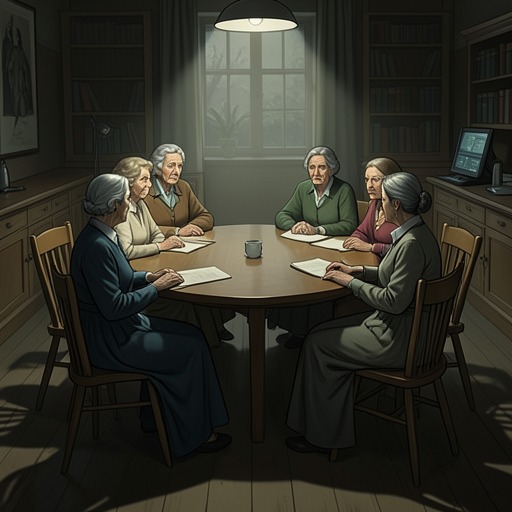
Mary Ann belongs to a weekly circle whose history is marked by absence. The Knit-Wits once numbered seven; now four gather, with another place at the table lost every few years. Their luncheons retain traces of the knitting that gave the group its name: when Tova visits Mary Ann, a crocheted yellow cozy wraps the teapot, a remnant of the projects the women once worked on together. The cozy matches the yellow jeweled barrette at Mary Ann’s temple, an everyday detail that makes her home feel personal and lived-in.
Mary Ann’s attentiveness appears in what she notices and what she does with that notice. At the luncheon, she sees the mark on Tova’s arm and reacts with alarm. When the conversation turns to Tova’s work mopping floors, Mary Ann recalls that Tova had done filing, then leans in to offer help. She specifically wonders how Tova’s late husband, Will Sullivan, arranged her finances. The question reflects concern about how Tova is managing, rather than treating her increasingly demanding work as something she should simply accept.
Friendship expressed through care
Mary Ann’s concern continues beyond the luncheon. After the death of Tova’s brother, Lars Lindgren, Tova comes home to a refrigerator already crowded with food left by friends and well-wishers. One of the dishes is an oversized ham-and-cheese gratin Mary Ann dropped off the previous day. The casserole is a modest but concrete expression of sympathy: Mary Ann’s care reaches Tova at home, where grief and ordinary needs meet.
At another gathering, Mary Ann takes Tova’s hand and asks her to let the group know if she needs help. Tova insists that she does not. The exchange makes their friendship attentive but not frictionless: Mary Ann offers support, while Tova maintains her independence. Mary Ann does not turn the offer into a demand; she leaves the possibility open. That patience matters in a story where Tova’s physical limitations and long-established self-reliance increasingly sit side by side.
Moving to Spokane
Mary Ann’s own life changes when she decides to move in with her daughter, Laura, in Spokane. Tova learns the news from Janice Kim, who explains that Mary Ann announced it at a Knit-Wits gathering Tova missed. The information arrives secondhand, but it has immediate emotional weight: Mary Ann is not merely skipping a luncheon; she is leaving the community in which the women have shared their weekly routine.
The group marks her departure with a farewell luncheon at the Elland Chophouse on a hot August day. Tova arrives early, still recovering from an ankle injury, and Mary Ann is among the friends gathered for the occasion. As the meal ends, Mary Ann asks Tova whether she will visit before Mary Ann leaves that weekend. Tova promises to stop by. Mary Ann’s smile is tight and her voice shakes slightly; Laura comes to stand behind her and puts an arm around her shoulders. The small gestures convey the strain of a farewell without turning it into a scene of open protest.
Significance in Tova’s life
Mary Ann’s departure gives shape to the dwindling circle of the Knit-Wits. The group’s decline is not presented as one dramatic loss, but as a succession of empty places and altered routines. Mary Ann’s move makes that gradual change personal for Tova, who must reckon with the absence of a friend she has relied on for companionship and practical kindness.
Her friendship also establishes a pattern against which Tova’s later choices can be felt. Mary Ann offers help when Tova’s age and physical labor become visible to others, and she keeps offering it even when Tova refuses. At the same time, the farewell reveals Mary Ann’s own need for connection: she asks to see Tova once more before leaving. Their bond is therefore reciprocal, held together not by a single grand gesture but by food delivered to a crowded refrigerator, hands briefly clasped, and a promise to visit.