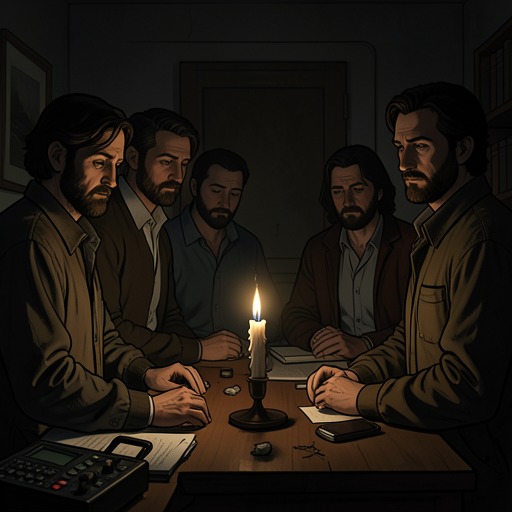
Secrets and unspoken truths
Remarkably Bright CreaturesSecrets and unspoken truths are not merely concealed facts in the novel; they are the distance between what a community concludes and what Tova Sullivan can believe, and between what Marcellus knows and what he can communicate. Human silence leaves grief private and history unresolved, while the sea preserves fragments that may matter without making them easy to interpret. The result is a world in which knowledge exists, but does not automatically become understanding.
Private grief and social belonging
The Knit-Wits began as a small gathering of Sowell Bay women who met to exchange yarn. Over twenty-five years, the club became a refuge from quiet homes and the bittersweet absence of children who had grown up and moved away. Tova initially resisted joining. When Erik had been gone for five years, the other women’s familiar maternal concerns touched the place where her own loss remained raw: for her, the emptiness held bitterness rather than sweetness. Her grief was not absent from the room so much as kept inward, beyond the easy language of family updates and shared complaints.
That contrast helps define secrecy as a condition of belonging as well as isolation. Tova has friends in the Knit-Wits, yet can still feel like a misplaced piece in their shared pattern. Their conversation moves among ordinary concerns, including an orthopedist’s poor surgery and Janice Kim’s Yorkie, while Tova carries the loss of her son privately. Her silence is not evidence that the loss has receded. It is a way of living with a wound that ordinary conversation does not reach.
The memory of Erik’s eighteenth birthday makes that persistence concrete. A few days before he disappeared, Tova baked him an almond cake; the smell of marzipan lingered in the house for days. The domestic detail remains vivid alongside the unanswered questions surrounding his last night. Private memory preserves what public explanations cannot settle: not an answer to what happened, but the intimacy of the life that preceded it.
The official account and Tova’s refusal
At first, authorities treated Erik’s disappearance as a possible runaway case. The last reported sighting came from a deckhand on the eleven o’clock southbound ferry. Erik was supposed to lock the ticket booth after his summer shift, a responsibility he valued. The booth was found unlocked, but its register cash was intact; his backpack, cassette player, headphones, and wallet remained beneath a chair. The sheriff initially allowed for the possibility that Erik had stepped away temporarily and planned to return.
A week later, a rusty Sun Cat missing from the marina near the ferry dock washed ashore. Its anchor rope had been cut, and Erik’s fingerprints were on the rudder. The evidence was thin, but the sheriff said it pointed to suicide. Neighbors and newspapers repeated that conclusion until it became what everyone said. Tova never believed it. The gap between the public verdict and her conviction is central to the novel’s treatment of unspoken truth: a repeated explanation can become socially settled without becoming emotionally or evidentially conclusive.
Years later, Tova tells Marcellus that Erik drowned alone in a small boat, that the search lasted weeks, and that the anchor line had been cut. She says the body was never found and believes it would have been consumed at the bottom of the ocean. Her account includes possible sources of conflict—an argument over a broken Dala horse and Erik’s anger at being made to work at the ticket booth—but neither detail resolves the disappearance. She remembers them without turning them into proof. The telling gives Marcellus access to the questions Tova has carried, while leaving the central event unresolved.
Marcellus and the sea’s store of secrets
Marcellus’s perspective enlarges the theme beyond human families. He regards himself as exceptionally capable of keeping secrets, but his captivity gives him few people to tell. His conversations with other creatures seem limited, and his account stresses both his loneliness and the difficulty of communication among humans. People, in his view, possess words in abundance yet often fail to say what they want. Even a herring, he observes, can follow the direction of its school. His judgment connects silence not only to deliberate concealment but also to the painful failure to communicate.
The sea represents a different kind of secrecy. It holds material traces without explaining them: what remains below the surface may preserve evidence, but not a complete account. Marcellus carries one such secret from the sea floor, a discovery that precedes his capture and that he cannot simply deliver as a coherent explanation. His knowledge is real but partial, and its meaning depends on recognizing how it connects to Tova’s loss.
The lost key and belated recognition
When Marcellus finds Tova’s missing house key on the floor near the place where she keeps her cleaning things, he takes it and hides it in a pocket of his tank’s hollowed rock. The concealment joins a larger collection of objects he has gathered: marbles, plastic superheroes, a ring, cards, a driver’s license, a barrette, and a tooth. The key attracts him for a reason he does not understand at first. Its ridges recall an identical key from his youth, before his capture.
That earlier key was attached to a circular ring among human remnants on the sea floor: a rubber sneaker sole, a vinyl shoelace, and several buttons, gathered beneath rocks. Marcellus thinks the remains must belong to the person Tova mourns. He also wishes he could return the other fragments—the shoe sole, lace, buttons, and matching key—and understands returning the key he has now as the least he can do for her. His action is therefore more than the return of a misplaced possession. It carries the trace of an older discovery, though the account does not make that discovery a full explanation of Erik’s fate.
Form and significance
The novel distributes knowledge across different kinds of telling. Tova’s recollections return to the disappearance through concrete details, while Marcellus’s first-person narration reveals that the sea has preserved objects and associations unavailable to her. Neither perspective supplies an omniscient solution: Tova has memory and doubt; Marcellus has a material clue and an inference. Their unequal knowledge creates a space between evidence and certainty rather than closing the case.
That space also gives the theme its emotional force. Tova’s refusal to accept the community’s conclusion persists beside her long-held silence, and Marcellus’s private knowledge persists beside his limited means of sharing it. Objects—the cake’s lingering marzipan scent, the abandoned belongings at the ticket booth, the cut anchor line, and the paired keys—make absence tangible without making it transparent. Secrets in the novel are thus both burdens and fragile connections: they isolate those who carry them, yet a recovered fragment can bring separate lives into relation without erasing what remains unknown.