Sowell Bay High School Class of 1989 ring
Remarkably Bright CreaturesThe Sowell Bay High School Class of 1989 ring is a discarded keepsake that becomes a lead in Cameron Cassmore’s search into his mother’s past. Its importance lies in the details it carries: the school and graduating class engraved on its face, and the faint EELS on its underside. Those marks turn an item Cameron initially values for possible cash into a material link to a place, a year, and a photograph of Daphne Cassmore with Simon Brinks.
Discovery in the Jewelry
The ring comes to light among possessions Aunt Jeanne gives Cameron. He is disappointed by the box’s contents: old cassette tapes have no resale value, and he sees little reason to feel closer to his mother through them. The small black drawstring bag is different. It contains bracelets, necklaces, empty lockets, and a broken silver chain—jewelry Cameron thinks he might pawn. As he checks that the bag is empty, a crusted photograph folded around a chunky class ring slips free. The ring’s first significance is therefore practical: Cameron is looking through an inheritance for something he can turn into money.
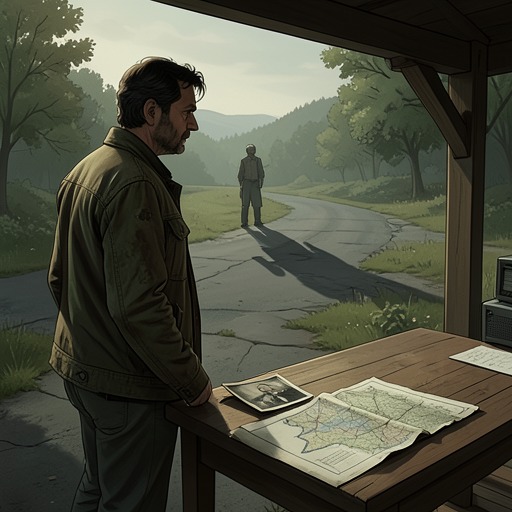
That first reading does not last. The object has been concealed inside the bag and wrapped in a photograph, so its identifying details are not immediately visible. Cameron brings it close enough to read the school and class year: Sowell Bay High School, Class of 1989. The photograph, once flattened, shows a teenage Daphne smiling with a man Cameron does not recognize. The ring and photograph arrive together, but neither initially tells him who the man is or what the ring means to Daphne. Their pairing supplies a question before it supplies an answer.
From Pawnable Object to Clue
Cameron carries the bag to Old Al’s bar and empties its contents onto the counter while asking for somewhere to stay. He presents the jewelry as evidence that he can pay for a couple of months’ lodging. Old Al examines a gold tennis bracelet, then picks up the class ring and notices its school and year. His comment that such rings are no longer bought as graduation gifts marks it as an old school keepsake rather than just another piece of gold among the items Cameron hopes to sell.
The exchange also gives the inscription a geographic consequence. Old Al recognizes Sowell Bay as a place in Washington. For Cameron, who needs cash and has not graduated high school himself, the class designation initially has little personal resonance. The place name, however, makes the ring useful in a new way: it points beyond the bar and the pawn attempt toward a past located elsewhere. No sale of the ring is established in these scenes; its value shifts from presumed resale worth to the information it can lead Cameron to find.
The Underside Inscription
Cameron later turns the ring over and discovers a faint engraving on its underside: EELS. He reads it as a possible school mascot, though the scanned yearbook pages he is looking through do not appear to use an eel theme. The mark is ambiguous rather than self-explanatory. It adds another clue without immediately settling what kind of clue it is, prompting Cameron to compare the ring with other evidence from the class of 1989.
The yearbook search connects the object’s brief inscription to a much fuller image. Cameron scrolls through scanned photographs from Sowell Bay High School’s reunion pages, looking for the man shown with his mother in the old photograph. He finds another image of Daphne on a crowded pier, with the same man beside her, his face turned into her windblown hair. Its caption identifies them as Daphne Cassmore and Simon Brinks. The ring has not named the man; instead, its school and year have helped orient Cameron toward the archive in which he finds the caption.
What the Ring Reveals—and Leaves Open
After identifying Simon Brinks in the yearbook photograph, Cameron searches his name online. The results present Simon as a prominent Seattle real estate developer and nightclub owner, with coverage of a vacation home in the Seattle Times and photographs of his Ferrari. The ring’s trail has thus led Cameron from a bag of mixed jewelry to an identifiable person whose public life is far removed from the low-value objects Cameron first hoped to pawn.
The discovery raises the possibility that Simon is connected to Cameron’s parentage, but the ring does not prove that relationship. It establishes a shared historical setting: Sowell Bay High School, the class of 1989, and a yearbook that places Daphne with Simon. The distinction matters because Cameron’s search begins with a question about who fathered him, while the object itself can provide only a school-year connection and a path to further evidence.
Narrative Significance
The ring’s role depends on its changing use. Cameron first handles it as part of a pile that might buy him shelter; Old Al’s recognition turns its engraving into a geographical pointer; the faint EELS on the underside sends Cameron back to the yearbook material; and the yearbook caption gives a name to the man in the photograph. Each step adds a different kind of value without making the earlier one disappear: the ring remains a piece of jewelry, but it also becomes an index to a concealed family history.
Its physical details shape the investigation. The ring is chunky, folded into an old photograph, and marked in two places, one inscription clear and the other faint. Cameron has to uncover and interpret those marks, then relate them to photographs and captions. As a result, the object does not simply announce a secret. It makes the secret searchable, while preserving uncertainty about what the search will finally confirm.