Tova Sullivan
Remarkably Bright CreaturesTova Sullivan is the seventy-year-old, oldest employee at the Sowell Bay Aquarium, where nightly cleaning gives structure to a life shaped by bereavement and her son Erik Sullivan’s unresolved disappearance. Her routines are acts of care and self-command, but they do not keep the past sealed away: her bond with the aquarium’s octopus and her growing connection to Cameron Cassmore lead her toward a family relationship she had not known existed.
Identity and Daily Work
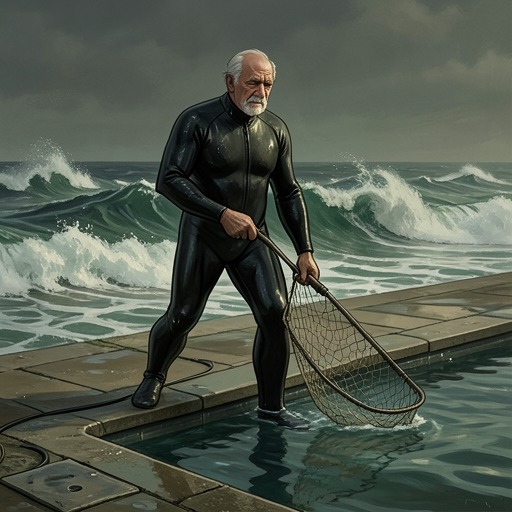
Tova’s work is practical, repetitive, and exacting. Each night she mops the aquarium floors, wipes the glass, and empties the trash. She earns fourteen dollars an hour after deductions, collecting a direct-deposit stub from her break-room cubby every two weeks. Rather than open the stubs, she stores them in an old shoebox on top of her refrigerator, while the money accumulates in an account at the Sowell Bay Savings and Loan. Even her modest wages become part of a quiet system: work is done, earnings are put aside, and attention turns to the next task.
That attention can settle on something as small as a wad of gum. Preparing to attack the pink blob with her mop, Tova approaches it with the seriousness of an opponent; the yellow rubber glove protruding from her back pocket gives the image a comic, almost ceremonial edge. She is not required to clean so deeply at her age, but she persists. Her curved back and birdlike bones make her brisk, purposeful progress all the more striking. Rain can make her front yard too wet for the push mower, yet bad weather does not trouble her in the same way as an unfinished job.
Carefulness is another part of her self-image. Terry Bailey repeatedly warns her to be careful, while the Knit-Wits joke that he fears she will fall and sue the aquarium. Tova does not imagine suing anyone, least of all the place where she works, and no longer tries to correct her friends’ teasing. Will Sullivan used to joke that caution should be her middle name. After she injures her ankle, the limits of that carefulness become tangible: she wears a molded-plastic boot and is told to expect six weeks of recovery. The prospect weighs on her less as an opportunity to rest than as six weeks away from pulling dandelions, tending her rhubarb beds, dusting baseboards, and cleaning the aquarium floors.
Grief, Memory, and the Aquarium
Tova’s routines coexist with losses she has not resolved. Will died after cancer, and Erik disappeared after going to work at the ferry dock one July night following his senior year of high school. The boat was not noticed missing, and the anchor rope was cut. Tova has never believed that Erik killed himself. For years, however, she has lacked the information that might make the last night of his life intelligible.
Her habits of order do not mean that grief has become simple or settled. At Fairview Memorial Park, Tova watches members of the Kretch family picnic beside a dead relative’s grave and speak to him as though he were present. She has never spoken aloud to Will’s grave, reasoning that his body cannot hear or answer. She also cannot bring herself to copy Mary Ann Minetti, who talks daily to her husband’s ashes, although she recognizes that the practice comforts her friend and harms no one. After the Kretch women leave, Tova finally addresses Will’s headstone, telling him that she is selling the house. She traces the stone with a finger, but the gesture does not summon tears. Speaking the decision aloud marks a change in her own conduct, not a sudden release from mourning.
At the aquarium, Tova’s care extends beyond work assignments. She greets the octopus, Marcellus McSquiddles, and notices that his colors look brighter. He emerges from behind a rock, approaches the glass, then darts back toward the narrow gap in his tank while keeping an eye on her. Their exchanges are quiet observations rather than human conversation, but she attends to his condition and movements. Later, she understands that Marcellus’s actions had carried a message she failed to recognize: he had taken Cameron’s driver’s license in an attempt to lead her toward the truth.
Erik Sullivan’s Past and Cameron’s Connection
A new refrain takes hold of Tova’s thoughts when she learns there may have been a girl in Erik’s life. The idea intrudes on ordinary tasks—making the bed, waiting for coffee, dusting the baseboards—and turns domestic routine into a setting for unanswered questions. The possibility matters because it offers another way to understand Erik’s disappearance, though it does not erase what remains unknown.
Tova eventually tells Cameron the story herself. She recounts how Erik went to work at the ferry dock one July night and never returned, including the missing boat and cut anchor rope. She explains that she never accepted the belief that he had taken his own life, and that the possibility of a girlfriend changed the questions she asked about his final night. When Cameron asks how she knows the girl was his mother, Tova identifies Cameron’s mother as the girl Erik was seeing. The discovery links a long-hidden part of Erik’s history to the young man now sitting across from her.
That knowledge unsettles Tova’s plans for living alone. She tells Janice Kim that she has no children who will come stay after a fall and no grandchildren to unclog a drain or make sure she takes her pills. She does not want such care to become a burden on friends or neighbors. Janice challenges the assumption that accepting help would be a burden, but Tova insists that Charter Village is the best option and that she intends to sign the house-sale papers. Her reasoning is bound to the family she believes she does not have; the emerging connection to Cameron will soon complicate that belief.
Recognition and Change
The change arrives not as an abstract promise of family, but in Tova’s recognition of Cameron as her grandson. She tells him that Marcellus led her to him, and the word grandson falters in her voice even as the knowledge warms her. She thinks of how much she wishes Will could have met him, and of the distance between Cameron and Modesto. The recognition brings joy together with absences that cannot be repaired: Will is gone, Erik is still missing, and Cameron’s arrival cannot restore the years in which they did not know each other.
Tova also sees Cameron’s resemblance to Erik in the way his face shows his mind at work. She notices a difference, too: Cameron’s eyes are not Erik’s, but his mother’s. This is an intimate act of recognition, made possible by the history she has pieced together and by the family connection she can now name. Cameron is not merely a stranger who has entered her aquarium routine; he is the grandson she had not expected to have.
Before Cameron leaves the family house, Tova gives him Erik’s class ring and tells him his son’s full name: Erik Ernest Lindgren Sullivan. Cameron had misunderstood the engraving as referring to eels, while Tova knows the initials identify Erik. The ring and the full name make the family link material and specific, carrying a piece of Erik’s identity from his mother to his son. Tova’s movement toward family does not cancel her grief or establish that every uncertainty about Erik has been resolved. It does alter the future she had arranged around solitude: the woman who planned a move because she believed there was no family to rely on now has a grandson, and a reason to reconsider what connection might make possible.
Narrative Role
Tova’s character is built through the tension between routine and revelation. Cleaning, saving her pay, tending her house, and guarding her independence are not incidental habits; they give form to a life in which grief has left major questions unanswered. The narrative repeatedly sets her precise attention to small things—the gum on the floor, the octopus’s color, a ring’s engraving—against the immense absences of Will and Erik. What she notices can become a path toward knowledge, though the meaning is not always immediately clear to her.
Her relationship with Marcellus and her discovery of Cameron also widen the idea of care in her life. Tova has spent years caring for a home, a workplace, and the creatures around her while resisting the prospect of depending on other people. Her grandson’s arrival does not erase that independence; instead, it reveals that the family she thought absent was connected to the loss she had carried all along. By the time she gives Cameron Erik’s name and ring, Tova has moved from keeping life orderly in the face of grief toward sharing its history with someone who belongs to it.