Tova Sullivan–Ethan Mack relationship
Remarkably Bright CreaturesTova Sullivan and Ethan Mack’s relationship develops through gestures of ordinary hospitality rather than a declared courtship: a Saturday supper, a bottle of wine, and Ethan’s increasingly welcome presence in Tova’s home. Its defining tension is that Tova values his company but resists naming it as romance, in part because her life with Will Sullivan still shapes what she can imagine after his death. The relationship’s movement is quiet but consequential: friendship begins to make room for a future without requiring Tova to erase her past.
An Invitation Tova Refuses to Call a Date
One Saturday at five, Tova arrives at Ethan’s house for supper and insists to herself that it is not a date. She has described it as a quick meal and pointed to the packing required for her planned move to Charter Village. Her spare time has instead been occupied by searching every volume the Snohomish County Public Library would lend her for information about Daphne Cassmore; when that research yields little, she allows herself an evening away from it. The practical explanation gives her permission to accept the invitation without deciding what acceptance means.
The bottle she brings makes the occasion feel more, not less, like a social ritual. Barbara Vanderhoof has pressed a bottle of last season’s Cab Franc on her, calling it suitable for Tova’s date; Tova has corrected that description repeatedly. Still, she carries the bottle carefully in the crook of her arm, reasoning that arriving at someone’s home without a gift would be rude. Because Ethan works at Shop-Way, she could not simply have bought the wine from him there. Her attention to the etiquette of the visit reveals how carefully she manages a situation she insists is unremarkable.
That insistence falters at the question of friendship. Tova wonders whether Ethan is her friend, a question the narrative leaves open rather than answering for her. The uncertainty is not evidence that she dislikes or distrusts him: she has accepted his invitation and is concerned to arrive as a considerate guest. Instead, it marks a threshold. She is still testing what kind of closeness she can acknowledge, even as her actions already place Ethan among the people whose feelings and company matter to her.
Company, Care, and a Difficult Moment
At Ethan’s house, Tova recognizes Cameron Cassmore’s sunglasses on the counter and thanks Ethan for opening his home to him. Ethan explains that the company is welcome. Tova understands the sentiment, comparing it with how nice it has been to have Cameron at the aquarium. Their exchange gives the supper a shared concern: each recognizes the value of having someone around, without turning that recognition into a declaration about their own relationship.
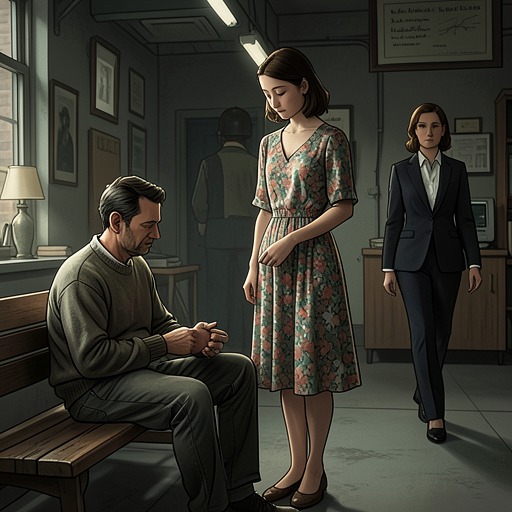
The evening also shows how attentive Tova is to Ethan’s emotional life. When she notices a precious garment put away in a kitchen cupboard, its faded and worn condition first strikes her as neglect; she revises that judgment, seeing instead that it has been well loved. Ethan says nothing, pours the remaining wine into his glass, and drinks it in one gulp. Tova becomes physically still, then apologizes and leaves, trembling, after thanking him for the meal. The moment interrupts the ease of hospitality. Her apology and departure show that she has encountered something tender and painful in Ethan’s home, though the evidence does not explain the garment’s history. Their developing closeness includes not only shared company but also the possibility of being present at an exposed moment—and the difficulty of knowing how to respond.
Grief and the Possibility of Moving On
Janice Kim eventually names what Tova herself avoids discussing: Ethan is in love with her, and she could give him a chance. Tova answers that Ethan is a wonderful man, but begins to set that possibility against her history with Will. Janice does not dismiss the marriage; she argues that surviving partners can move on and still have good years ahead. Her intervention makes explicit the choice that has remained implicit in Tova’s careful distinction between supper and a date: accepting Ethan’s affection would mean considering a future after Will, not pretending Will never mattered.
Tova does not give Janice a clear promise in this exchange. Her unfinished response preserves the conflict rather than resolving it. Ethan’s goodness is not the obstacle; Tova’s enduring bond with Will is. The conversation also reframes companionship as something more than a distraction from grief. Janice asks Tova to consider a future in which friendship and intimacy are still possible, while Tova remains caught between acknowledging that possibility and feeling that loyalty to her marriage prevents it.
A Place in Tova’s Everyday Life
By Thanksgiving, Ethan’s presence has become part of Tova’s domestic routine. He arrives half an hour early for turkey supper, and Tova observes that he seems to spend nearly every free minute at her condo. He usually sits in the recliner beside the small curio shelf where she displays her Dala horses. The frequency and ease of these visits make a contrast with her earlier uncertainty about whether he counts as a friend: whatever label she chooses, he has become a familiar presence in her home.
The condo also holds Will’s memory. Ethan listens to records on Will’s old turntable and treats the apparatus with almost religious reverence. Tova never sought an education in rock music, but she is receiving one through Ethan; she admits that it is nice to have him around. This is a form of closeness built inside, rather than outside, her past. Ethan does not displace Will’s belongings or the habits attached to them. Instead, his company brings new activity into a home still marked by Tova’s marriage.
Ethan’s early arrival and his comfort in the living room do not, by themselves, settle the question of romance. They do establish the relationship’s direction: Tova increasingly welcomes his company and lets him share spaces and routines associated with her private life. The movement from a supper she calls not a date to an ordinary holiday spent together gives her hesitation a counterweight in repeated, practical intimacy.
An Unresolved Opening
The relationship remains defined by possibility rather than a decisive declaration in these scenes. Tova’s repeated denial of a date, her uncertain question about friendship, and her invocation of Will all register real reservations; so do her careful gift, her concern for Ethan, and her enjoyment of his regular visits. Neither set of facts cancels the other. The tension gives their connection its shape: affection grows through attention and shared domestic life while grief continues to influence what Tova can accept.
Ethan’s place in Tova’s life is therefore significant even before she openly names it. He offers company, music, meals, and a presence that she says she does not mind and, eventually, likes having around. Janice’s challenge brings the unspoken romantic possibility into the open, but Tova’s response remains constrained by her continuing love for Will. The relationship’s development is not a clean replacement of one bond by another; it is an opening toward intimacy that must coexist with memory.