Tova’s planned move to Charter Village
Remarkably Bright CreaturesTova’s planned move to Charter Village is an effort to make her later life manageable without depending on friends, set against a deeper struggle over what it means to leave her home and the unresolved past it contains. She organizes the move as a practical solution to living alone, but the preparations expose how much of her life remains bound to the house—and how little certainty a new address can offer. In the end, she gives up the plan, exchanging a settled destination for an open question about where to go next.
Why Charter Village Seems Necessary
Tova’s reasoning is direct: she does not have children or grandchildren who can stay with her after a fall, unclog a drain, or check that she is taking her pills. She also refuses to make those needs a burden on her friends and neighbors. When Janice suggests that Tova may be assuming too quickly that accepting help is a burden, Tova does not change her mind. Charter Village, she insists, may not be the only option, but it is the best one. The decision is less a rejection of friendship than an attempt to avoid making friendship into an obligation of care.
The plan fits a life built around doing things for herself. Tova is the oldest employee at the Sowell Bay Aquarium, where she mops floors, cleans glass, and empties bins each night. She earns fourteen dollars an hour; her direct-deposit stubs go unopened into a shoebox, while the money accumulates in an account. Work gives structure to her days, and even at seventy she presses herself to clean what others might excuse her from cleaning. Her independence is not abstract: it appears in habitual labor, careful movement, and a determination to keep going. A move into a retirement community promises a practical answer to the vulnerabilities of aging, but also requires her to reconsider a way of life organized around managing alone.
Preparing to Leave the House
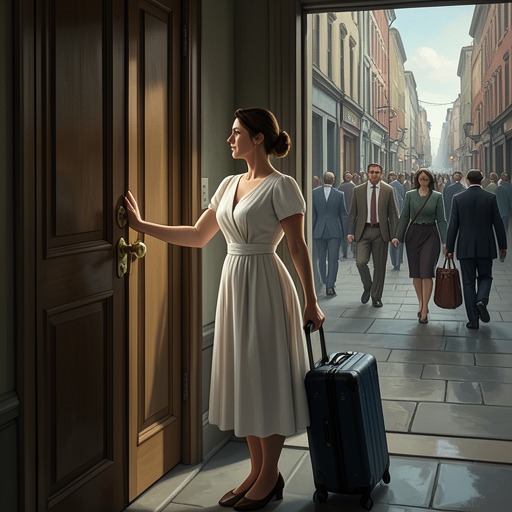
Tova sets concrete dates for the transition. She plans to sign the house-sale papers on Wednesday and expects to move into Charter Village the following week. Because her suite will not yet be available, she intends to stay in a hotel in Everett. She has even lobbied for accelerated check-in. By the time the move is close, these arrangements make departure seem nearly accomplished: the house is to be sold, the next residence chosen, and the interval between them accounted for.
Packing turns that decision into a reckoning with particular objects. Tova divides the attic’s contents into categories, asking friends to help sort and haul rather than allowing strangers to handle her family’s heirlooms. She plans to take only a few things to Charter Village: some of Erik’s toy cars, photographs, and what remains of her mother’s porcelain tea set. Much else goes into a discard pile, including photographs and carefully saved memorabilia. The objects were preserved for decades, yet Tova sees no one left to want them. Her preparations therefore involve not just transporting belongings but deciding which traces of family life she can carry and which she must relinquish.
The move also runs beside Tova’s search for Daphne Cassmore. She spends her free time consulting volumes from the Snohomish County Public Library, hoping to learn more, but the research yields little useful information. As she packs, she tries to end the search along with her attachment to the house: she tells herself that one summer night in 1989 should not shape every aspect of her life, that she has had enough of seeking answers and living with ghosts. Yet she keeps the yearbook in which she found Daphne’s photograph among the books she is taking. Daphne was the last person to see Erik alive, and Tova knows she will continue to look for faces resembling the photograph in crowds. The move is thus planned as a new start, but its packing boxes still contain the unresolved history she hopes to leave behind.
The Decision Breaks
The decisive change comes after Tova releases Marcellus into the water. As she says goodbye, the force of her own promise about caring for his eventual replacement makes her recognize that she is not going to Charter Village; she cannot go. Her decision follows the release directly, not a newly secured alternative residence. Marcellus has spent his life in a tank, and Tova tells him that he saved her. In returning him to the water, she confronts the meaning of confinement and freedom in a moment that alters the plan she had treated as settled.
The next morning, the old house still appears to be in the process of being left. Tova boils coffee on her avocado-green stove for what she expects will be the last time. It is clean and works perfectly, though she assumes it will be ripped out and replaced after the sale. She has sought accelerated admission to Charter Village, and her premier suite is expected to be available the following week. She has left a message about checking in, but has no intention of going. The contrast between the carefully polished stove and the anticipated replacement makes the change tangible: the house’s future had seemed decided, yet Tova’s own departure is no longer proceeding with it.
An Unsettled Future
When Cameron arrives, Tova tells him plainly that she is not going to Charter Village. Asked where she will go instead, she laughs and admits that she does not know. She might stay with Barbara or Janice for a while, until she figures out what comes next. These are possibilities, not a new settled plan. Tova has abandoned the security of a scheduled move without pretending that uncertainty has already been solved.
Cameron recognizes the change in terms he can understand: he lives in a camper, and Tova jokes that they are both homeless. The exchange lets her acknowledge the precariousness of her situation without treating it as a failure. Her next gesture is to offer to show him where his father grew up. The house she had prepared to sell is not merely an empty container awaiting new owners; it holds the family history that connects Cameron to Erik. By staying, Tova remains close to that history and to a relationship newly opened between them.
The abandoned move does not erase Tova’s concerns about aging, care, or the ghosts attached to her home. Nor does she announce a permanent return to independent living. Instead, she replaces a firm institutional destination with temporary reliance on friends and the freedom to decide later. The plan’s reversal marks a change in what she is willing to leave behind: she can no longer treat the house, Erik’s story, and her own future as matters that can be settled simply by packing them into separate boxes.