Bellevue Hospital
Requiem for a DreamBellevue Hospital receives Sara Goldfarb after her incoherent, tearful insistence that she is waiting to appear on television brings an ambulance to the studio. The hospital’s first response is a rapid succession of forms, corridors, brief examinations, and diagnostic labels; a young resident’s more patient assessment then challenges the assumption that shock treatment is the answer. The institution becomes the setting for a conflict between hurried psychiatric judgment and attention to the physical consequences of Sara’s diet pills.
Intake and psychiatric assessment
At the television studio, Sara is wet from the weather, exhausted, and still waiting for the show. She tells the ambulance attendants that she is always walking across the stage and that they should see Harry Goldfarb on the six o’clock news. When asked her name, she calls herself Little Red Riding Hood. As her distress continues, the attendants take her through traffic to Bellevue Hospital.
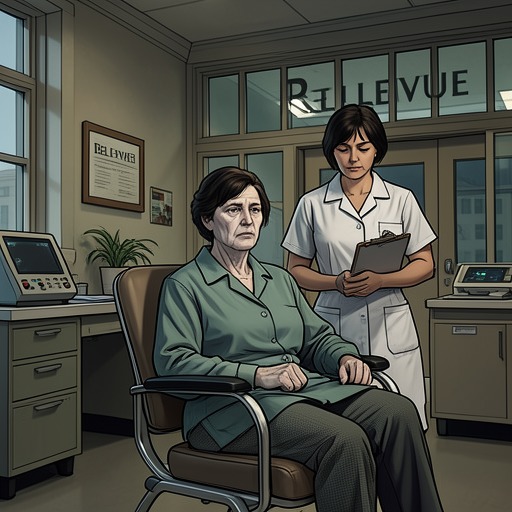
At the hospital, staff move Sara by wheelchair through successive lines and examinations. A doctor reads the ambulance report, sends her to the psychiatric service, and another doctor briefly questions her. When Sara tries to explain Harry and the television show, he writes that she is paranoid schizophrenic and needs a more thorough examination, but that shock treatment is definitely indicated. She is sent onward; after many more hours, she reaches a bed in a locked ward, among patients who are heavily tranquilized, restrained, or crying out.
A resident challenges the first diagnosis
A young medical resident reads Sara’s chart and frowns at the admitting doctors’ comments. Rather than relying only on the paperwork, he examines her slowly and carefully, checks her chest and back, and asks her to raise her arms and bend her fingers. He notices the flesh hanging from her upper arms and the hollows around her eyes and neck, and asks whether she has recently had a heart attack. Sara says that her heart is beating very hard.
The resident asks about her recent weight loss. Sara connects it to wearing her red dress on television, and, with his patient questioning, tells him about her weight, her doctor, and the pills. Her answers repeatedly return to Seymour Goldfarb, Harry, and the television. The resident reassures her and arranges for her to be transferred from psychiatry to the medical service. In a conversation with a nurse, he dismisses the paranoid-schizophrenia label and says the diet pills are the problem; the nurse adds that the doctor who recommended shock treatment thinks everybody needs it. The exchange makes the initial diagnosis look less like a settled account of Sara’s condition than the result of a brief and inadequate assessment.
Treatment, restraint, and loss of control
The later institutional scenes show Sara subjected to care that becomes coercive. Terrified by the distant sound of a food cart despite heavy tranquilization, she is no longer coaxed to eat: staff force-feed her through a rubber hose passed through her nose into her stomach. They strap her into a wheelchair, tape the hose in place, and tie her hands to the chair when she tries to resist. Her gagging and attempts to defend herself are overcome by the restraints.
The narration follows the bodily cost of this treatment in close detail. Sara struggles to hold her head up, cannot speak clearly around the hose, and tries for hours to get someone’s attention because she needs the bathroom. Staff pass her by; eventually she loses control of her bladder and bowels. The scene shifts the focus from the diagnostic language in her chart to the vulnerability of a patient whose ability to communicate, move, and preserve her dignity has been taken from her.
In another ward routine, Sara sits tied in her wheelchair each morning while people give medication, care for patients, make beds, and mop floors. She waits silently for someone to come, speak to her, or help her; instead, staff arrive to prepare her for another shock treatment. Later, Ada and Rae visit her in a psychiatric ward on remote grounds. They recognize Sara but are shocked by her changed appearance: her bones protrude, her hair hangs lifelessly, and her skin is gray. Ada brings a bag of food, and Rae wipes mustard and spittle from Sara’s mouth as they try to understand what has happened to their friend. These later scenes establish the continuing institutional consequences of Sara’s treatment, though they do not identify every ward as Bellevue Hospital.
Institutional significance
Bellevue Hospital’s part in Sara’s story is marked by a contrast between its systems of classification and the resident’s closer attention to her body and history. The first psychiatric assessment rapidly turns her confused speech into a diagnosis and a recommendation for shock treatment. The resident instead notices her weight loss, asks about her heart, and learns about the pills. His intervention redirects her care to the medical service, but the later scenes show that institutional treatment can still reduce her to a restrained, medicated body, waiting for help that does not come.
The hospital episode therefore connects the visible crisis at the television studio to the physical consequences of Sara’s diet-pill use and to the loss of agency that follows her institutionalization. Bellevue is not simply a destination reached by ambulance: its hurried intake, competing assessments, and proposed treatments shape the transition from Sara’s television fantasy to prolonged medical and psychiatric confinement.