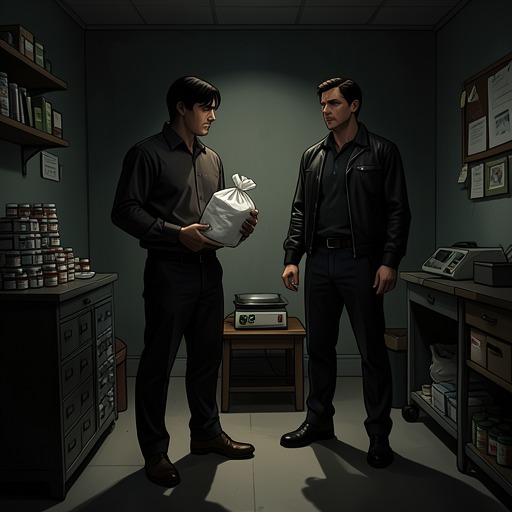
Brody’s death cuts off Harry and Tyrone’s supply
Requiem for a DreamBrody’s death cuts off the dependable supply of unusually potent heroin that Tyrone C. Love and Harry Goldfarb had relied on for their business. The loss first arrives as a change in the product: what they obtain no longer gives the rush they expect, and the supply they had assumed would return is gone. When Brody is found dead, the cause remains uncertain, but the consequence for the two partners is immediate. Their confidence in his source has left them without a workable backup.
The Supply They Took for Granted
The interruption begins when Brody tells Tyrone C. Love that the dynamite is gone. Brody does not know exactly what happened to it. He connects the disappearance, as something he has heard, to the Jefferson brothers: two men were found in garbage cans with their throats cut and signs reading Keep our city clean, and the account he has heard says the men had taken drugs from the brothers and tried to make a quick sale. Brody’s explanation is hearsay rather than a settled account, but it gives the shortage a violent context. The men who tried to interfere with the supply were reportedly killed; the heroin itself has vanished from circulation.
For Tyrone C. Love and Harry Goldfarb, the critical fact is not who caused the shortage but that the reliable product is no longer available. They had depended on Brody to find exceptionally strong heroin, and they had let the possibility of its return stand in for actively establishing another connection. The disappearance therefore exposes a weakness in the business before either partner has a replacement source: their supply was concentrated in a connection they trusted and did not prepare to lose.
Testing the Weaker Product
Tyrone C. Love asks whether the new stuff is like the old supply. He is told that it can be cut only in half if they want to put anything in the bag. He takes it back to the old pad, where Harry Goldfarb is waiting, and they first try it themselves before doing anything else. Their usual routine produces only a hint of the flash they expect. It does not rush them as the earlier product did.
They cook up more and try again. The second attempt is a little better, enough for them to feel it in their gut and on their eyelids, but it still falls short of the old effect. Their response mixes disappointment with an effort to make light of the change: they joke about saving money on milk sugar and tell one another that they are still doing all right. The joking cannot restore the lost potency. Their repeated attempts establish the difference through experience rather than rumor: the replacement can be used, but it is not the dynamite they had been counting on.
A Business Reduced to Expenses
The weaker supply also changes the arithmetic. By the time Tyrone C. Love and Harry Goldfarb have used the amount they want, considerably less remains to sell. They make little beyond expenses. Their immediate reaction is to treat this as manageable: they have some money hidden away, and they expect that soon they will be able to buy in greater quantity, find dynamite again, and put together a pound of pure heroin. The hoped-for recovery remains a plan, not an accomplished change in their circumstances.
That optimism depends on the same assumption that exposed them to the shortage. They continue to expect the exceptional product to return, while the current stock leaves them with less to sell and little profit. Their confidence that they can soon recover the business sits beside evidence that the operation has already contracted: the supply is weaker, their usable saleable amount is smaller, and the earnings barely exceed costs.
Brody’s Death and the Lost Connection
The uncertainty becomes sharper when Tyrone C. Love learns that Brody is dead. He asks half a dozen people what happened and hears half a dozen versions. Brody was found in an alley; accounts variously say he was shot, stabbed, pushed from a roof, or killed in some other way. His pockets were empty, which makes it clear that he was done in, but no precise manner of death is established. Tyrone C. Love eventually stops pursuing the competing stories. The manner matters less to him than the fact that Brody is gone and the source is no longer available.
On the way back to the pad, Tyrone C. Love fixates on their failure to secure a good backup connection. He and Harry Goldfarb had looked around only halfheartedly. Brody’s heroin had been so good that they believed they could not find anything comparable even if they went to France; when it ran out, they kept expecting it to come back and assumed Brody would discover anything worthwhile in town. His death turns that complacency into a practical crisis. They are not only missing their supplier: they have no established alternative to replace what he brought them.
Harry Goldfarb and Tyrone C. Love acknowledge that they cannot simply sit and wait. Their frustration gives way to a decision to get out and see what they can find. Harry Goldfarb jokes about taking the front of the bus while Tyrone C. Love takes the back, and they end by insisting that they will latch on to something and that a break will come. The ending offers movement, not a solution. Brody’s death has forced them to search, but their last assurance repeats the hopeful certainty that had kept them from preparing for the loss in the first place.