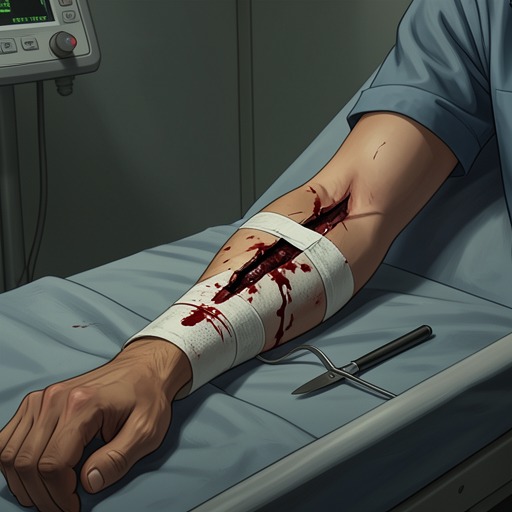
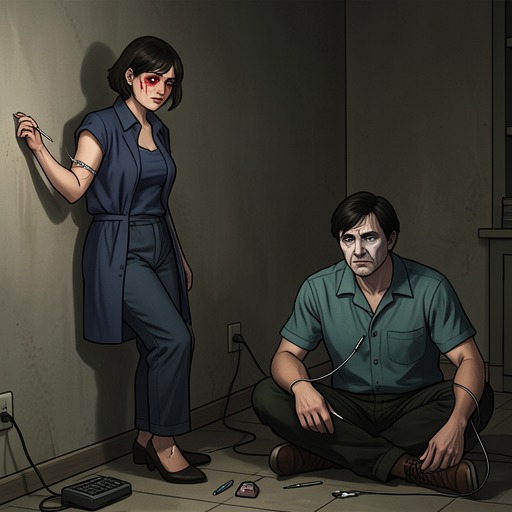
Harry Goldfarb's gangrenous arm infection
Requiem for a DreamHarry Goldfarb’s gangrenous arm infection turns his effort to reach a new heroin supply into a bodily and institutional catastrophe. A festering injection site becomes an open hole; pain and visible deterioration do not stop him from using it again. When he finally seeks medical help, the doctor reports him to the police, and the resulting arrest leaves the infection untreated until Harry’s arm must be amputated at the shoulder.
The Infection Takes Hold
During the winter shortage, Harry and Tyrone C. Love set out for Miami, hoping to buy enough heroin to return to New York City and sell it. Harry’s injection options were already narrowing. He had increasing difficulty finding a vein, first trying his fingers and then returning to a place on his arm that had periodically festered. It had become a hole, and he knew he should avoid it. But when he wanted to get high, finding another site felt like too much trouble, and he pushed the needle into the damaged place and squeezed in the drug.
The choice is not presented as an isolated lapse. Harry recognizes the danger and repeatedly makes a contrary decision under the pressure of addiction: the fix takes precedence over his intention to stay away from the wound. Tyrone urges him to find another place to inject, but Harry answers that it is enough if the drug gets where it is going and they keep moving toward their destination. That practical, forward-driving logic carries them south even as Harry’s body supplies mounting evidence that the journey is becoming untenable.
Pain on the Road to Miami
At a roadside stop, Harry rolls up his sleeve so that he and Tyrone can inspect the hole. It hurts badly, but Harry says he will deal with it after they return. He tries to inject into a usable vein in his right hand and cannot; rather than risk losing the fix, he goes back to the hole in his left arm. The injection hurts intensely before settling into a dull ache. The stop briefly interrupts the drive, but it does not interrupt the cycle that is worsening his condition.
As the trip continues through the night, the pain becomes harder to dismiss. Harry is sometimes forced back to the same hole because other sites are unavailable, and the distance from home, the cold, and the prospect of finding a connection do not relieve his dependence on the next dose. When the pain suddenly intensifies, he can hardly move the arm. He takes off his jacket and sees a large greenish-white lump around the hole, with red streaks extending toward his shoulder and wrist. He tells Tyrone that he may not make it and that he has to do something. The infected site is no longer merely a hidden consequence of injection: it is visible, spreading, and obstructing the journey on which both men have staked their hopes.
Medical Help Becomes Arrest
Harry and Tyrone stop at a small medical office. Harry tells the nurse that the arm has a bad infection and that he is afraid he will lose it, and asks whether the doctor can see him. The doctor looks at the arm, then leaves the room and calls the police. He describes Harry as a suspected drug user because the infection appears to come from a needle and his pupils are dilated. Instead of treating the urgent condition or directing him to care, he makes the men objects of suspicion.
When the doctor returns, he grabs and twists Harry’s arm, causing him to gag and bend with pain, then delays treatment. Tyrone grows uneasy in the waiting room, sensing that something is wrong without knowing what has happened. The police arrive and arrest both men. An officer strikes Harry, knocks him onto the injured arm, and drags him to a car by that arm. At the station Harry asks to see a doctor; the booking officer laughs and tells him there may be a doctor on Monday. Harry’s need for immediate care is subordinated to custody, while the handling by the officer adds further pain to the already damaged limb.
Neglect and Amputation
Once in custody, Harry cannot obtain heroin, and withdrawal compounds his pain and exhaustion. More than twenty-four hours without sleep, the combination of uppers and heroin, and the arm’s worsening condition leave him increasingly disoriented. The infected arm swings as he rocks on the floor of the cell. He and Tyrone are held apart by their distress, and the loss of access to drugs does not bring relief: it makes Harry’s physical crisis more acute while he remains unable to secure care.
At a later examination associated with the work-camp process, Harry cannot stand steadily. When a doctor pulls up his sleeve, Harry cries out and collapses. The doctor jokes about the arm, and the guards laugh at its appearance and smell, but they direct that Harry be taken to a hospital, predicting he may not live through the week. The scene marks a grim reversal: the wound that had been treated as evidence against Harry and then mocked is now impossible to dismiss as a minor consequence of drug use.
Harry is unconscious when surgeons amputate his arm at the shoulder. They begin anti-infection treatment immediately in an effort to save his life. His condition requires intravenous feeding through his right arm and both ankles, oxygen through a tube in his nose, and drains connected to a pump to remove poisonous fluid from his body. He is strapped to the bed so that convulsions will not tear out the needles. The earlier image of a hole in his arm has expanded into the removal of the limb itself and a treatment effort focused on preventing the infection from killing him.
Significance
The infection links Harry’s repeated injection into a damaged site with the consequences of a trip undertaken to escape a shortage, but the narrative also shows what happens after he asks for help. His own dependence narrows his choices; the doctor’s decision to call the police, the officers’ violence, and the delay in medical attention further restrict them. The outcome therefore cannot be reduced to the initial wound alone: its progression unfolds through both Harry’s continued drug use and the institutions that fail to respond to his urgent medical need.
The amputation is a physical reversal of the men’s plan to travel south, acquire heroin, and return with a way to make money. Harry reaches neither the hoped-for security nor a manageable solution to the shortage. The arm that he repeatedly uses because it is the available site becomes the source of a life-threatening infection, and finally the limb he loses. His decline is registered in concrete changes—the hole, the swelling and red streaks, the inability to move the arm, the collapse during examination, and the surgery—so that the promised future of the trip is measured against a body progressively less able to carry it.