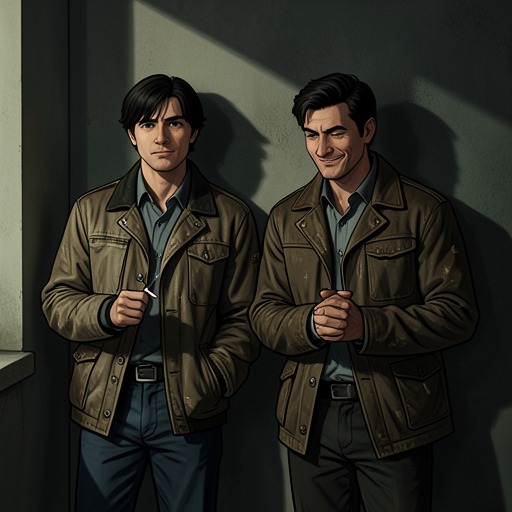
Harry and Tyrone Go to Miami for Drugs and Are Arrested in the South
Requiem for a DreamHarry Goldfarb and Tyrone C. Love’s journey toward Miami begins as a scheme to outpace a heroin shortage and ends with both men in Southern custody. Their imagined escape depends on an easy drive, a fresh connection, and enough drugs to bridge the distance; instead, the trip exposes their physical dependence, their unfamiliarity with the South, and Harry’s increasingly dangerous arm infection. The arrest turns a desperate search for supply into a passage through racial hostility, medical betrayal, and withdrawal.
Causes and the Plan
The journey grows out of the worsening shortage in New York City. Harry and Tyrone have heard the familiar complaints that dealers are exploiting the panic for money, but Harry turns their anger into a proposal: travel to Miami, where he believes they can find a major source before other buyers arrive. If they reach it first, he imagines, they can set their own price and return with enough heroin to stop scrambling on the streets. Tyrone doubts that the plan is as simple as Harry makes it sound. Miami is far away, the roads are dangerous, and neither man knows the city or its dealers. Harry answers each concern with confidence, treating distance and uncertainty as problems they can solve once they are on the road.
Their need is not only commercial. Both men are dependent on heroin, and the cold, the shortage, and the daily effort to obtain drugs have made their present circumstances feel intolerable. Harry promises that the trip will let them get a large supply and then settle down until the weather improves. The optimism rests on the very supply they are trying to find: they must remain well enough to reach Miami while already relying on dwindling drugs to function.
Harry asks Marion Silver for money without telling her the destination or the full plan. He presents the trip as a few days away and promises that they will return with a large amount of heroin and plenty of cash. Marion says she can spare one hundred dollars, but makes clear that she needs it back before the end of the month for rent. Harry waves away the concern and asks her for uppers as well, so the drive can be made quickly. After he leaves, Marion calls Big Tim and arranges to see him, anticipating that she can maintain her own supply while Harry is away. The departure thus depends on money and stimulants borrowed from Marion, while she prepares to secure heroin through a separate arrangement.
The Road South
Gogit finds them a car through a cousin who is serving time on Rikers. It is not much of a car, but it runs. Harry and Tyrone leave at about nine at night, expecting to miss heavy traffic and drive through the night on uppers. Harry’s injection problem is already serious: the veins in his fingers are no use, and a spot in his arm has festered into a hole. Though he has resolved to avoid it, he returns to that damaged place rather than risk wasting a bag while trying to find another vein. The journey begins with the bodily cost of their addiction already built into it.
At first, the car seems to support their fantasy. Its heater eventually produces warm air, the radio plays, and the men listen to music, finger-pop, talk, and imagine reaching Miami and ending their troubles. At a Howard Johnson’s, however, Harry removes his jacket and rolls up his sleeve to examine the painful hole. They inject separately in the men’s room; Harry cannot find a usable vein in his right hand and uses the damaged spot again. They eat pie, drink soda, take more uppers, and continue south, buoyed by the drugs and the prospect of a future supply.
The morning brings no relief from winter. Snow still covers the ground, and Tyrone realizes how far they have travelled from New York City. Neither man has previously left New York State; Harry’s only earlier trip outside the city was to Boy Scout camp as a child. As the countryside grows unfamiliar, their confidence gives way to fear. The uppers and heroin seem to pull against each other, while both men become increasingly conscious that they are strung out in an unknown state, driving toward connections they have not actually secured. They each want the other to suggest turning back, but neither does. Harry’s pain becomes so intense that he can scarcely sit still. A huge greenish-white lump forms around the hole in his arm, with red streaks extending toward his shoulder and wrist, and he can hardly move the limb.
Hostility and Arrest
The South first confronts them through ordinary encounters that turn threatening. At a gas station, Harry asks to use the men’s room and is told it is out of order. The attendant greets another customer warmly, while a mechanic stares at Harry and spits. Harry’s pain and confusion begin to turn to rage, but Tyrone urges him to stay calm and get back in the car. They leave without confronting the men, describing the encounter to each other as evidence that they are in a place where they are unwelcome.
As Harry’s arm worsens, the two men stop at a small medical building. Tyrone tells the nurse that Harry has an emergency; Harry shows her his arm and says he is afraid he will lose it. The doctor examines him roughly, then leaves the room and calls the police. He identifies the apparent needle infection and Harry’s dilated pupils as evidence that he may be a drug user, and describes Harry and Tyrone in explicitly racist terms. Rather than treating Harry’s urgent condition, he tells the nurse to keep watch until the police arrive. The prospect of medical help becomes the means by which the men are delivered to law enforcement.
The police arrive separately to confront the two men. One officer questions Harry about where he is from, jabs him in the chest, uses racist abuse, and strikes him hard enough to knock him down onto the infected arm. He then grabs Harry by that arm, drags him to the police car, and handcuffs him; Tyrone is already being held with his hands cuffed behind him. Harry’s need for treatment does not slow the arrest. At the station, a booking officer laughs when Harry asks to see a doctor and tells him that one may not be available until Monday. The immediate consequence is that Harry’s infection remains untreated while he and Tyrone are locked up.
Custody and Consequences
In the cell, Tyrone blames Harry’s plan for bringing them hundreds of miles from their neighborhood, with no reliable way to get help or contact anyone. The place is filthy: drunks lie on the floor and the toilet is covered with vomit. Their last fix was hours earlier, and the drugs that had sustained the drive are gone. Harry’s exhaustion, pain, and lack of heroin combine into rapidly intensifying withdrawal. He paces, tries to sit, and struggles against the physical collapse; even when his eyes close, nightmares begin before he can sleep. The supply run has become its opposite: they have travelled far from home only to be confined without the drugs they depended on and without prompt medical care.
The arrest also initiates a longer ordeal for Tyrone. In the labor camp, he spends much of his first week doubled over with cramps, weakened by diarrhea, and repeatedly retching bile. When exhaustion makes him fall, a guard laughs, taunts him about being a New Yorker, and pushes his chin with a foot before hauling him upright. The trip’s initial promise of freedom and warmth has thus led Tyrone into forced labor and racist abuse. For Harry, meanwhile, the infected arm continues to define the immediate crisis that brought the police to him and then prevented him from obtaining timely treatment.
The sequence reverses the men’s original calculation. They set out believing that distance would put them ahead of the street-level competition and restore control over their lives; instead, the road strips away their familiar surroundings, exposes their dependence, and places them at the mercy of hostile authority. The repeated assurances that they can get more and return safely cannot withstand the concrete facts of the journey: a failing car’s heater, an arm they cannot stop using, an unfamiliar landscape, a doctor who calls the police, and a cell in which neither drugs nor medical help is available.