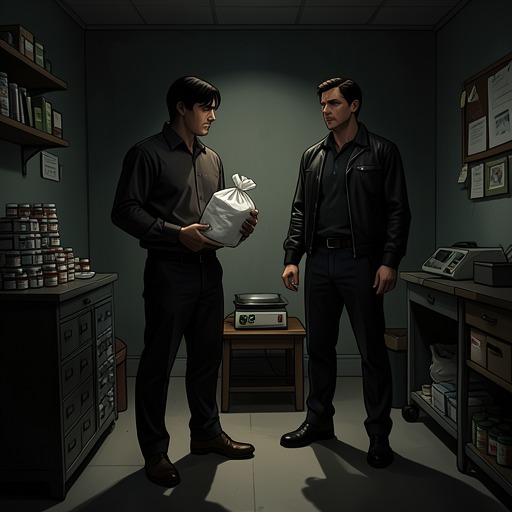
Harry and Tyrone launch their heroin-dealing operation
Requiem for a DreamHarry Goldfarb and Tyrone C. Love launch a heroin-dealing operation by converting the wages from grueling overnight work into a first major purchase. With Marion Silver supplying the money they lack, they acquire, cut, package, and distribute heroin, building a business whose early prosperity seems to offer an exit from their precarious lives. Its promise is inseparable from its danger: the partners use the product themselves, and every step toward greater scale tightens their exposure to the street risks they are trying to escape.
Raising the money
Harry and Tyrone’s initial capital comes from work at a plant loading newspapers. They have been using Dexedrine to stay awake and downers to crash afterward, but recognize that feeling capable of working indefinitely is not a reliable measure of what their bodies can endure. They put in overtime, driven by the pills and by the wish to make as much as possible quickly. By claiming twenty-five dependents, they arrange for their paychecks to be as large as possible.
After cashing the checks at a bar opposite the plant, they count the money repeatedly, pleased with what they have earned. The total is not enough to buy the heroin they want: Brody tells Tyrone that a good piece will cost about five hundred dollars, perhaps four hundred and fifty. The partners estimate that they still need a hundred dollars. Harry proposes asking Marion, reasoning that they can repay her by that night and move ahead with their imagined coffee-house venture. Marion agrees to cash a check and lend them the shortfall. Her dry comparison of the loan to a sound investment meets their excited assurances, but her help makes her part of the operation’s practical infrastructure as well as Harry’s intimate life.
The loan carries a limit in Harry’s mind. He does not want to bring the drugs into Marion’s apartment or make her home a place that could attract police attention. After collecting the money, the partners separate to handle their parts of the purchase. Harry buys glassine bags and milk sugar, while Tyrone goes to Brody. The preparation for the deal already shows their division of labor: Tyrone manages the connection, and Harry gathers the materials needed to turn the supply into saleable packages.
From purchase to product
Before the deal, Harry completes a case exchange at Macy’s, meeting the other participant around the toy department’s moving train display. He carries the case away and travels by a series of cabs and walks to the cutting room, where Tyrone is waiting. The setting and method make the transaction feel practiced, but what they have acquired is not yet ready for sale.
Tyrone reports that Brody considers the heroin exceptionally strong and has advised them to dilute it at least three times. Brody will not let them test it at his apartment, so the partners argue over whether they can judge the product without trying it. They decide to take a small taste. The first rush convinces them that the supply is potent enough to be cut repeatedly and still sold as good merchandise. Their confidence in the business therefore begins with the same substance they intend to distribute: they test its commercial value through their own intoxication.
They mix the heroin carefully with milk sugar, avoiding smoking because they do not want to lose any of the powder to the air or a cough or sneeze. Already high, they slow their movements and concentrate on the work. They take breaks for cigarettes, then divide the finished product into bags. Each takes fifty and goes out to find buyers. The care they bring to measuring and packaging contrasts with the recklessness of being high while handling a large quantity of drugs.
A network takes shape
The partners do not sell indiscriminately. Tyrone takes most of the supply because he deals with Black customers; Harry carries the remainder to white customers. Their arrangement relies on personal contacts and on knowing whom they consider trustworthy. Because Tyrone has no telephone in his apartment, they initially have to move through the streets to make contact, carrying the product and letting potential buyers know where they are. They understand that being known to have heroin can bring customers, but can also invite robbery or violence.
Marion offers the use of her telephone number, with the condition that they exercise discretion and give it only to people they know. Harry agrees that they can leave the supply at Tyrone’s apartment and route calls through Marion’s number, keeping the business and its stock physically separate from her home. Tyrone gives the number to Gogit, who makes his usual rounds and finds buyers. The first demand is strong: Tyrone sells out quickly and has to return to replenish his supply. Customers are already waiting by the time he comes back, drawn by word that he is selling a good bag.
Their success makes the street more dangerous, not less. Tyrone feels excitement as the waiting customers gather, but tries not to feed the growing hysteria around him. He is alert to the possibility that someone may follow him or try to take the money or drugs. His expectation that this may be a rare chance to get ahead sharpens his caution: he believes there may not be another opportunity, and that a mistake could cost more than the business.
Expansion and its costs
As calls multiply and the partners make repeated trips, taking messages and coordinating sales becomes cumbersome. Marion points out that the arrangement creates unnecessary risks and suggests they keep the product at her apartment until a telephone is installed in Tyrone’s. Harry accepts the change; once Tyrone has a phone a few days later, the operation runs more smoothly. Marion’s involvement remains limited but consequential: her telephone and temporary space help bridge the gap between the partners’ first improvised distribution system and a more stable one.
The quality of the supply and the growing customer base allow Harry and Tyrone to cut the heroin five times and still sell it as a good bag. They begin making more than a thousand dollars a day. They put the accumulated cash in a safety-deposit box under assumed names, a measure that signals both the scale of their earnings and their need to conceal them. Because they have little time to buy proper clothes or handle the growing business themselves, they front drugs to a couple of dealers, including Gogit, who sell overnight and bring back the money the next day for a split.
The operation’s early success briefly reverses the partners’ sense of scarcity: money accumulates, demand keeps arriving, and practical arrangements become easier. But the foundation remains unstable. They have financed the business through exhausting work, depend on a supplier whose product they test by using it, and must continually manage the risks of carrying, storing, and selling heroin. Their first expansion thus brings genuine income and a convincing sense of momentum without separating their ambitions from addiction or the dangers of the trade.