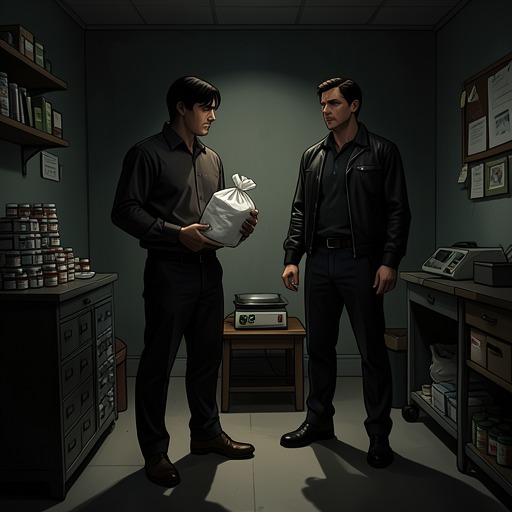
Harry and Tyrone plan to cut and sell heroin
Requiem for a DreamHarry Goldfarb and Tyrone C. Love plan to buy heroin, dilute it, and sell it at a profit, imagining that dealing will turn their dependence into a route to money and independence. The scheme’s decisive contradiction is present from its beginning: they picture themselves as disciplined businessmen even as the drug intensifies their appetite and shapes the plans they make under its influence.
From finding a source to imagining a business
The idea grows out of a conversation about where to obtain heroin. Tyrone objects to traveling elsewhere when they could look for a new connection nearby, using the visible signs of addiction on the street to identify where good heroin might be found. Staying local would save cab fare as well as effort. The search for a source thus begins not with a settled business strategy but with an immediate concern over access to the drug.
As they smoke, Harry notices how pleasurable a cigarette seems after heroin. The sensation prompts a larger proposal: buy some of the drug, take only a taste, cut the rest, and sell it. Tyrone agrees that the heroin seems strong enough to be diluted and still satisfy customers. Their first calculation is simple multiplication: sell part of the purchase, double their money, then use the proceeds to buy more. They imagine moving quickly from one small deal to a larger operation.
The plan is framed as a way to stop living by street hustles. Harry and Tyrone imagine buying directly from Italian suppliers, cutting the heroin themselves, and recruiting addicted users to sell it for them. They picture themselves sitting back to count the money rather than working the streets. In the most extravagant version of the dream, their earnings will buy tailored suits, a fine apartment near Central Park, a stable of beautiful women, and a pink Cadillac driven by a chauffeur in uniform. The practical proposal expands into a complete fantasy of comfort, status, and leisure.
The promise of controlled use
Their intended business depends on a distinction they insist they can maintain: they will use just enough heroin to stay steady, but never enough to become dependent or squander the profits. They point to other users who have lost their money and ended up in jail as examples of what they will avoid. Their confidence that they are smarter and more controlled allows them to imagine addiction as something that happens to other people, even while their scheme requires them to stay close to a drug they already use.
That contradiction also shapes their camaraderie. They build the plan together through joking, mutual encouragement, and increasingly grand promises, turning a risky proposal into a shared picture of their future. The banter gives the enterprise a tone of ease, but it does not make the financial or personal risks disappear. Their assurance that they can separate business from consumption is itself part of the fantasy that makes the venture seem manageable.
Raising the first money
When Harry and Tyrone return to the idea, the missing capital becomes impossible to ignore. They estimate that they need a couple of hundred dollars and decide that four hundred would be safer, leaving room for whatever might arise. They expect Brody to obtain a piece for them; even after he takes his share, they believe they can cut what remains in half, sell it, and preserve a taste for themselves. Their calculation treats the initial purchase as the gateway to doubling their money, but it depends on money they do not yet have.
Harry draws a boundary at robbery. He is willing to regard taking his mother’s television as one kind of hustle but does not want to commit a stickup or go to jail. They briefly joke about selling hot dogs, imagining the absurd division of labor between preparing the bun and adding mustard, before returning to the urgent question of how to raise the cash. Their humor postpones the problem without solving it.
Tyrone proposes looking for work loading newspaper trucks. The men who take those shifts, he observes, seem to have good clothes and attractive cars. The work begins at four or five in the morning, and both men dislike the prospect; Harry is dismayed by the hour, while Tyrone admits he is not keen on working. Still, they agree to see what happens. The suggestion marks a sharp contrast with their vision of sitting back while other people sell their product: before they can begin dealing, they may have to take an ordinary job to finance the first purchase.
The plan’s limits and consequences
The scheme’s imagined scale far exceeds its demonstrated resources. Harry and Tyrone speak of moving from a small purchase to a pound of pure heroin, hiring sellers, and living on the proceeds, but the evidence of the plan itself stops at the unresolved task of raising the initial money. Their ambitions are vivid; their means remain uncertain. The gap between the two is not a minor logistical obstacle, because the whole promise of independence depends on turning an unfinanced idea into reliable profit while keeping their own use under control.
Later events expose the danger of confusing the dream of managing heroin with actual control over it. In the South, Harry and Tyrone are arrested; Harry is struck and injured by a police officer, and Tyrone is sent to a work camp, where withdrawal and abuse leave him severely weakened. Their later circumstances are not the successful expansion they imagined. The early plan’s appeal lies in its promise to convert dependence into business, but its consequences belong to a world of continuing need, vulnerability, and punishment. The projected Cadillac and easy income remain distant from the physical costs that finally overtake them.