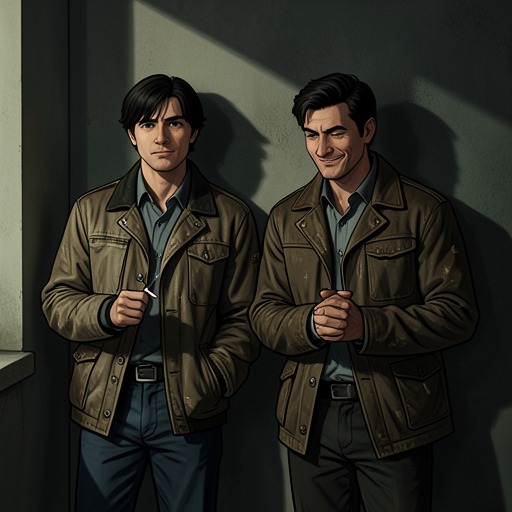
Harry and Tyrone's arrest in Florida and labor-camp sentence
Requiem for a DreamHarry and Tyrone’s arrest in Florida and labor-camp sentence turns their search for drugs into a collision with systems that deny them safety and care. Harry’s infected arm brings them to a medical office, but the doctor treats him as a suspect rather than a patient; the police then use violence, and the court process sends both men to a work camp. Their punishment compounds Harry’s medical emergency and Tyrone’s withdrawal, while racial hostility shapes nearly every encounter with authority.
From the road to the medical office
The danger of traveling south has already entered the men’s conversation before this arrest. Earlier, on a bus, Tyrone panics at the thought of being seen in the front and warns Harry that they are in the South Bronx, emphasizing the danger he associates with the South. Later, at a gas station, Harry asks to use the men’s room and the attendant refuses, while a mechanic stares at the men and spits at them. Tyrone recognizes the encounter as a sign of the region’s hostility; Harry’s pain and confusion begin turning to rage, but Tyrone urges him to keep calm. They leave without resolving their need for gas, and drive on in silence, both wishing they were elsewhere.
Harry’s arm has become the urgent problem. He holds it close, and the pain and fever make him fear losing it; he tells Tyrone he needs penicillin or something similar. They park near a small medical building and enter the first office they find. Tyrone tells the nurse that Harry has an emergency, and Harry explains that the infection is bad and that he is afraid of losing his arm. The nurse initially asks whether they have an appointment and suggests a hospital, but admits Harry to the examination room after he pleads for help.
The clinic becomes a police trap
The doctor handles Harry’s arm roughly, then leaves the examination room and telephones the police. He interprets the infection as likely caused by a needle and Harry’s dilated pupils as signs of drug use. His call also identifies Harry as a New Yorker and Tyrone through a racial slur, framing both men as suspicious before any examination or treatment has taken place. When the doctor returns, he again grabs and twists Harry’s arm, causing severe pain, then leaves him waiting while claiming he has another patient to see.
The delay heightens Tyrone’s unease. He tries to read a magazine, but keeps watching the nurse and wishing he could return to New York, even to the cold and snow. When a police officer approaches, Tyrone recognizes that the situation has changed before he fully turns to face him. Another officer enters Harry’s room. The narrative describes Harry’s response as a moment of terror: the expected relief of someone coming through the door gives way to the sight of the officer.
The officer demands to know where Harry is from, strikes him, and declares that local authorities do not want New York drug users there, singling out white men associated with Black people as an additional target of hostility. Harry falls onto his infected arm. The officer then grabs that arm and drags him, half fainting, to the police car, where he handcuffs him and shoves him inside. Tyrone is already there, also handcuffed. The clinic has not treated Harry’s infection; instead, the medical encounter has delivered both men into police custody.
Detention and sentence
At the station, Harry asks the booking officer for a doctor. The officer mocks the request and says there may not be a doctor available until Monday, telling Harry he will have no use for his arm for a while. The delay leaves Harry in custody through the weekend with the infection untreated. He suffers fever, chills, sweating, pain, and periods of delirium; Tyrone watches him and resents Harry’s decision to follow their connections south, but is himself trapped and unsure whom he could contact for help.
On Monday, guards remove the prisoners from the cell. Harry’s arm has begun to turn green and smell. A guard twists it while handcuffing him, making him scream and collapse. When Tyrone reaches toward Harry, a guard clubs him on the head and kicks him in the ribs and stomach, then the guards handcuff and drag him away as well. The men are taken to court, where Tyrone is told that a court-appointed representative can secure only a few weeks on a work gang if he pleads guilty to vagrancy. Tyrone says that he and Harry had more than a thousand dollars, but the report says otherwise. The money is not accounted for in the official record, and the promised brief sentence does not match what follows.
At the work-camp staging area, the men learn that they have received three months rather than a few weeks. Prisoners are checked off a typed list and examined by a doctor who asks everyone the same basic questions about hearing and sight. The doctor and guards joke together, drink Coke, and treat the chained prisoners as a source of amusement. Tyrone, already injured, is struck and prodded while officials taunt him about his manners and his origins. Harry, nearly delirious, cannot stand steadily. When the doctor sees his arm, he mocks its condition and remarks that Harry will not be able to inject drugs into it again; only then does he direct that Harry be taken to a hospital. The doctor’s decision comes after days of untreated illness, an arrest, and further rough handling.
The camp and the cost of custody
The arrest leads to different but connected forms of bodily harm. Harry’s infection advances while he is denied timely medical treatment, and by the camp examination his arm is visibly deteriorating. Tyrone is sent onward despite his injuries and acute withdrawal. He wants to resist the guards, but understands that an attempt could provoke still worse violence; his immediate aim is to endure the sentence and get home. That restraint is not consent to his treatment but a calculation made under coercion.
During the first week, Tyrone is repeatedly doubled over with cramps, diarrhea, and retching, sometimes bringing up only bitter bile. When exhaustion makes him fall, a guard ridicules him, kicks or pushes him, and hauls him back upright. The abuse is explicitly racialized: the guard tells him that local white authorities do not like men like him from New York and demands that he carry that warning back north. Tyrone’s earlier fear of the South is thus confirmed by the conditions of arrest and forced labor. The episode does not present the camp sentence as a consequence separable from the medical crisis: the clinic’s suspicion, police violence, delayed access to care, court processing, and coerced labor accumulate upon the same vulnerable bodies. Harry’s removal for hospital treatment offers no undoing of the harm already inflicted, while Tyrone remains subject to the camp’s labor and abuse.