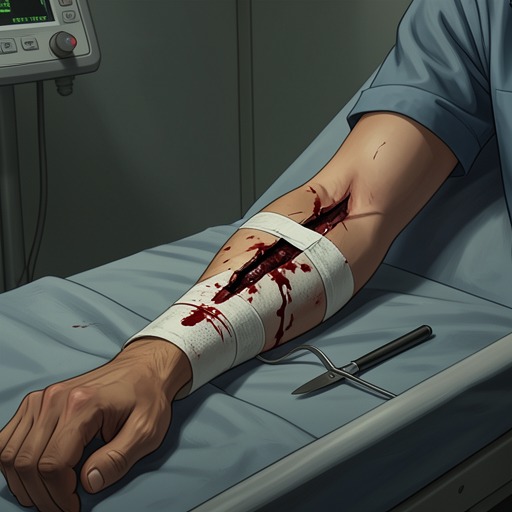
Harry's arm amputation due to infection
Requiem for a DreamHarry Goldfarb’s arm amputation is the bodily climax of a journey undertaken to escape a heroin shortage: the attempt to secure more drugs ends with an infection so advanced that surgeons remove his arm at the shoulder. The sequence links his dependence to a chain of increasingly constrained choices, then makes that damage worse through the hostility and indifference he encounters while seeking help in the South.
Infection on the Road South
Harry and Tyrone C. Love set out for Miami hoping to buy a large quantity of heroin and bring it back to New York City. By then, Harry has trouble finding a usable vein. A spot in his arm has been festering and become a hole, but when he is high he cannot face the effort of searching for another injection site. He returns to the wound and pushes the needle into it, despite knowing he has meant to stay away from it. The immediate need to use repeatedly overrides that intention, and the damaged arm travels with him as both a physical injury and a threat to the plan.
The drive begins in cold, windy weather. Harry and Tyrone take turns attending to the car’s heater, watch for police, and measure their progress toward Miami. Their imagined destination promises warm weather and a fresh supply; the failing arm makes that future harder to reach. As the journey continues, Harry has to soothe the ache and adjust his arm on the armrest. Later, the pain becomes so severe that he can scarcely sit still. The two men grow increasingly aware that they are far from their neighborhood, strung out, and unsure what they will do when they reach Miami. They each want to turn back, but neither says so, and the car continues south.
When Harry finally rolls up his sleeve, the wound has become a large greenish-white lump, with red streaks extending toward his shoulder and wrist. He can hardly move the arm and tells Tyrone he must do something about it. The worsening infection turns the trip’s central objective against itself: the men are driving toward a drug supply, but Harry’s condition makes continuing dangerous and makes getting help urgent. At a small medical office, he tells the staff that the infection is bad and that he fears losing his arm. The nurse lets him into the examination room, offering a narrow opening toward care.
That opening does not hold. After Harry and Tyrone leave the office, a police officer confronts them, demands to know where they are from, and reacts with explicit hostility to their identities as New Yorkers and drug users. He hits Harry, who falls onto the infected arm, then grabs that arm and drags him to the car. Tyrone is already handcuffed. At the station, Harry asks to see a doctor, but the booking officer laughs and tells him that medical attention may not be available until Monday. Harry’s urgent need is treated as a joke, and the delay leaves him trapped with the injury as his heroin supply runs out.
Amputation and Its Immediate Aftermath
Harry’s condition deteriorates in custody. More than twenty-four hours pass without another fix, and the infected arm’s pain compounds the exhaustion and withdrawal: he cannot keep pacing, his knees buckle, and he slides down the cell wall as the arm swings in front of him. When a doctor finally examines him, Harry is scarcely able to stand. The doctor exposes the arm, reacts to its condition with mockery, and orders that Harry be taken to a hospital, while the guards laugh. The delay has left him in severe pain and delirium before treatment begins.
Harry is unconscious when surgeons amputate his arm at the shoulder. They immediately start anti-infection therapy in an effort to save his life. He is fed intravenously through his right arm and both ankles, restrained so that convulsions will not tear the needles from his veins, and given oxygen through a tube in his nose. Two drains, connected to a small pump beneath the bed, draw poisonous fluid from his body. The operation removes the limb, but the surrounding treatment shows that the infection remains an immediate threat to his survival.
As Harry stirs, groaning and struggling against nightmares, a nurse wipes his head with a cool, damp cloth and soothes him until he lies still again. His drugged, near-unconscious state becomes a passage between two kinds of experience: in a dream, he is surrounded by an all-encompassing light that fills him with warmth and joy; waking brings darkness, terror, and the difficulty of moving or speaking. The nurse rubs an ice cube over his lips and tells him he is in a hospital. Slowly, Harry understands that he has survived, then tries to move and discovers that his arm is gone. The amputation is therefore both the physical consequence of injecting into the festering wound and the decisive interruption of the journey that had carried him south in pursuit of heroin.
Unequal Bodily Consequences
The operation does not close the crisis so much as divide its consequences. Harry is unconscious through the amputation, and the hospital’s intensive measures—anti-infection treatment, intravenous feeding, oxygen, and drainage—are directed first toward keeping him alive. His eventual waking brings no easy restoration: he can barely move or speak, and the dream of boundless light gives way to the discovery that his arm is gone. The distinction matters: survival is secured, but the bodily cost remains, and the scene gives that cost concrete form rather than treating the lost limb as an abstract setback.
The aftermath also separates Harry’s fate from Tyrone C. Love’s. While Harry is hospitalized, Tyrone is sent to a work camp, where withdrawal and physical punishment compound one another: cramps, diarrhea, and retching leave him doubled over, and a guard kicks him and forces him back to his feet. Their shared journey south thus ends not in the hoped-for supply or safety but in different forms of bodily damage under institutional control. Harry’s amputation is the most visible consequence of the infected arm, while Tyrone’s forced labor makes clear that the trip’s costs extend beyond the injury that first demanded medical attention.
Institutional Handling of the Injury
The amputation is preceded not only by the infection but by a sequence in which Harry’s injured body is treated as an inconvenience and then as an object of ridicule. During the arrest, the officer strikes him and Harry falls onto the infected arm; the officer then grabs that arm to drag him to the car. At the station, his request for a doctor is laughed off. Later, during the examination that determines his transfer to hospital, the physician yanks up Harry’s sleeve, provoking a cry and collapse, then jokes about the arm in front of the guards. Their laughter turns the visible infection into a spectacle even as the doctor recognizes that Harry needs hospital care. The operation that follows is urgent treatment, but it arrives after Harry has been injured further, denied timely attention, and made to endure the worsening condition in custody.
That sequence sharpens the meaning of the loss without making the amputation merely a symbol: it is the concrete result of injecting into a festering wound, compounded by force and delayed care. Harry’s body has become the site where the journey’s private desperation meets public authority. The final intervention preserves his life, but it cannot restore what the preceding chain of choices and institutional encounters has taken from him.