Heroin
Requiem for a DreamHeroin in Requiem for a Dream begins as a commodity with the promise of money and escape, but its value changes as the supply contracts and its users become dependent on it. Harry Goldfarb and Tyrone C. Love try to build a profitable dealing operation around a potent batch; before long, selling gives way to using, and use gives way to a daily scramble for enough to stave off sickness. The drug’s recurring preparation and injection offer moments of warmth and belonging, while its shortage makes the same need a source of fear, risk, and bodily harm.
A commodity with a promised future
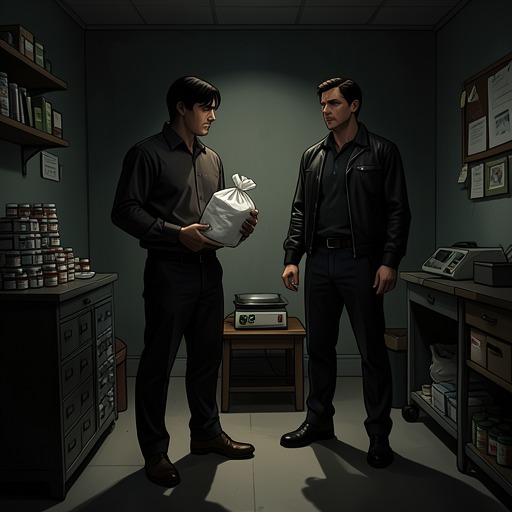
Harry Goldfarb and Tyrone C. Love initially approach heroin as a business opportunity. When Tyrone brings home a package from Brody, he reports that Brody calls it potent and advises cutting it at least three times. The partners hesitate over how to judge the supply without sampling it, then take a small taste. The effect confirms its strength: they believe they can dilute it several times and still sell a good product. They carefully mix it with milk sugar, avoiding smoking or coughing lest they lose any of the powder.
Their caution is practical, but it does not separate business from consumption. They take enough to get high before beginning the work, even as Harry insists that this is their chance to make serious money and that they cannot afford to get wasted. The hoped-for next step is a pound of pure heroin, a scale of dealing that would free them from the small-time street hustle. The drug is therefore both the merchandise they plan to sell and the immediate reward that threatens to undo the plan.
At first they try to limit their own use to small tastes while selling the rest. Calls come in before they have finished cutting the supply, and Harry makes several drops. When the volume of calls and message-running becomes a burden, Marion suggests operating from her apartment until a phone is installed at Tyrone’s place. The new arrangement makes business smoother. They cut the heroin five times, continue selling, and accumulate thousands of dollars, which they place in a safety-deposit box under assumed names. The operation appears to validate their ambition, even as their continued sampling keeps them involved with the product they are trying to control.
Potency, ritual, and dependence
The quality of the supply later changes. Brody tells Tyrone that the potent heroin has disappeared, possibly after men who stole from the Jefferson brothers were killed. The replacement is weak enough that Tyrone and Harry repeatedly test it and find that the familiar rush no longer arrives. They can cut it only about in half if they want the bags to retain any strength. The contrast between the first batch and the replacement makes the trade’s instability immediate: their business depends on a supply they cannot control, and the drug that once promised expansion can no longer reliably satisfy its users.
Heroin use is also rendered as a repeated domestic ritual. Harry and Marion share their equipment and take comfort in the routine of preparing a dose: opening a bag, putting the drug in a cooker, adding water with a dropper, heating and stirring the solution, drawing it up, tying off an arm, and finding a vein. They sometimes prepare new cookers simply for the sake of doing so. The sequence makes them feel part of something and gives the day an anticipated structure; after injecting, they feel warm, whole, safe, and temporarily invulnerable. Harry uses a piece of matchbook cover to make a collar for the dropper, while Marion uses a piece of dollar bill. Small, ordinary scraps become components in a ritual organized around the drug.
The apparent security of that routine depends on having heroin available. When supply becomes harder to find, the partners use most of what they obtain and sometimes have none left to sell. One night they cannot get any at all. They save their cottons for morning and try to sleep with the help of sleeping pills, but their bodies shake; sweat, cold, pain, nausea, and panic turn the night into a prolonged ordeal. The following day they use again, and the fears and nightmares of the night before seem to dissolve. A week later they attempt to stop once more, but panic, burning eyes, and running noses bring them back to the spoon before they have dressed. They tell themselves that they can quit later, when the timing is better. The delay is presented as a repeated justification rather than a successful decision to stop.
Scarcity and the street-level crisis
As heroin becomes less available, the partners’ objective shifts from making money to finding enough for themselves. Their phones ring with requests, but they cannot reliably meet them. The search takes Tyrone into dangerous parts of the city, where people promise potent supplies, arrange meetings, or try to take his money. He eventually buys bundles from someone he knows, then is stopped by narcotics officers. The officers find his money but do not remove the heroin from his pocket; Tyrone conceals it in the car before being taken to the station and charged with consorting.
The shortage extends beyond the partners. Streets, hallways, and abandoned buildings fill with people searching for heroin, including in snow and sleet. Those who find a supply may have to reach a private place before it is stolen, because the drug can seem more immediately necessary than personal safety. Cabbies avoid neighborhoods and carry guns; deliveries and some services stop. The city takes on the character of a place under siege, but the threat is not only outside its inhabitants: dependence has weakened their ability to resist the substance they need. The drug’s scarcity turns individual withdrawal into a wider atmosphere of danger and deprivation.
A jail cell briefly offers another view of heroin’s hold. Tyrone listens as an old, experienced user describes concealing heroin in the padding of his jacket’s shoulder. After a fix, he puts a little into the padding so it can be recovered and used in jail, preserving the prospect of one last dose after arrest. His improvised hiding place makes dependence visible as preparation for future confinement: even the possibility of incarceration is incorporated into planning for the next use.
Intimacy and exchange
The shortage also changes the terms of Marion’s relationship with heroin. Before visiting Big Tim, she is apprehensive about the arrangement but focuses on the promise that he will give her the drug. In his large apartment overlooking Central Park, he offers her alcohol and hash before making clear what he expects sexually. Marion becomes sick and briefly panics, but she returns to him because she still wants the heroin. She performs the sexual act, and the prospect of the drug shapes what she can endure in the moment.
Later, after attending the sexual gathering Big Tim arranges, Marion sits alone at home and recalls that she had not understood what she would be expected to do with the other women. The experience shocks her, as does how easily she was able to proceed once she understood the exchange. Yet receiving her share of the drug makes the ordeal seem worthwhile to her at that moment; after using, its effects dissolve her unease. The transaction offers immediate relief while narrowing the choices available to her under the pressure of dependence. Heroin is not simply a reward at the end of the encounter: the need for it helps determine the encounter’s conditions and the meaning Marion assigns to them afterward.
Significance
Heroin’s role changes from saleable product to organizing necessity. The potent batch briefly supports Harry Goldfarb and Tyrone C. Love’s ambitions, but even at the height of their business they use the goods they hope to control. As quality declines and supply dries up, profit becomes secondary to avoiding withdrawal; relationships, movement through the city, and even the possibility of prison are reshaped by that priority. The carefully repeated injection ritual promises wholeness and safety, while the shortage exposes how temporary that promise is. In this progression, the drug’s changing availability makes dependence legible not only as a physical condition but as a force that reorganizes work, intimacy, and everyday survival.