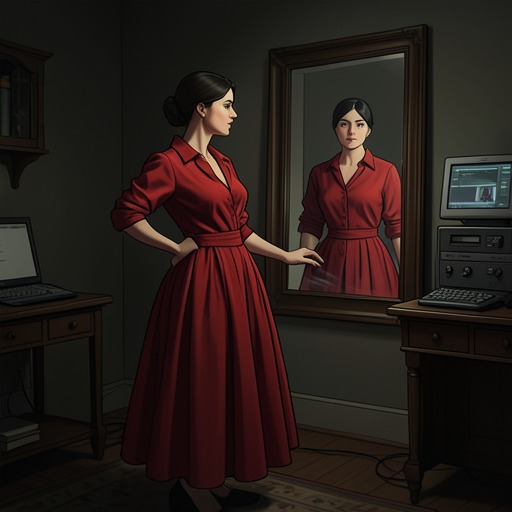
Sara Goldfarb and Seymour relationship
Requiem for a DreamThe marriage between Sara Goldfarb and Seymour Goldfarb survives in the novel through Sara’s memories rather than scenes between the couple. Seymour is dead, and Sara describes herself as alone, but her account of him remains bound to the red dress she wore at their son’s bar mitzvah. The dress becomes more than an item of clothing: it carries a remembered moment of her husband’s attention into Sara’s present, where she invests it with hopes of being seen again and of giving her days a purpose.
Marriage in Memory
Sara invokes Seymour while explaining to Harry why the red dress matters. She remembers that his father loved it and that the bar mitzvah was the only time Seymour saw her wearing it. Not long afterward, he became ill and died, leaving Harry without a father. The dress therefore holds a compressed family history: a public celebration of their son, a moment of spousal admiration, and the loss that followed. Sara does not offer a fuller account of the marriage, but the details she repeats show how strongly she preserves this particular image of Seymour.
The memory also gives the dress a meaning that reaches beyond appearance. Sara wants to wear it on television, and she connects losing weight with making that possible. Her imagined appearance joins a hoped-for future to the remembered time when Seymour saw her dressed for Harry’s milestone. The garment can thus be read as a material link between the woman Sara hopes to become and the wife and mother she remembers being. That link is emotionally potent even though Seymour is no longer present to see her wear it again.
Loss and the Empty Household
When Harry visits, Sara names Seymour among the people who are gone from her life. She says she is alone and has no one to care for, describing the ordinary tasks of shopping and cooking as diminished when they are only for herself. She buys small amounts of food rather than preparing a roast or making a special meal. Her account makes bereavement tangible through the domestic routines that have lost their shared purpose: cooking is not simply a matter of feeding herself but something she associates with having family to care for.
That sense of absence coexists with a strong wish to restore family life around Harry. When he promises to visit with Marion, Sara imagines making his favorite borscht and stuffed fish. She is glad that he has a partner and a business, and tells him that she and his father always wanted the very best for him. Her hope that Harry will have many children extends this family ideal into a future Seymour will not share. The exchange does not establish what Seymour himself said about grandchildren; it shows Sara remembering their common hopes for their son and carrying those hopes forward alone.
The Red Dress and the Television Dream
Sara’s red-dress ambition draws the memory of Seymour into her present plans. She tells Harry that the dress is the one his father liked, and that she intends to wear it on television. She has received an application and believes she will become a contestant, although she does not know which show. The prospect matters to her not only as a chance to win a prize. She explains that the television plan gives her a reason to rise in the morning, lose weight, and smile. In that account, the dress joins her remembered marriage to a newly imagined public future.
The connection is made more complicated by Sara’s use of diet pills. After a doctor gives her a package and instructions, she follows a schedule of colored pills and measures her progress by how close the dress comes to fitting. Two weeks into the regimen, she has lost ten pounds in the first week and repeatedly tries the dress on. When Harry warns her about the pills, she answers by returning to the dress, Seymour’s admiration, and her imagined television appearance. The memory of her husband is not the cause of the medical danger, but it forms part of the emotionally charged picture Sara uses to sustain her pursuit.
A Family Bond That Persists
Sara’s recollection of Seymour is inseparable from her identity as Harry’s mother. In the visit, she thinks back to Harry as a baby, remembers wrapping him warmly for the cold, and clings to the prospect of seeing him again. Her promise to cook for him and her pleasure at imagining him with a partner and children express a continuing investment in the family they made together. Seymour’s death has ended the marriage as a shared life, but it has not erased the family story through which Sara understands herself.
The novel gives little direct information about the marriage beyond Seymour’s death, Sara’s attachment to the red dress, and her statement that the two parents wanted the best for Harry. Its emphasis falls instead on how a few remembered details persist in Sara’s present: a dress at a bar mitzvah, a husband who admired it, and a son whose future she still imagines in family terms. The marriage is therefore represented less as a complete history of two people than as an enduring absence, carried forward in Sara’s clothing, domestic hopes, and memories of the family they shared.