Sara Goldfarb's delusional psychosis
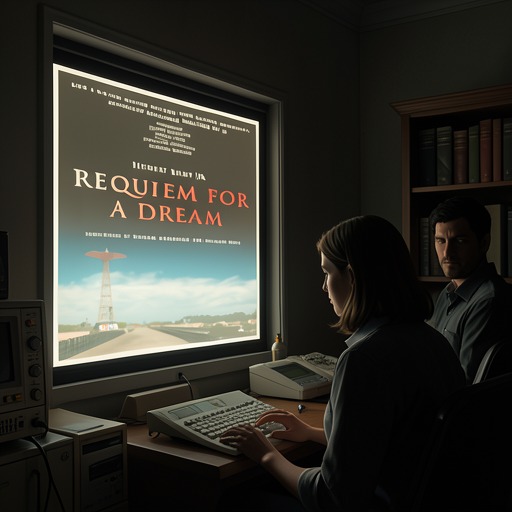
Requiem for a DreamSara Goldfarb's delusional psychosis grows from a consoling fantasy of television fame into a crisis in which the imagined audience invades her home and strangers seem to be watching and obstructing her. Television first supplies reassuring models of family happiness and a stage on which she can picture herself helping the poor; as her belief hardens, the same medium becomes evidence of public scrutiny and a conspiracy to deny her the appearance she expects.
Television as a Model of Happiness
Before her illness takes this persecutory form, Sara watches commercials and soap operas with intense emotional involvement. She imitates the gestures of people brushing their teeth and worries that an advertised child looks too thin, then interprets domestic advertisements as pictures of the life she wishes for Harry Goldfarb: a tidy home, a pretty young wife, and a happy family. When an advertisement shows a mother anxiously awaiting news of her son's operation, Sara leans toward the screen, urges the woman to trust the surgeon, and imagines that the boy will recover. The scene's promised resolution reassures her about Harry as well as the fictional child.
The television's ideal household also offers Sara a kind of company. She is pleased by a smiling couple sharing a meal, even though it is a TV dinner, and gives up lunch for several days rather than lose the Television set. Its scripted endings let her treat uncertainty as something that can be resolved: the mother will be comforted, the son will be all right, and her own Harry will eventually settle down. The comfort depends on accepting television's polished images as a guide to life beyond the screen.
Pills, Weight Loss, and the Red Dress
Sara's wish to lose weight becomes more urgent when she imagines appearing on television. At a doctor's appointment, she jokes that she has fifty pounds she would be willing to give away. The doctor says she is in good condition and provides a package of Diet pills with instructions, while the nurse explains that Medicare will cover the bill. At home, Sara sorts the pills by color and time of day, treating them as substitutes for meals. She takes the morning pill and then celebrates her plan with a large onion roll, cream cheese, and smoked fish, confident that the pounds will soon fall away.
Within two weeks she is accustomed to the pills' effects. Her teeth grind, her eyes sometimes feel bulgy, and she reduces her coffee, but the symptoms seem a small price for feeling good and seeing the scale change. The doctor tells her that she has lost ten pounds in the first week and that her symptoms are normal. Sara returns weekly for another supply, weighs herself, and signs the Medicare form. Each morning and evening she tries on Sara Goldfarb's red dress, watching the back come closer to fitting. The dress connects her expectation of a television appearance to a treasured earlier family occasion, and her progress in losing weight seems to confirm that the appearance is approaching.
From Consolation to Persecution
As Sara's imagined television career becomes more vivid, she watches quiz shows and pictures herself answering confidently, receiving presents, and giving them to people in need. In her fantasy, the applause leads to newspaper photographs and coverage on the evening news; people in the street call out their affection for her. She imagines sharing the occasion with Harry and the family she expects him to create. The promised appearance is not simply fame: it would make her useful to others and restore the family future she repeatedly pictures.
The television fantasy also begins to cross the boundary of the screen. A Little Red Riding Hood figure steps into Sara's apartment, surveys its old furnishings, and seems to judge its shabbiness. The announcer joins the inspection; then a crowd, cameras, and cables follow. Sara experiences the scene as a public exposure of her home, with millions of viewers witnessing her shame. She tries changing channels, but the same picture appears everywhere. The imagined audience does not merely observe her; its disapproving looks make her feel crushed by the poverty and loneliness of her surroundings.
The threat persists beyond these intrusions. Sara draws the curtains, peeks through them for watchers, tapes over the keyhole, and looks through it when she thinks she can do so unseen. She becomes suspicious that someone is spying on her, while the television remains on and supplies her with the scenes through which she interprets her life. After taking Valium, she returns to watching, sometimes identifying with mothers on screen who miss their sons. She says she has no phone number for Harry, but reassures herself that he is a professional man with his own business and will soon make her a grandmother. Her television hopes and her maternal hopes remain entangled even as grief and fear overtake them.
The Crisis at McDick Corp.
Sara's fear reaches a breaking point when she calls McDick Corp., hangs up in confusion, and becomes convinced that someone there has destroyed her application card to keep her off television. She decides she must go in person, get a new card, and find out who is responsible. In winter sleet she puts on stockings, thick wool socks, layers of sweaters, her coat, and scarves over the red dress, then sets out in golden shoes. On the subway she talks about her coming appearance and her plans to help the poor, while nearby passengers ignore her.
At the Madison Avenue offices, Sara asks the switchboard operator to put her through to Lyle Russel. Her wet clothes, sunken eyes, and disordered appearance alarm the staff, who try to calm her and persuade her to go home. She insists on staying until she knows what show she will be on. Staff bring her hot soup, call a doctor, and arrange an ambulance. Sara continues to explain that she does not want the prizes for herself; she wants to appear with Harry and her imagined grandson and give the prizes away. Her answers show how completely she experiences the anticipated appearance as a real commitment rather than a private wish.
Hospitalization and the Failure of Care
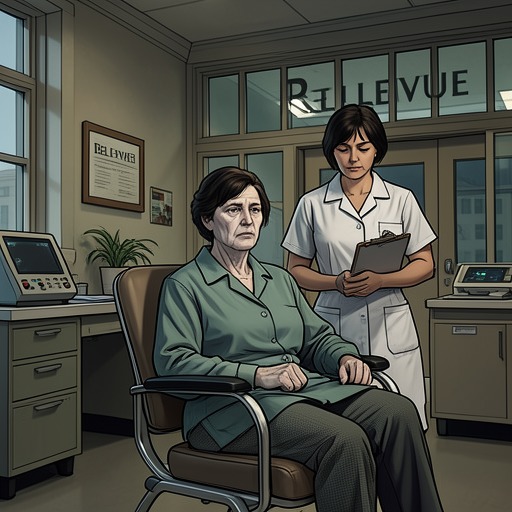
At Bellevue Hospital, an admitting doctor hears Sara's account of Harry and the television program, labels her paranoid schizophrenic, and recommends examination and shock treatment. The diagnosis frames her distress as psychiatric, but a young medical resident examines her more carefully. He notices the flesh hanging from her upper arms and the hollows around her eyes, asks about her recent weight loss, and listens as she describes the pills, her doctor, Seymour Goldfarb, Harry, and television. He concludes that the Diet pills and Valium, together with her inadequate eating, are central to her condition, and orders her transferred from the psychiatric service to medical care.
Dr. Spencer later argues that Sara's disorientation has a medical cause and that she needs rest, proper food, and time for the stimulants and depressants to leave her system. He says that six patients with similar symptoms recovered under medical treatment without shock treatment or psychotropic drugs. Dr. Reynolds, however, countermanded his transfer order and kept Sara in the psychiatric ward. The disagreement exposes the consequences of treating a medication-related crisis as a psychiatric disorder: the assessment that might have addressed her physical condition does not determine the care she receives.
Sara's subsequent hospital experience strips away what little control she has left. Terrified by the approaching food cart despite heavy tranquilizers, she is force-fed through a tube passed through her nose into her stomach. Staff strap her into a wheelchair, tie her hands to its arms, and leave her retching and unable to communicate her needs. Her delusional world began with television offering an audience, recognition, and a happy ending; in the hospital, she is instead rendered mute and isolated, while the treatment process compounds her fear rather than restoring her grasp of reality.