Sara Goldfarb's diet-pill misuse
Requiem for a DreamSara Goldfarb’s diet-pill misuse turns a doctor’s weight-loss prescription into a destructive regimen that increasingly governs her days, reshapes her body, and destabilizes her sense of reality. The pills initially seem to offer a manageable route toward fitting Sara Goldfarb's red dress and appearing on television; their promised transformation instead becomes entangled with sleepless agitation, compulsive behavior, and a crisis interpreted differently by competing doctors.
A Prescription Joined to an Existing Dream
Sara seeks medical help because she considers herself overweight and hopes to lose fifty pounds. After examining her, a doctor describes her as being in good condition and gives her a package of pills with instructions, arranging a follow-up appointment for the next week. When Sara asks about the cost, the nurse reassures her that Medicare will cover the bill. The treatment is thus presented as routine, accessible, and straightforward: take the prescribed pills, return to be weighed, and expect the weight to come off.
At home, Sara turns the instructions into a colorful daily schedule. She assigns the purple pill to morning, the red one to afternoon, the orange one to evening, and the green one to night. Jokingly treating the pills as her meals, she takes the first with water, then eats an onion roll with cream cheese and smoked fish. She imagines that losing weight will eventually lower her food expenses, while the teasing conversation she conducts with her refrigerator gives the regimen the air of a private contest. The meal and the pills coexist; at this stage, Sara is not simply abstaining from food but combining an ordinary appetite with a new pharmaceutical routine.
The prescription also attaches itself to hopes that predate the clinic visit. Sara has long looked to television for reassuring pictures of family life, beauty, and happy endings. She has already sacrificed meals to keep the television set, and the advertisements and dramas she watches supply images of the thin, appealing woman and the contented household she wants for herself and Harry Goldfarb. The red dress gives her weight loss a visible test, while the imagined television appearance gives it a public destination. The pills promise to narrow the distance between her present life and that carefully watched future.
Routine, Reward, and Bodily Warning
Within a day, the regimen begins to change Sara’s activity. After taking the orange pill, she cleans and scrubs, drinks water while thinking of becoming thin, and keeps moving between the household and the television. As the afternoon wears on, her energy wanes; she fidgets, clenches and grinds her teeth, and feels a faint apprehension in her stomach. She notices that she does not feel quite as good as before, but the contrast with years of feeling less alive makes the discomfort seem like a small price. She takes the green pill before the program she is watching has finished, then explains away her unease by blaming coffee and plans to drink less of it.
After two weeks, Sara has become accustomed to the pills’ effects. She almost welcomes the teeth-grinding because it accompanies the sense of improved energy and the visible loss of weight. Each morning and evening she tries on Sara Goldfarb's red dress and watches its back come closer to meeting. She reduces coffee to one pot in the morning and drinks tea afterward; when her eyes seem unusually bulgy, the doctor tells her that this is a normal reaction. At the weekly appointments she is weighed, given more pills, and asked to sign the Medicare form. The first week’s loss of ten pounds overwhelms her concern about other symptoms and reinforces her confidence in the treatment.
Sara’s progress becomes something she displays socially as well as measures in private. When she joins the other women in the sun, she lets them admire her changing figure, then gets up frequently to stretch or walk rather than remain still. Her friends and neighbors see an energetic woman who talks about her weight loss; for Sara, the dress’s changing fit confirms that the television future is approaching. The pills’ effects are therefore reinforced by several signs she values: a lower number on the scale, a garment that fits more closely, and the attention of other people.
Harry Recognizes the Misuse
When Harry visits, the signs that Sara has treated as evidence of success acquire a different meaning. As he embraces his mother, he hears teeth-grinding and realizes that it is not his own. He recognizes the sound as a possible sign that Sara is taking uppers and asks whether she is using diet pills. Sara says she is seeing a specialist for her weight and knows the pills only by their colors and shapes; she does not know what they contain. She explains that a doctor gives them to her and that she takes them because they make her lose weight.
Harry presses her about the pills’ effects. Sara acknowledges that they make her feel good and give her energy, and that she talks more than usual; she says the green pill puts her to sleep quickly at night. He points to her grinding teeth and urges her to stop. By this conversation, Sara reports having lost twenty-five pounds. She treats that number as a vindication, while Harry sees the same weight loss, energy, and grinding as warning signs of stimulant misuse. Their disagreement exposes the regimen’s central reversal: what Sara reads as proof that the treatment is working is what makes Harry fear that she is becoming dependent on drugs.
Escalation and a Fractured Reality
As the television opportunity remains uncertain and Sara grows increasingly uneasy, she struggles to sit through programs or sustain the image of herself walking across a quiz-show stage. She begins to think that more pills might make matters better. Instead of following the separate schedule she had established, she takes the purple, red, and orange pills together in the morning. The change brings a burst of activity—she cleans her house quickly and gets ready to go out—but by noon her body feels as though it is crawling and knotting. She cannot sit still and becomes convinced that something terrible is about to happen, imagining a car crashing into her or something falling from a roof.
The agitation disrupts even the social routines that once made Sara feel at ease. The other women joke about her restlessness, and Ada has to push her back into the chair when touching up her hair. Sara cannot reliably anticipate when she will spring up. Yet she continues to insist to herself that she is losing weight and should be happy: the dress fits, her hair looks right to her, and television still seems to be in reach. The repeated insistence sits against mounting evidence of distress rather than resolving it.
Her television fantasy then turns into an experience of exposure and shame. A little red-clad figure and an announcer seem to leave the screen and inspect Sara’s shabby apartment, joined by crowds and television equipment. Sara feels that millions of people can see her surroundings and judge her; changing channels does not end the spectacle, because the same imagined scene appears again. She clings to the television and folds inward under the sense of being watched. Later she continues to wear the red dress and gold shoes, refuses food, and watches quiz shows while imagining herself answering questions, receiving presents, and being celebrated. At the same time, she pulls down the shades, peers through the curtains, and listens at the door for people she suspects may be watching. The desired public appearance and the feared public scrutiny have become inseparable.
Medical Disagreement and Consequences
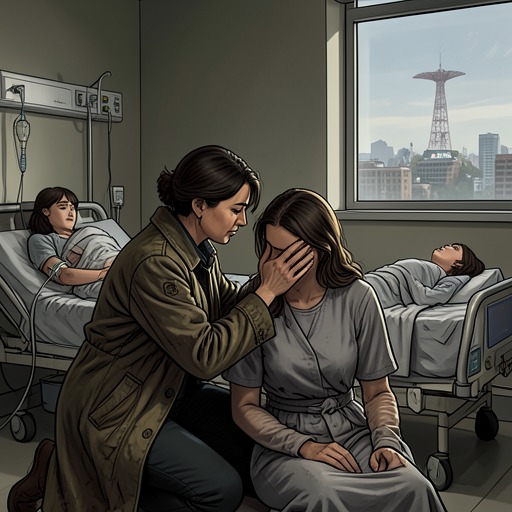
When Sara is admitted to the hospital completely disoriented, Dr. Reynolds diagnoses her as paranoid schizophrenic and recommends psychiatric treatment with possible electroshock. Dr. Spencer challenges that account. He reports that Sara has been taking diet pills and Valium and has not eaten a decent meal in many months; on that basis, he regards her condition as medical rather than psychiatric and orders her transferred to the medical service. His intervention makes the drug regimen and poor nourishment central to how her crisis should be understood, rather than treating the diagnosis as self-explanatory.
Dr. Spencer’s orders are countermanded, and Sara remains in the psychiatric unit under Dr. Reynolds’s authority. When Dr. Spencer protests to Dr. Harwood, he argues that rest, proper food, and clearing the stimulants and depressants from Sara’s body would allow her to recover. He supports his position with his experience treating six of Dr. Reynolds’s patients with similar symptoms and causes; he says they recovered medically in less than a month without electroshock or psychotropic drugs. Dr. Harwood acknowledges that Dr. Spencer has treated such patients but backs the existing decision and disputes his authority to judge a superior specialist’s care. Sara’s misuse thus ends not with a simple correction of the original prescription, but with a conflict over whether her suffering will be treated as a drug-related medical condition or as psychiatric illness. The novel links her collapse to a regimen she could not identify by its contents, a weight-loss goal continually reinforced by her television hopes, and a hospital system that fails to act on Dr. Spencer’s account.