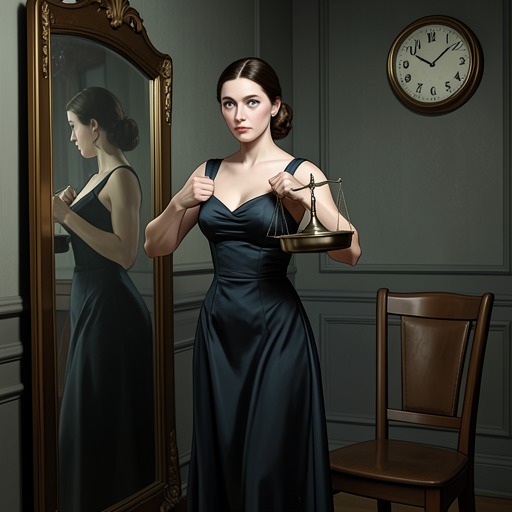
Sara Goldfarb's red dress
Requiem for a DreamSara Goldfarb’s red dress carries two versions of Sara at once: the garment she wore when her son celebrated his bar mitzvah, and the costume in which she imagines becoming a television personality. Its movement from a treasured reminder of family life to an emblem of the future she expects to claim gives the dress a central place in her hopes, her dieting, and her increasingly consuming television fantasies.
A Garment Tied to Family Memory
When Sara receives a call about appearing on television, she immediately wonders what to wear. She briefly considers the red dress, then worries that red will look blurred on the set. But the practical question of how a color will register on television cannot displace her attachment to the garment. She remembers that she loves it and brings it out along with the gold shoes she wore when Harry Goldfarb had his bar mitzvah.
The dress summons a whole family moment. Looking at herself in the mirror, Sara recalls that Seymour Goldfarb was alive then, and that Harry was her beloved boy. The garment belongs to a past in which her husband and son were part of a shared household, not only to a possible future in which strangers might watch her on television. Its power comes from that overlap: it is both a relic of family happiness and something she hopes to wear into a new public life.
The dress does not fit. Sara manages to zip it only a short way before giving up, and stands before the mirror with its back unfastened, holding it together as she looks at herself. Rather than discard it as unsuitable, she asks Ada to see how it looks. The visit turns her private dressing-room anticipation into news shared with a friend, while both women remain alert to the television in the next room. The red dress thus enters the social life of Sara’s television hope even before the hoped-for appearance has taken place.
A Promise Measured Against the Body
The garment becomes a practical measure of the change Sara wants from herself. While watching television, she admires its red color and imagines that losing weight will make it fit as it did before. She considers looking for books at the library and beginning a diet, linking the dress not just to an old celebration but to a deadline: she hopes to fit into it by the time she appears on television.
That hope is tested by the diet book. Its menus offer very limited food, and the small changes from one week to the next—a broiled egg replaced by a four-ounce broiled meat patty, then by four ounces of broiled fish—make the restriction concrete. Sara feels hollow and alone as she takes in how little the plan allows. Yet the image of herself on television in the red dress, slim and curvaceous, interrupts that distress. The imagined body on the screen is also linked to her remembered body when she first met Seymour, and to his admiration of her beauty. The dress binds the promised transformation to both lost desirability and anticipated applause.
Sara’s later preparations give this promise a visible routine. She has her hair colored red, puts on the dress and gold shoes, and poses and turns before her mirror, holding the back together as tightly as she can. She thinks she has lost weight because the dress seems to come closer to fitting. At lunch she chooses egg, grapefruit, and lettuce, rejects the herring in the refrigerator, and treats the meal as evidence that her plan is working. The dress is not merely recalled or displayed: it becomes a test she repeatedly uses to judge her body and a reason to continue restricting what she eats.
The Television Costume and Its Rehearsals
As Sara’s expectation of an appearance grows, the red dress becomes part of a detailed imagined performance. She pictures herself walking across a stage in it, with matching red hair and gold shoes. In this fantasy, the fit is no longer a problem: after losing weight, she can cross the stage in a dress that suits her. The wish to wear it therefore connects private acts of dressing and dieting to a public scene of recognition.
The performance is rehearsed through repeated viewing. Sara studies quiz shows, keeps the television on, and imagines herself answering questions with ease, receiving presents, and being applauded. She pictures photographs in the papers and her appearance on the evening news. The red dress gives this expansive fantasy a familiar, tangible center: the imagined public figure is still the woman standing before her mirror in a garment associated with her family’s earlier happiness.
The actual garment remains stubbornly material. It once will not zip; later, Sara believes it is drawing closer to fitting, while still holding the back together in front of the mirror. That discrepancy gives the dress a double role. It is an object Sara can touch and try on, but it also serves as evidence for a future that exists chiefly in her expectations. Her repeated rehearsals do not make the television invitation more definite; instead, they make the dress and the imagined appearance increasingly difficult to separate.
Persistence and Significance
Sara eventually wears the red dress all the time, along with the gold shoes. Ada continues to touch up her hair, and Sara resists suggestions that something may have happened to the show. She declines food brought by visiting friends, drinks coffee, and continues to speak about television. The dress has become everyday clothing, not an outfit reserved for a confirmed appearance. Its continuous presence shows how completely Sara has organized her daily life around the anticipated broadcast.
The garment’s meaning darkens as her confidence gives way to fear and shame. In a recurring television delusion, figures leave the screen and inspect her shabby apartment; then a crowd and television equipment seem to bring that private space before millions of viewers. Sara watches the apartment appear smaller and feels overwhelmed by the exposure. The dress is not identified as part of this inspection, but its place in her life has already changed: the clothing she once prepared for an imagined triumphant entrance belongs now to a world in which television seems able to expose and judge her.
By the time Sara is still wearing the dress and insisting that she is thinking of becoming thin, it has ceased to function as a simple token of nostalgia or a special-occasion garment. Its memories of Seymour Goldfarb and Harry Goldfarb remain embedded in it, but Sara also invests it with the promise of a television future and the proof of a body she believes she can recover. The same dress therefore holds together remembrance, aspiration, and painful misrecognition: it keeps the past close while making the distance between Sara’s actual circumstances and her imagined public life impossible to ignore.