Sara mails her television-show questionnaire
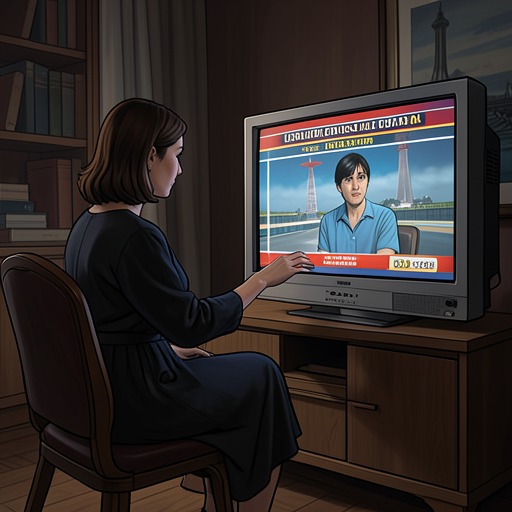
Requiem for a DreamSara Goldfarb’s mailing of a television-show questionnaire turns an ordinary form into a promise of transformation. The invitation names no particular program, yet Sara answers its questions with painstaking care and sends it off as if the future she has watched on television might now be addressed, sealed, and delivered to her. Her friends share the hope; later, Sara’s imagined appearance on television shows how completely that possibility has entered her sense of what is to come.
The Invitation and Its Promise
A mailman brings Sara a thick envelope while she is with the women in her building. Inside are a form letter and a two-part questionnaire, with a return envelope clipped to them. The letter explains that the sender is a promotional agency for several television shows that use contestants, as well as proposed shows, but does not identify which program might want her. The women gather around Sara, eager to learn what the envelope means. When she explains that the decision comes after she returns the form, their excitement meets the uncertainty of an opportunity that has not yet become a specific invitation.
The prospect takes shape against Sara’s habitual television viewing. Earlier, she has watched commercials promise dazzling clothes, sparkling kitchens, and contented domestic life, and she has felt happy for a couple sharing a television dinner as though their scripted ease were something real. She has also followed a hospital drama so intently that she supplies the frightened mother with confidence in the doctor and imagines the boy recovering. Such scenes give her a pattern in which distress resolves, families reunite, and everyone becomes happy. The questionnaire offers no guarantee of any such ending, but it gives Sara a concrete action to attach to the patterns she sees on screen.
Completing the Form
Back in her apartment, Sara reads the questionnaire several times while the television is on. She sits at the kitchen table with her back to the refrigerator, makes tea, and waits for the questions to become manageable. At first the blank form seems difficult; then she brings it close and begins printing carefully. She supplies her name, address, telephone number, and Social Security number, moving from one item to the next until the questions about her birth date and age make her pause.
The marital-status question draws an answer that expresses more than a category: Sara describes herself as wanting and needing. She treats the question about sex with a giggle rather than embarrassment, then continues. Her answers register her longing for a future companion, even as the form itself offers no promise that one will appear. When she finishes, she rereads every response several times, convinced that nothing important can be left out. She thinks of how often television shows people’s lives suddenly working out and wonders how many dreams might come true through this form. The care she gives each letter contrasts with the vagueness of the opportunity: she can make the application exact, but cannot know what it will lead to.
Sealing and Mailing the Questionnaire
Sara folds the questionnaire along its original creases, places it in the self-addressed envelope, and presses hard on the flap for many seconds. She then puts the envelope on a chair and sits on it to make certain it is sealed. After leaving the apartment, she waves the envelope to show the women that it is ready to go. They walk with her to the mailbox on the corner, imagining that she might be sent to a resort associated with television stars. Their joking does not diminish their investment in her prospects; for the women, their friend of twenty years may soon have a place on television.
At the mailbox Sara lowers its panel, kisses the envelope, and drops it inside. She shuts the box, opens it again to check that the letter has fallen through, and finally leaves her application in the care of the postal service. The repeated checking makes the transition from private fantasy to outward action almost ceremonial. The questionnaire is no longer on her table: Sara has sent her hope beyond the apartment, although she has no confirmation of a show or of what response will follow.
Hope and Its Later Distortion
The mailing briefly makes Sara’s dream communal. The narrative presents her friends’ hope as a light shared among people acquainted with sorrow and loneliness: their attention gives her imagined future a social presence before a television audience ever does. Yet the form’s uncertain purpose remains important. It is a questionnaire sent by an agency representing several shows and possible programs, not an assurance that Sara has been selected. Her confidence grows in the space between that limited fact and the complete, happy outcomes she has learned to expect from television.
Later, Sara wears her red dress and gold shoes, refuses food, and keeps the television on while studying quiz shows so she will be ready for whichever program calls. In her imagined appearances, she answers questions with ease, receives presents, makes a speech, and hears people celebrate her. The later visions of television figures leaving the screen to inspect and condemn her shabby apartment turn the same medium’s gaze into a source of exposure and shame. These developments do not change what the envelope contained; they show the weight Sara gradually places on the act of sending it. The questionnaire begins as a modest application with no named show, but in her imagination it becomes the first step toward a life in which she will be seen, applauded, and no longer alone.