Television fantasy and escapism
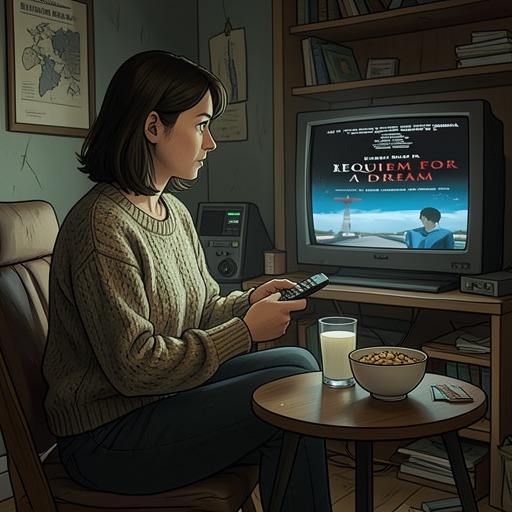
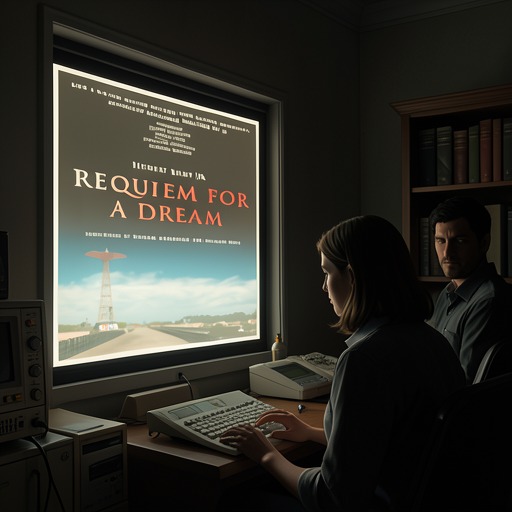
Requiem for a DreamTelevision fantasy and escapism are central to Sara Goldfarb’s effort to imagine a life larger and happier than the one she inhabits. The Television set offers her ready-made scripts for health, romance, family, and public recognition, but these borrowed images gradually become inseparable from her hopes and fears. Television comforts Sara, gives shape to her imagined future, and eventually turns the private shame of her apartment into a spectacle from which she cannot escape.
Television as a Domestic Script
After the boys leave with the Television set, Sara chains it to the radiator again, adjusts its antenna, and settles into her viewing chair. Commercials and soap-opera scenes do more than occupy the room: she watches closely, responding to the images as if their lessons could guide her own family. When an advertisement celebrates a thin, sweet-looking wife and a husband delighted by a clean house, Sara imagines the woman as the sort of partner Harry Goldfarb should find. The scene offers her a compact ideal of domestic happiness, and she folds it into her hopes that Harry will settle down with a nice young Jewish girl.
The images also make ordinary consumption look like intimacy. A couple shares a television dinner and exchanges affectionate looks; Sara is happy for them, even though she recognizes the meal as one prepared for television. Her attachment to the set has a material cost: she checks her money and realizes that keeping it means going without lunch for several days. This is not the first meal she has sacrificed for television. The screen’s promise of a comfortable household therefore sits beside the actual deprivation that sustains her access to it.
A televised hospital drama gives Sara another reassuring script. She watches a mother struggle over whether to permit an operation, urges her in her imagination to trust the doctor, and anticipates a happy ending in which the boy survives and returns home. Sara fills in the scene’s conclusion before it arrives, even revising her expectation that the boy will walk by deciding he will leave in a wheelchair. The imagined recovery lets her transfer the program’s reassurance to Harry: though he is sometimes mischievous, she believes everything will be all right. Television turns uncertainty into a story with a capable doctor, a relieved mother, and a child who comes home.
An Imagined Public Future
As Sara’s investment in appearing on television deepens, her red dress and gold shoes become part of a future she treats as imminent. She studies quiz shows so she will be ready for whichever program invites her, while continuing to refuse food and to think about becoming thin. In her imagined appearance, she answers questions with poise, receives presents, and announces that she will give them to people in need. Applause expands into newspaper photographs and coverage on both the six o’clock and eleven o’clock news; people recognize and celebrate her in the street. The fantasy joins personal fame to generosity, making public acclaim seem like proof that she can give something worthwhile to others.
The imagined success does not displace her hopes for family; the two futures reinforce one another. Sara pictures Harry as a professional man with a fiancée and a child, and imagines herself wearing the red dress when they visit. She also invokes Seymour Goldfarb and recalls the dress from Harry’s bar mitzvah, drawing the absent past into a scene of future celebration. The program she hopes to join, the prizes she means to give away, and the grandson she expects to babysit form one continuous vision of recognition and belonging.
Yet her expectation of being watched changes from pleasurable anticipation into fear. Sara closes the drapes, peeks out through them to detect anyone spying, tapes the keyhole, and cautiously removes the tape to look through it. She takes Valium and returns to the viewing chair, but television no longer dispels her suspicion. She imagines that someone at McDick Corp. is keeping her off the program and that her application has been destroyed. Even as she consoles mothers on screen by speaking of her own absent son, she says she has no phone number for Harry Goldfarb. Her story of his successful future persists alongside the loneliness and uncertainty of the present.
The Screen Turns on Sara
The fantasy becomes openly threatening when figures from a program appear to step out of the screen and move through Sara’s apartment. A little red riding hood wanders among the old furnishings, seeming to inspect them and look down on their condition. When an announcer joins her, the pair survey the rooms with expressions of disapproval. Sara tries to explain the shabby apartment: it is an old building, it has not been painted for years, and she is alone and doing what she can. The figures do not stop to listen. Instead, a crowd follows them out of the set, accompanied by television cameras and cables, turning Sara’s small, dim apartment into a scene exposed to an audience.
The distinction between a private room and a televised image collapses. Sara sees herself on the screen, surrounded by the apartment’s gloom, while also feeling crushed by shame and despair. Changing channels does not restore an ordinary boundary: every channel shows the same image of her, and she believes millions of people can see her humiliation. Clinging to the Television set as though she could hide its screen, she folds into herself. The device that had promised to bring her into public view now appears to broadcast a judgment she cannot control.
Other Viewers and the Limits of Escape
Television also marks the difference between Sara’s immersion and other characters’ strained attempts to use the screen. Marion Silver watches a show while waiting to learn whether Harry has obtained heroin, but finds herself attending to how absurd and insulting its predictable events and commercials seem. Her critical response does not free her from waiting: she continues to watch as time passes, with her attention caught between the screen and uncertainty about Harry. For her, television is both an object of disbelief and a way of letting the wait continue.
Tyrone C. Love uses television differently. Alone on the couch after Alice has gone back to her family in Georgia, he watches the set alongside the heroin in his system, using its images and sounds to quiet recurring confusion. Street hustling and the heroin shortage have worn him down; habit and television help him avoid dwelling on why he is relieved to be alone or on his lack of desire to seek another partner. The set does not resolve those questions. It helps him stop asking them, just as heroin sustains the routines that have come to feel ordinary.
Sara’s final institutional surroundings sharpen the contrast between television’s imagined freedom and her actual confinement. She shuffles through a medication line, where an attendant gives her Thora-zine and watches her swallow it, then moves into a television room with the other patients. Some already appear affected by the tranquilizers; Sara stares at the screen. The movement from her viewing chair at home to this supervised room does not erase television from her life, but it strips away the future she had built around appearing on it. The screen remains available as an object of attention even when the promise of recognition and happy resolution has given way to medication, surveillance, and isolation.