Tyrone C. Love
Requiem for a DreamTyrone C. Love is Harry Goldfarb’s closest friend and partner in heroin dealing, a resourceful survivor whose dream of getting clear of street life is repeatedly drawn back into its dangers. His movement from neighborhood hustling to a guarded drug operation, then to arrest and forced labor in the South, gives his hopes of security a stark counterpoint: every plan to get ahead leaves him more exposed to addiction, policing, and violence.
Background and Survival
Tyrone is introduced as a Black man from the streets of New York who knows how to read danger and make his way through it. His confidence is not simple bravado. It rests on a life shaped by instability, hard-won street knowledge, and the belief that trouble can appear wherever people are trying to get by. He and Harry joke together easily, but Tyrone is often the one alert to immediate risks. When Harry starts to sit near the driver on a cross-town bus, Tyrone pulls him away, frightened that the sight of a white man sitting at the front could provoke a racist response. The pair retreat to the back, where their joking about race lets them recover some ease without erasing Tyrone’s fear.
A conversation between the two men reveals the childhood memory beneath that vigilance. Tyrone’s mother died when he was about eight. He remembers her as affectionate and musical, a mother of seven who sang gospel songs and made home feel warm. His father had left before her death; afterward, the children were sent to live with different people. Tyrone went to an aunt in Harlem. She was kind in her own way, though stricter than his mother, and made sure he had a sweet treat after school. Harry, remembering his own mother’s embrace and hot soup, recognizes the loneliness in Tyrone’s story. Their memories briefly open a space beyond drugs and hustling: both men can recall being cared for, and both feel the absence of that security in adult life.
Harry, Alice, and the Promise of a Different Life
Tyrone’s friendship with Harry is intimate, comic, and practical. The two men work together, share money and drugs, slap palms in celebration, and rely on one another when plans go wrong. Harry’s rescue of Tyrone after his arrest deepens the attachment: Tyrone is moved that Harry came to get him, and the ride back together leaves him feeling close to his friend. He insists to himself that he is not like the old addict he has just encountered in a cell, but the image of that man keeps returning. Harry’s loyalty offers real comfort, yet it also helps Tyrone preserve the hope that they can resume dealing and avoid the fate he has seen up close.
Tyrone’s relationship with Alice gives that hope a domestic shape. He takes pleasure in the fine silk shirts in his closet, loving their smoothness and the order of their colors; the mirrored closet doors are a source of amusement and delight. More important, he imagines a life with Alice in which they can be safe, laugh together, and have no one troubling them. After making love, he checks that she is really beside him, kisses her forehead, and thinks of keeping her close and taking care of her. The tenderness of the moment is presented as something neither of them has known before, with or without heroin. For Tyrone, intimacy suggests a home and a future beyond the street. Yet his recurring wish for there to be no hassles is also a wish to escape conditions he cannot control, not evidence that he has found a way out.
Work, Dealing, and the Dream of Escape
Tyrone and Harry try to turn their energy into money through both legitimate work and heroin sales. While working loading newspapers, they use dexedrine to keep going and downers to crash, then collect checks enlarged by falsely declaring twenty-five dependents. They celebrate the cash as the means to buy heroin and move into a larger operation. The sequence shows how readily work, stimulant use, and dealing become parts of the same scheme: the men’s stamina produces extra hours, but the money they earn is already committed to the next risk.
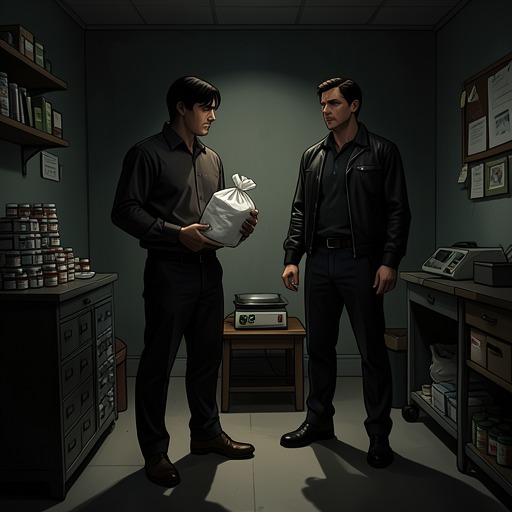
When Brody supplies unusually potent heroin, Tyrone and Harry know they must cut it heavily before selling it. They nevertheless take a small taste, confirming its strength and intensifying their confidence in the opportunity. As the product draws eager customers, Tyrone distributes his supply in several places and watches for anyone trying to rob him. He knows that making the deal visible can attract danger, so he stays alert, hides the drugs, and treats the moment as a rare chance to leave the life he has known. His ambition is not chiefly for luxury: he wants enough money to stop running the streets and to live without constant conflict. The contradiction is immediate. To reach that imagined safety, he must become more deeply involved in a business that makes him a target and keeps heroin at the center of his plans.
The earlier sense of success does not last. As the supply situation worsens, Tyrone finds that locating good heroin means returning to dangerous street corners, where people promise drugs, money, or connections and may simply be lying. He eventually obtains a couple of bundles from someone he knows, but police stop him on his way to a cab. They find money and feel the heroin in his pocket without taking it out. Tyrone slips the drugs beside the car seat, then goes through booking on a charge of consorting. He knows how to move through the encounter, but the arrest interrupts the business and forces him to depend on Harry and Marion to get word out and arrange his release. Escaping the station does not mean escaping the cycle: soon afterward he is again thinking about how to find enough drugs to keep withdrawal at bay.
Arrest and Punishment in the South
The cold and the dwindling supply push Harry and Tyrone toward a desperate plan: drive to Florida, where they hope to find a source and buy enough heroin to regain their footing. Tyrone doubts the scheme. New York is the territory he understands; Miami is not, and he questions why no one else has already tried the supposedly obvious solution. Harry’s certainty wins him over. On the drive south, an encounter at a gas station makes the danger of their journey tangible. The attendant refuses them the use of the restroom, and a mechanic stares and spits at Harry. Tyrone urges Harry to keep calm and leave rather than turn the hostility into a fight. The incident exposes the racism shaping their passage through the South, while Harry’s injured arm makes their vulnerability physical as well as social.
After they are arrested, a Southern officer insults Harry, strikes him, and drags him by his injured arm. Tyrone is already handcuffed in the car. At the station, Harry asks for medical attention, but the booking officer mocks him and says that a doctor may not see him until Monday. Tyrone, confined with Harry, blames Harry’s plan for bringing them to this distant jail, yet the complaint cannot undo their shared predicament. The man who had hoped to stay in control of his own movements is now trapped in a system whose officers can decide when he works, where he goes, and whether he receives care.
Tyrone’s first weeks in custody are marked by withdrawal and forced labor. He shivers through cold nights, suffers cramps, diarrhea, and repeated retching, and is made to join a highway work gang for twelve hours. When exhaustion leaves him doubled over, a guard laughs, kicks at him, and hauls him upright. The guard’s abuse is explicitly racialized: he tells Tyrone that Southern authorities do not like New Yorkers like him and threatens him as he struggles through the sickness. Tyrone’s earlier insistence that he can quit whenever he wants is set against the bodily reality of withdrawal and the coercion of the labor camp. His story ends in captivity, with no recovery or safe return established. The journey meant to secure a fresh start instead places both men under the power of a hostile system.
Narrative Role
Tyrone’s arc repeatedly contrasts his practiced street competence with the limits of that competence. He can spot a risky bus seat, conceal heroin from police, read the dangers of selling on the street, and keep Harry from escalating a confrontation. These skills help him survive particular moments, but they cannot protect him from the larger forces governing the story: addiction, dwindling supply, racist hostility, and imprisonment. His memories of his mother, tenderness toward Alice, and loyalty to Harry make his wish for an ordinary life concrete rather than abstract. Yet even his most hopeful plans depend on another deal. The gap between the secure home he imagines and the highway labor he endures turns his repeated desire for a life without trouble into a measure of how little control he ultimately has over it.