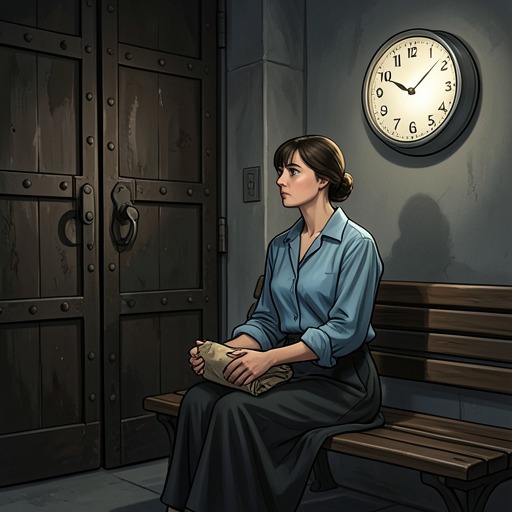
waiting to live
Requiem for a Dream“Waiting to live” names a condition Marion Silver recognizes in herself: life treated as rehearsal or preparation rather than something already under way. The phrase gathers the novel’s contrast between imagined futures and present experience, while the scenes around it make waiting feel less like peaceful anticipation than a pattern of suspended action, dependency, and exposure to forces beyond one’s control.
Marion’s Recognition
At the kitchen table, Marion tries to occupy her mind with hot chocolate and then coffee, but watches the time without registering it. The line “They also serve who only sit and wait” prompts a bitter recognition: she seems to have spent her life waiting, and what she has been waiting for is “waiting to live.” She recalls having reached this insight in therapy, where she had treated her current life as rehearsal for a future one. The thought is not new to her; its familiarity is part of its force. She can name the pattern, but naming it has not freed her from it.
Her recollection turns against the language of therapeutic advice. A former therapist praised her intelligence and talents and urged her to come to terms with her problem and become productive. Marion remembers the repeated injunctions to sublimate, to stop doing what causes the problem, and simply to use willpower. The word “just” makes change sound effortless, while her experience suggests otherwise. She wants another coffee but cannot summon the initiative to refill her cup. When she finally gets up, the pot is empty. The ordinary task gives physical form to the distance between understanding what should be done and being able to do it.
Waiting in the Present
Marion turns on the television to occupy her mind, yet the program and its commercials absorb her attention only through their absurdity. She criticizes their predictability and wonders who watches or buys what they advertise, then continues to stare as time passes. Her critical awareness does not release her from the scene: she is still waiting, now with the television filling the room while her attention returns to her watch and to whether Harry has obtained heroin. She hopes he has kept enough back for them. The phrase therefore sits beside a concrete dependency; the hoped-for future is bound to the next supply, not to an independent beginning.
The contrast is sharp between Marion’s articulate account of postponement and her inability to move beyond it. Her thoughts range through therapy, literature, productivity, and television, but the empty cup and empty coffee pot remain. The passage does not present insight as a cure. Instead, the expression exposes how readily a person can understand a pattern and still remain caught inside its daily repetitions.
A Wider Pattern of Suspended Freedom
Elsewhere, Harry Goldfarb and Tyrone C. Love turn to the streets for “a little action.” On a crosstown bus, Tyrone pulls Harry away from the front seat, afraid that sitting there will draw danger; they move to the rear and make jokes together. Their banter gives them a moment of movement and companionship, but their choices remain shaped by the threat Tyrone perceives around them. The scene offers a different register of waiting: not Marion’s reflective pause, but the precarious calculation of where it is safe to sit and how to get through the immediate moment.
On their journey south, Harry and Tyrone encounter hostility at a gas station. After the attendant refuses them access to the restroom and a mechanic stares and spits at them, Harry’s pain and confusion begin to turn to rage. Tyrone urges him to cool it, and they drive away, worried about how to get enough gas. Their movement through the region does not give them control over their circumstances; the encounter instead makes the journey more constrained and dangerous.
The danger becomes direct when a police officer questions and strikes Harry, drags him by his injured arm, and takes him into custody with Tyrone. At the station, Harry asks to see a doctor and is mocked and made to wait. Tyrone, meanwhile, suffers severe withdrawal in the labor camp: cramps, diarrhea, and retching leave him doubled over, while a guard taunts and physically abuses him and forces him back to work. These scenes are not literal repetitions of Marion’s phrase, but they enlarge its significance. For the characters, the future can be deferred not only by habit or hope but by addiction, injury, racial hostility, and coercive confinement.
Meaning and Limits
Marion’s formulation is powerful because it distinguishes waiting for life from living it without pretending that recognition alone can close the gap. Her reflection moves from a remembered therapeutic insight to the minute details of the present—the watch, the empty cup, the television—and back to the uncertain question of whether Harry has found heroin. That movement makes the phrase both an idea and a lived condition. Across the surrounding trajectories, time passes, but passing time does not guarantee progress: movement may lead into greater restriction, and waiting may persist even when its causes are painfully clear.