Arthur Burbridge’s Death at the Golden Ball
Roadside PicnicArthur Burbridge’s death at the Golden Ball is the expedition’s decisive reversal: the young man reaches the quarry in jubilant expectation, proclaims happiness for everyone, and is killed by the very force the group has come to seek. The scene turns Arthur’s generous, public wish into a grotesque contrast with the quarry’s indifferent violence, leaving Redrick Schuhart alone with the consequences of their journey.
Approach to the Quarry
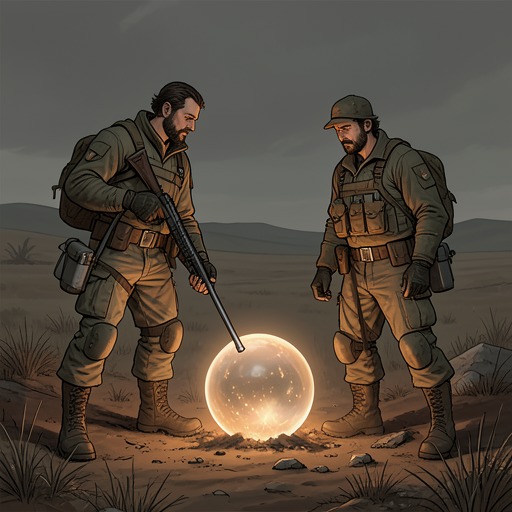
At the steep descent into the quarry, Arthur stops and strains to look downward and into the distance, extending his long neck. Redrick joins him but does not look in the direction that has fixed Arthur’s attention. The small divergence between them marks the threshold of the scene: Arthur is absorbed by what lies below, while Redrick’s attention is elsewhere. The descent is not simply the last stage of their approach to the Golden Ball; it is the point at which their expectations are about to be tested by an encounter neither can control.
The broader hope surrounding their expedition is expressed in the conviction that everything must change—not just one or two lives or fates, but every link in a rotten world. Arthur’s final words give that sweeping desire an immediate, personal form. His death does not answer the wish or show that it has been granted. Instead, the quarry interrupts it with an abrupt violence that makes the distance between a universal hope and the lives exposed to the Zone painfully concrete.
Arthur’s Last Moment
Arthur declares that they have made it and asks Redrick whether they really have. He laughs happily, crouches, and beats both fists hard against the ground. His words and gestures present arrival as a triumph: after the dangers of the expedition, the quarry seems to him a place of fulfillment. There is no hesitation in his celebration. He experiences the moment as success just before it becomes the scene of his death.
Arthur then walks farther down, dancing a jig and shuffling to his own beat. White dust rises from his heels as he shouts at the top of his lungs, in a voice that is clear, joyous, and festive. Redrick thinks that no one in the quarry’s history has descended as if going to a party. The comparison captures the scene’s defining incongruity: Arthur meets a place of lethal danger with the open, communal exuberance of a celebration. His descent gives the expedition’s expectation of reaching the Golden Ball its most buoyant image, while making the coming reversal all the more stark.
The Wish and the Reversal
At first, Redrick does not attend to what the talking key is yelling. Then something clicks inside him, and he hears Arthur’s repeated invocation: “Happiness for everybody! ... Free! ... As much as you want! ... Everybody come here! ... There's enough for everybody! Nobody will leave unsatisfied! ... Free! ... Happiness! ... Free!” Arthur’s words make his final act more than a private expression of relief. He calls to everyone, promises abundance without exclusion, and insists that no one will leave unsatisfied. The desire is universal even as the speaker stands alone in the quarry.
The scene places this promise against a material world that offers no protection to the person making it. Arthur’s voice is loud and festive; the force that kills him is transparent and empty. The stark contrast is not between two competing human intentions but between Arthur’s expansive invitation and an apparently impersonal danger he cannot see or overcome. His call for free happiness does not stop the Zone from taking him. The wish remains audible, but its speaker is removed before its promise can be tested or fulfilled.
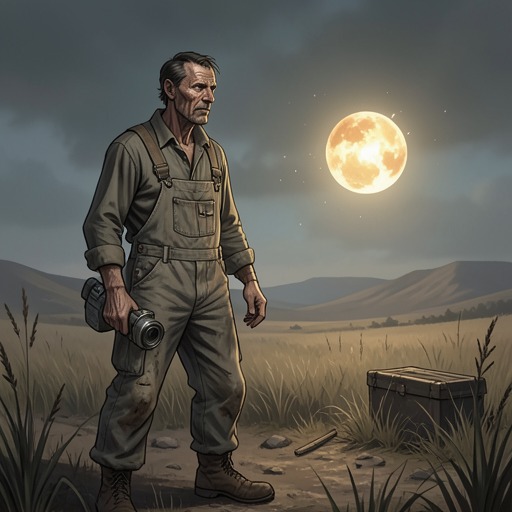
Arthur suddenly falls silent, as if a huge fist has punched him in the mouth. Redrick sees the transparent emptiness lurking in the excavator bucket’s shadow seize Arthur, throw him into the air, and slowly twist him, “like a housewife wringing her wash.” The violence is presented with dreadful deliberation: the force lifts Arthur and turns his body while Redrick watches. One of Arthur’s dusty shoes comes off his jerking leg and flies high above the quarry. That single dislodged object makes the bodily violence visible in the landscape, a small remnant of the exuberant figure who had just been dancing down the slope.
Aftermath and Significance
Redrick turns away and sits down. He has no thought in his head and has somehow stopped sensing himself. His response does not supply an explanation for the force or a consolation for Arthur’s death; it registers the immediate collapse of thought and sensation after witnessing it. Silence hangs heavily in the air, particularly behind Redrick, back on the road. The quiet contrasts with Arthur’s ringing cries and leaves the aftermath suspended rather than resolved.
The death is therefore both a physical catastrophe and a reversal of the expedition’s emotional meaning. Arthur reaches the quarry believing that he and Redrick have made it; moments later, Redrick is alone, unable even to think. Arthur’s refrain survives the change in circumstance as an unanswered call for universal happiness. Its hope is not mocked by any reply from the quarry: it is simply met by the lethal force that acts without explanation. The Golden Ball’s approach, imagined as the culmination of the journey, becomes instead the place where Arthur’s celebratory certainty ends and Redrick’s stunned silence begins.