Currigan Labs
Roadside PicnicCurrigan Labs is the research facility whose destruction exposes the danger of treating an unexplained Zone substance as if it were already understood and safely contained. When Witches' jelly passed through a porcelain vessel and the barriers meant to isolate it, the laboratory became the site of a catastrophe: thirty-five people died, more than a hundred were crippled, and the building was destroyed. Its consequences also reach beyond the disaster itself, because investigators never discovered where the laboratory had obtained the jelly.
Facility and Research Context
The available account identifies Currigan Labs as a well-equipped laboratory and describes it as the recipient of a private supplier's Witches' jelly. The institution appears in conversation as a place where the material was subjected to controlled handling, not as an organization whose internal structure, personnel, or wider research program is described. That limited picture matters: the catastrophe is narrated through the failure of containment, while the precise institutional procedures and the supplier's identity remain unspecified.
Witches' jelly is discussed as a substance whose behavior resists ordinary explanation. Redrick Schuhart asks whether it is colloidal gas, and Valentine Pilman confirms that this is the material involved. The exchange makes clear that a scientific-sounding classification does not settle what the substance can do. In a separate discussion of alien objects, magnetic traps are identified as such even though their powerful magnetic field and its cause remain unexplained. Across these examples, the language of research offers provisional names without guaranteeing command over the phenomena named.
The Witches' Jelly Catastrophe
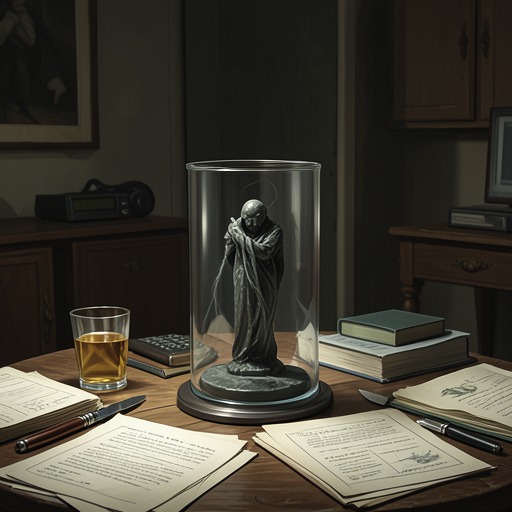
The laboratory's staff placed the jelly in a porcelain container inside a special room designed to be highly insulated and isolated. They believed those precautions made the sample secure. When manipulators opened the container, however, the jelly passed through metal and plastic as readily as water through a sieve. Every material it touched also turned into jelly, transforming the containment system itself from a defense into a route for further spread.
The reported human toll was thirty-five deaths and more than a hundred people crippled; the entire building was destroyed. The jelly then seeped down into the basement and lower floors, extending the disaster through the structure after the initial breach. Valentine Pilman responds to the account with a grim expression. The facility's impressive equipment, recalled in the same conversation, sharpens the contrast: technical sophistication did not prevent a substance with unknown properties from defeating the assumptions built into the experiment.
Provenance and Wider Consequences
The disaster becomes relevant again when Redrick Schuhart discusses the jelly with Richard Noonan. Noonan recounts the catastrophe and adds that the investigators never tied up the loose ends: they never found where Currigan Labs had obtained the material. He describes the jelly as having come from a small private supplier, but its own source remains unresolved. Redrick listens while feigning distraction, clucking his tongue and shaking his head, as the missing link in the chain of custody is brought into view.
That unanswered question keeps the catastrophe from being only a story of an experiment gone wrong. The material reached a research facility through a private supplier, yet the route by which it entered that supply network was never established. The episode therefore links scientific handling to the broader movement of Zone-derived substances without resolving who first brought this sample into circulation. Its precise source, and the full consequences of that uncertainty, remain unknown.
Narrative Significance
Currigan Labs makes the limits of classification concrete. Elsewhere, an observer remarks that unfamiliar objects seem simple only once they are seen and believed; the jelly offers a harsher version of that problem, because even a familiar-looking container and an insulated room cannot make an unknown substance legible or safe. The laboratory's procedures presume that barriers work in the conventional way. The jelly's passage through porcelain, metal, and plastic overturns that premise, making the supposed boundary between sample and environment meaningless.
The catastrophe also gives institutional force to the difference between naming and understanding. Redrick's question about whether the jelly is colloidal gas receives a confident identification, but that label does not account for its ability to pass through materials and convert whatever it touches. At Currigan Labs, the cost of that gap is measured in lives, injuries, and a ruined building. The unresolved supplier trail adds another failure of knowledge: neither containment nor investigation succeeds in making the substance's path fully knowable.