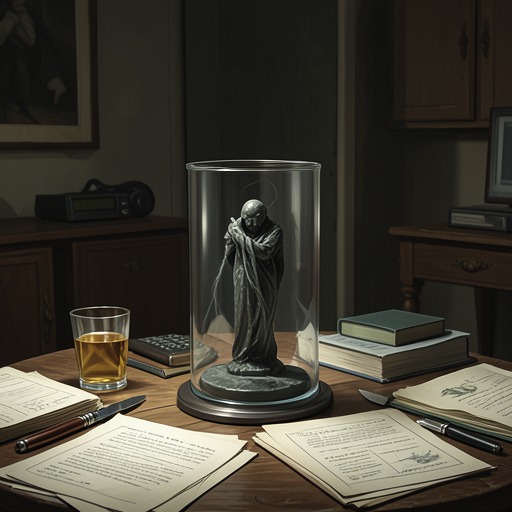
Death lamp
Roadside PicnicThe Death lamp is a Zone apparatus said to emit a ray fatal to Earth organisms, but the account of it is defined as much by what remains unknown as by the danger attributed to it. A stalker brought the device out and offered it to the institute; after the two sides failed to agree on a price, he reentered the Zone and never returned. The apparatus itself was never located again. Its history links an apparently lethal technology to the fragile chain of extraction, appraisal, and institutional custody through which Zone discoveries pass—and shows how little naming or valuation can guarantee actual knowledge or control.
Reported Discovery and Lethal Function
The Death lamp enters the discussion as a remembered case rather than as an object anyone can inspect. The account dates the episode to eight years earlier and identifies the stalker as Stefan Norman, nicknamed Four-Eyes. He brought an apparatus out of the Zone that, as far as could be judged, was a ray-emitting system fatal to Earth organisms. That qualification matters: the report presents a grave assessment, not a demonstrated explanation of the device’s mechanism. The threat is legible enough to shape its reputation, while its workings remain outside what the account can establish.
The name Death lamp compresses this uncertain assessment into a practical, ominous label. It signals the presumed consequence of exposure, but the evidence supplies no confirmed test, description of a beam, operating procedure, range, or account of an actual victim. The device’s lethal potential is thus a reported judgment about an extraterrestrial apparatus, not a fully documented technical profile. The gap between the force of the name and the thinness of the available explanation is central to its significance: a category can tell people what they fear without telling them what they possess.
Failed Sale and Disappearance
Four-Eyes offered the apparatus to the institute, but the parties did not agree on a price. The account gives no amount, counteroffer, or explanation of the disagreement, so the episode cannot be reduced to a specific dispute over the device’s merits. What is clear is the immediate consequence: Four-Eyes went back into the Zone and never came out. The attempt to transfer the discovery into institutional hands ended not in custody or study, but in the disappearance of both the stalker and the object from view.
The apparatus’s present whereabouts are unknown. Its disappearance does not establish that it was destroyed, recovered, or used; the account leaves each of those possibilities unresolved. The institute’s people are still described as tearing their hair out over the loss, a vivid measure of how persistently the missing device troubles them. Its absence is not a minor gap in a completed investigation: it prevents the very institution seeking the object from verifying what it is, determining how it works, or securing the danger it is believed to pose.
Institutions, Value, and Control
The story is recounted in a discussion of the systems meant to handle Zone discoveries. Valentine Pilman explains that he has served for two years as Canadian consultant to the UN Commission on Problems of the Visitation, while distinguishing that work from the scientific study of extraterrestrial cultures. His role on the commission is to represent the international scientific community when the implementation of United Nations decisions about internationalizing the Zones is at issue. In broad terms, he says, the commission helps ensure that extraterrestrial marvels found in the Zones reach the International Institute.
That institutional pathway is complicated by a steady leak of materials from the Visitation Zones into the hands of irresponsible persons and organizations. Pilman says the commission deals with the consequences of those leaks. The Death lamp’s history gives that general problem a particularly sharp form: a potentially lethal find is brought out by an individual stalker, offered for a price, and lost again when the transaction fails. The account does not establish that the apparatus passed through a black market or reached an irresponsible organization. Instead, it shows the vulnerability that makes such leaks a concern: official intentions to collect and manage discoveries cannot ensure that an object will actually be secured.
Price is the point where the device’s material and institutional histories meet. Four-Eyes evidently treated it as something that could be offered to the institute, while the institute did not accept the proposed terms; the account gives no basis for claiming either side’s motives or setting a market value. The result nevertheless exposes a fault line in the intended process of international custody. A discovery may be scientifically important and dangerous, yet its movement into research depends on negotiations among people whose access, incentives, and knowledge are not the same. Here that process breaks off before study begins.
An Object Named but Not Known
Elsewhere, the book makes the limits of interpretation explicit: people may learn how to use an artifact or give it a workable name without understanding its underlying nature. The account of the so-so objects, for example, distinguishes practical knowledge of their use and multiplication from an explanation of their relationship to fruit. Magnetic traps can be identified as traps even while the source of their powerful magnetic field remains unexplained. Those examples do not supply facts about the Death lamp’s mechanism, but they clarify the larger pattern into which its story falls: classification and operational knowledge can remain partial, and a name need not amount to comprehension.
The Death lamp is an especially stark instance because even the practical chain of knowledge remains incomplete. The apparatus is assigned a lethal function, given a memorable name, and associated with a missing transaction, but no subsequent examination resolves what it does or where it went. Its history also reverses the expected progression from discovery to secure institutional study: the object is retrieved, offered, rejected on price, and lost. The result is not a confirmed weapon under control but an unresolved hazard beyond anyone’s reach. In that reversal, the device stands for the wider difficulty of making Zone matter governable: institutional plans, scientific labels, and commercial valuations all depend on access to objects whose behavior and whereabouts may resist them.