Ernest
Roadside PicnicErnest is the proprietor of the Borscht and a practical broker at the boundary between Harmont’s ordinary commerce and the illicit trade in Zone salvage. His bar offers food and familiar routine to people returning from the Zone, but his attentiveness is not simple benevolence: he understands what their goods are worth, what they need, and how to connect one person to another. His career traces a change in the Borscht itself—from a lively meeting place to a sober, steady restaurant run in his absence—while his imprisonment leaves his influence visible in the business and its clientele.
Identity and Place in Harmont
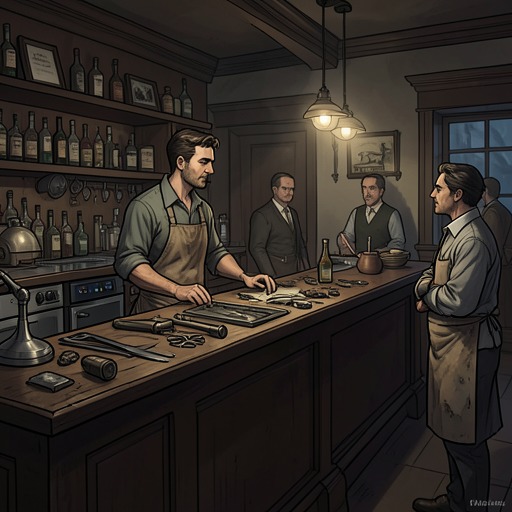
The Borscht is Ernest’s workplace and point of access to Harmont’s varied social worlds. He is shown behind the bar wiping glasses, a deliberately ordinary gesture that frames the establishment as a place of habitual service. Yet the bar also receives stalkers carrying salvage back from the Zone. Ernest recognizes that return at a glance and knows that a stalker needs food after a visit; when Redrick comes in, Ernest has grilled hot dogs brought from the kitchen, sets down catsup, and lets him eat. The kindness is concrete and knowing, grounded in familiarity with the risks and appetites of the trade.
The Borscht’s position gives Ernest a reach beyond serving drinks and meals. A young, clean-cut visitor tells Redrick that Ernest directed him to Redrick, showing that Ernest can act as an intermediary and route people toward those with relevant knowledge or connections. Redrick’s reaction is bitter: he thinks Ernest has shown no pity in sending this young man his way. The episode complicates any picture of Ernest as merely hospitable. He is well connected, but his referrals can place another person in an uncomfortable encounter; the evidence does not explain what Ernest promised the visitor or why he made the introduction.
Trade and Relations with Redrick
Ernest’s dealings with Redrick include the blunt valuation of Zone-related goods. In one transaction, Ernest pays 400 in cash for an empty. Redrick reflects that he could have pressed Ernest for more if the item had been full, but says that he did not even think of doing so. The exchange gives the relationship an economic edge: Ernest knows how to buy, while Redrick recognizes the opportunity to exploit the difference in value. Redrick’s restraint is notable, but it does not erase the asymmetry or make the transaction charitable; Ernest is operating as a trader in a market where a small distinction in an object’s condition matters.
The two men’s connection is also expressed through routine care. After Redrick returns from the Zone with salvage, Ernest responds with food rather than questions or ceremony. Redrick calls him “Good old Ernie” and sarcastically calls him “A humanitarian,” a joke whose warmth depends on the very practical service being described. The nickname signals familiarity, while the irony preserves Redrick’s wary, unsentimental view of kindness. Ernest’s hospitality and commercial acumen coexist: he can feed a stalker and buy from him without the narrative reducing either act to the other.
The Borscht’s Changing Fortune
The bar’s fortunes and character shift over time. In a later account, the Borscht is still brightly lit and gives off the smell of food, but it is no longer the place of dancing and fun. Gutalin has stopped going there, put off by the change. Ernest is in prison, and his partner has taken over the business. Under her management it builds a dependable clientele: the entire institute eats there, including senior officers. The booths are cozy, the food good, the prices reasonable, and the beer lively. The establishment has become a reliable everyday institution rather than the earlier venue remembered for nightlife.
That change is not simply a decline. The loss of dancing and the absence of Gutalin mark a break with the old social atmosphere, but the bar’s steady business demonstrates its successful adaptation. Institute employees and senior officers now share the same dining place, and the Borscht’s appeal rests on comfort, affordability, and consistency. Ernest’s partner is the person explicitly credited with building that clientele; his imprisonment is the circumstance under which she runs the establishment, not evidence that he personally directed its later transformation.
Imprisonment and Continuing Presence
Ernest’s imprisonment is mentioned more than once, and the repetition makes his absence an enduring fact of the bar’s history. Redrick tells Richard Noonan that Ernest is still in the cooler while offering to treat him to a meal and recalling the old days and the Borscht. The casual reference folds confinement into familiar conversation: Ernest is absent, but remains a point of shared memory through the place he ran. The bar can continue without him, yet its altered atmosphere and the phrase “Poor old Ernie” keep his fate attached to it.
Ernest’s significance lies in this double position: he is both a calculating participant in the Zone’s salvage economy and the proprietor of a place that feeds people and sustains everyday social contact. The empty he buys, the hot dogs served to a returning stalker, the referral that sends a young visitor to Redrick, and the changed Borscht under his partner’s management show different forms of exchange—goods, care, information, and continuity. His imprisonment interrupts his work but does not erase the institutional footprint he leaves behind.