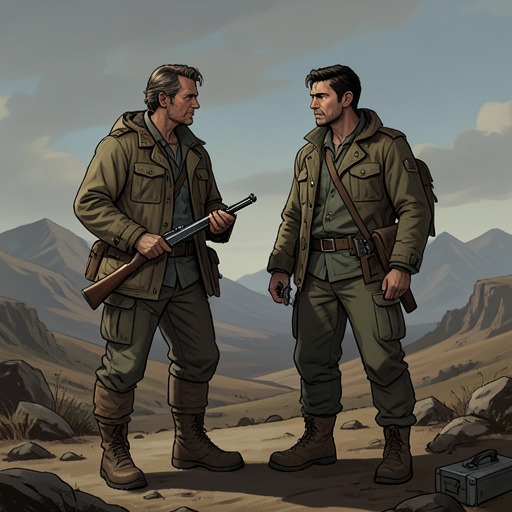
Friendship between Redrick Schuhart and Kirill Panov
Roadside PicnicRedrick Schuhart and Kirill Panov’s friendship joins two sharply different ways of confronting the Zone: Kirill tries to understand its strange objects, while Redrick’s loyalty is most visible in what he does for his friend. Their bond grows around the empties, especially the magnetic trap designated Object 77b, and ends in a loss that Redrick can neither explain nor easily absorb. Kirill’s work survives him, but its posthumous record makes the friendship’s central promise—curiosity directed toward a changed world—also a reminder of what the Zone has taken.
Shared Work and Unequal Curiosity
Kirill has spent almost a year exhausting himself over the empties. Redrick has been with him from the beginning, yet admits that he has never been sure what Kirill hopes to learn from them and has not tried especially hard to find out. Their partnership is therefore not a story of identical interests: Kirill pursues knowledge with sustained concentration, while Redrick accompanies him without fully sharing the intellectual purpose that drives the work.
That difference does not make Redrick indifferent. In the repository he watches Kirill, notices his sunken eyes, and feels more sorry for him than he has ever felt for anyone. The scene turns companionship into attention: Redrick may not understand the investigation, but he sees what it is costing his friend. His response begins in concern for Kirill himself, rather than in any sudden conversion to Kirill’s scientific outlook.
The Full Empty
At the repository, Kirill stands with his last empty on the scales, looking as if he is ready to climb into it. Redrick breaks the strain with a teasing proposal: what if Kirill had a full empty? Kirill looks puzzled, and Redrick clarifies that he means the hydromagnetic trap, Object 77b. Their exchange makes a technical object—the magnetic trap—part of a personal gesture. Redrick’s offer is an attempt to help a friend whose dedication has become visibly punishing, even though the evidence does not establish what the proposed trap ultimately means for Kirill’s work.
The scene also gives the friendship its characteristic asymmetry. Kirill is absorbed in the empties as problems to be studied; Redrick meets that absorption by noticing the exhausted person beside the apparatus. The object does not dissolve the difference between them. Instead, it gives Redrick a way to reach toward Kirill in terms connected to the research he cannot quite follow.
Death and the Delayed Recognition of Loss
Later, someone tells Redrick that Kirill Panov has died. Redrick is heavily drunk and initially cannot take in the announcement; he registers only that someone has died and responds by proposing a drink to the departed. The bluntness of that first reaction does not settle the meaning of his loss. It shows how far he is, in that moment, from being able to meet the news directly.
When Redrick leaves the Zone, the feeling becomes unmistakable. He wants to cry but cannot; what he sees is emptiness and sadness. He calls Kirill his buddy and his only friend, then asks himself how it could have happened and how he will manage without him. The questions mark a break in Redrick’s life, not merely grief for a colleague. Kirill had given him visions of a new, changed world, and his death leaves both the friendship and that imagined future without their principal voice.
The Work That Remains
Kirill returns after death through a posthumous article in the institute’s Reports. Over coffee from Guta, Redrick reaches for the publication and finds diagrams, markings, blueprints, and photographs of familiar objects seen from strange angles. The article is titled “An Unexpected Property of the Magnetic Trap Type-77b”; Kirill’s surname is framed in black, and a small notice identifies Dr. Kirill A. Panov as having perished. The practical details of the printed page—the black frame and the death notice—make absence part of the scientific record.
The article links Kirill’s persistence to the earlier repository scene: the magnetic trap Redrick had named while trying to help him is now the subject of work published after his death. The Reports preserve the investigation, but they cannot restore the researcher or explain the loss to Redrick. Their friendship consequently endures in two unequal forms: as Redrick’s private memory of the only friend he says he had, and as Kirill’s unfinished human presence carried forward by the work he left behind.