Golden Ball
Roadside PicnicThe Golden Ball is a legendary artifact of the Zone, reputed to grant human wishes and ultimately sought by Redrick Schuhart and Arthur Burbridge. Its decisive significance lies in the gap between its enormous promise and its mute, unadorned physical presence: the sphere does not supply a wish, but leaves Redrick to decide what human happiness should mean.
Legend and Reputation
The Golden Ball enters the story through tales that have accumulated around it. Buzzard Burbridge tells Redrick that he found it and admits that he himself spun some of the stories: it would grant any wish. The legend is already a form of currency, something Burbridge can use to hold Redrick’s attention and bargain for rescue. Yet Burbridge punctures its promise even as he invokes it. If the Ball truly granted every wish, he says, he would not be trapped in his present predicament.
His account makes the artifact’s reputation deliberately unstable. Burbridge recalls wishing for eternal youth and money, neither of which he claims to have received; instead, he counts health, good children, survival, and the extraordinary places he has visited among the things he does possess. His claims do not establish what the Ball can do. They show how its legend sits beside the hard facts of a stalker’s life, in which being alive and returning with experiences can matter more than riches or escape from age.
The idea also has an official, distanced form. When Mr. Lemchen asks Richard Noonan what he has heard about the Golden Ball, Noonan reports it as a legend: a mythical artifact in the Zone, shaped like a gold ball and said to grant human wishes. The contrast between the formal definition and Burbridge’s personal account is revealing. In one, the Ball is a reported object to classify; in the other, it is a story a wounded man deploys while trying to persuade Redrick to save him.
A Promise Used for Survival
Burbridge’s appeal to Redrick is both urgent and transactional. He insists that Redrick will get him out, and offers to tell him where the Golden Ball is. When Redrick examines him and says his knees are whole, Burbridge suspects he is being lied to, then offers everything he can: the Ball, a map, knowledge of the traps, and any other information Redrick might want. The promise of access to the artifact thus becomes one part of a larger bargain for rescue, alongside practical intelligence about the Zone.
Redrick has already said he will save Burbridge if he can. Burbridge’s offer does not change that pledge into a simple purchase: by the time he lists what he can give, Redrick is no longer listening. The exchange sets up an important distinction between the Golden Ball’s legendary value and the immediate human stakes of getting a man out alive. In this scene, the artifact is not yet an answer to suffering; it is a promise that Burbridge can offer, while Redrick’s attention has moved elsewhere.
From Rumor to a Physical Object
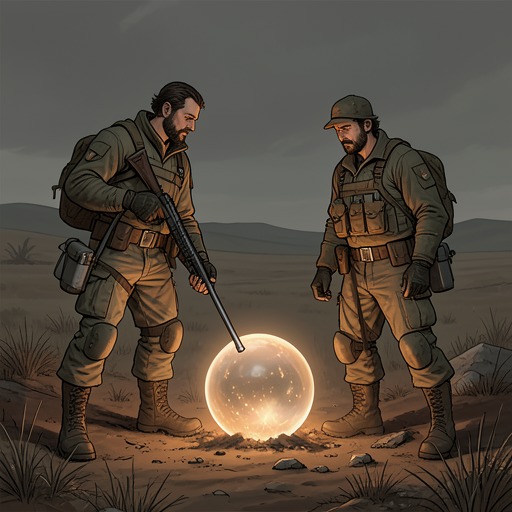
The Golden Ball later becomes the destination of Redrick and Arthur Burbridge’s journey. Near the end of that expedition, Arthur, overcome with relief, tells Redrick that they have made it. His celebration places the Ball at the end of a dangerous undertaking, but the object itself does not arrive as the radiant treasure suggested by its name and legend. It is reddish, more copper-colored than gold, completely smooth, and shines dully in the sun.
It lies at the foot of the quarry’s far wall, cozily set among piles of accumulated rocks. The physical details resist the expectation of a brilliant, self-announcing wish machine. What the travelers reach is a solid, quiet sphere in a worked-over landscape, not an object whose appearance explains its powers. The long journey has delivered them to the legendary thing, but arrival does not resolve what the legend means or what Redrick should ask of it.
This conversion from hearsay to matter changes the Ball’s role without making its powers certain. Earlier, people could describe, trade, and embellish a story about it; at the quarry, Redrick and Arthur confront a particular object, with a color and surface that can be seen but no visible guarantee of what it will do. The sphere’s material presence gives the legend a focus while preserving the uncertainty at its center.
The Wish and Its Meaning
At the quarry, Redrick raises the question of what one would wish for if the Golden Ball really worked. Arthur quickly asks whether Redrick believes in it. The exchange makes belief part of the encounter, but does not settle the question by itself. The Ball remains an object to which the characters bring competing expectations: a legend of unlimited wishes, a prize at the end of an expedition, and a test of what its seeker values.
When Redrick finally hears his talking key, the words he takes up as his wish are a demand for happiness for everybody, free and without anyone left unsatisfied. The wish enlarges the Ball’s familiar promise beyond private reward. Rather than asking for the youth or money Burbridge once named, Redrick invokes universal happiness. The request gives the artifact its clearest thematic force: the legendary power matters less as a means of satisfying one person than as the possibility, however uncertain, of ending deprivation for all.
The Golden Ball’s ending remains unresolved in a crucial sense. Redrick’s appeal expresses the scale and moral direction of his desire, but the words themselves do not establish that the Ball grants it or show the consequences of fulfillment. The object has drawn the expedition to its conclusion and elicited a wish, yet it does not explain its own operation. Its final significance therefore rests in the tension between an apparently concrete sphere in the quarry and the boundless hope Redrick addresses to it.