Harmont
Roadside PicnicHarmont is the industrial town where the Visitation made the Zone part of the landscape of ordinary life, while dividing that life into spaces of radically unequal access and danger. It is at once a hometown, a research site, a guarded boundary, and a place whose fortunes are altered by the traffic of people and materials to and from the Zone.
Town and Visitation
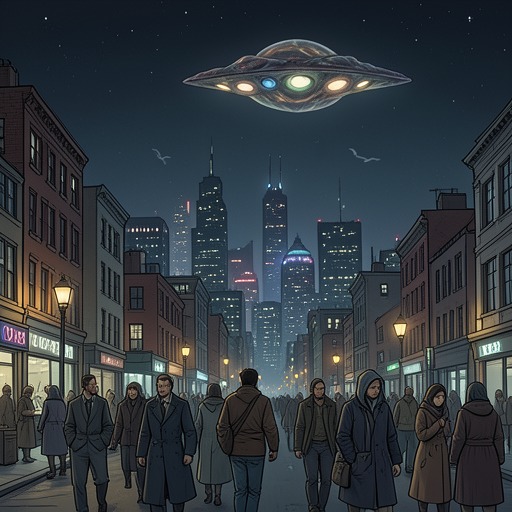
The Visitation’s thirtieth anniversary is marked publicly in Harmont, where a speaker asks Valentine Pilman to address his fellow townsmen about the Pilman Radiant. The anniversary turns a town’s local catastrophe into a subject of public explanation: Harmont is not merely near an extraordinary event, but one of the places on Earth directly changed by it. Pilman recalls initially thinking the account was a hoax. The possibility seemed too immense for a small hometown, and he had imagined locations such as the Gobi or Newfoundland as more plausible sites.
Pilman’s recollection also places Harmont within a pattern extending beyond its borders. He says that Harmont and the other four Visitation sites known at the time lay along a very smooth curve, an observation he reached by calculation. The town’s place in the world is thus both intimate and planetary: for its residents the Visitation happened at home, while for scientific observers Harmont became one point in a global configuration that could be studied and explained.
The town beside the Zone
The Zone is not an abstract region beyond the town. From a window, an observer can see it close enough to seem touchable, though the glass is thick and leaded. That barrier gives the view its force: the Zone presses against the visible edge of domestic space, present to sight but not safely available to ordinary touch. Harmont’s defining boundary is therefore not a distant frontier but a threshold embedded in the town’s daily geography.
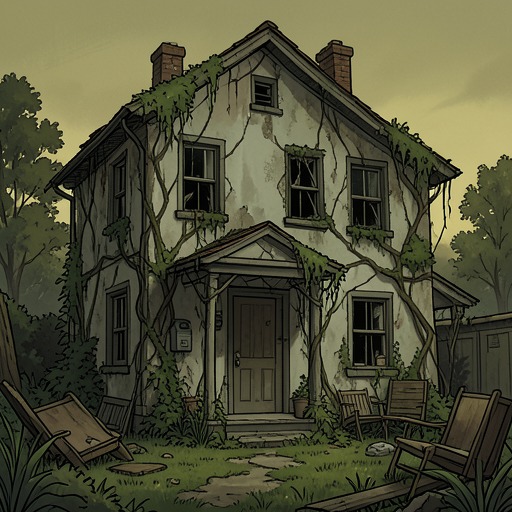
Beyond the windows lies an industrial landscape rendered uncanny by absence. The view includes cone-shaped mounds, blast furnaces shining in the sun, rail lines and a locomotive with flatcars. Yet the place is empty of people, neither living nor dead. A garage stands open like a long gray intestine, with trucks parked on the paved lot beside it. The familiar structures of production and transport remain in view, but human presence has vanished; the Zone’s strangeness is sharpened by the recognizable industrial setting it interrupts.
Work, access, and risk
Harmont’s institutions make the Zone an object of organized observation as well as a perilous space. Redrick Schuhart is introduced at age twenty-three as a bachelor and laboratory assistant at the Harmont branch of the International Institute for Extraterrestrial Cultures. His position connects the town’s inhabitants to formal research, but the work of entering the Zone is not rendered safe or detached. Before an expedition, workers put on special suits; Redrick pours nuts and bolts from a bag into his hip pocket and joins the trek across the institute yard to the Zone entrance.
The public display surrounding that departure sits uneasily beside the practical preparations. Redrick describes the routine as making sure everyone sees the scientific heroes setting out to risk their lives in the service of humanity and knowledge. The institute yard and entrance thus form a passage from the town’s institutional order into a space where ordinary protections and expectations no longer hold. Research, spectacle, and danger converge at the boundary.
Streets, concealment, and the Zone economy
The Zone’s influence also reaches Harmont through movement and concealment. In one episode, Redrick approaches his own garage from the side of a radio and electronics store and waits while workmen load television sets into a van. He settles in ragged lilac bushes nearby. The ordinary commercial activity and the makeshift hiding place occupy the same street-level world: Harmont’s spaces of trade and private property can also serve as cover for people moving under pressure.
That movement is part of a wider material traffic. Richard Noonan reports that, according to his information, the flow of materials from the Zone through Harmont has stopped during the last three months. The statement frames the town as a conduit between the Zone and the surrounding society; a change in that flow is consequential enough to be discussed as evidence of a larger retreat or disruption. Harmont’s importance is therefore not confined to its residents’ proximity to danger. Its roads and networks connect the forbidden landscape to a market beyond it.
A changing frontier
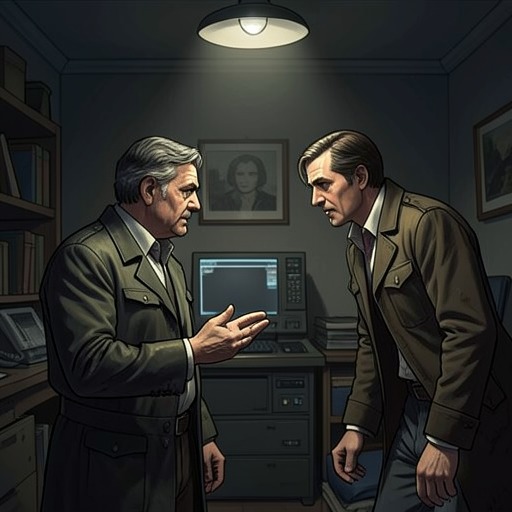
The town’s relationship to the Zone does not remain fixed. Noonan says that almost no professional stalkers are left in Harmont. Those who remain, he adds, no longer have a relationship to the Zone, while the young are lost and undergoing a process of being tamed. The account presents a declining human presence at the frontier, even as the town remains marked by the Zone and by the systems built around it.
The contrast between the early expeditions and this later report gives Harmont a history of changing access. At first, suited researchers cross the institute yard in a visible, ritualized procession; later, professional stalkers have nearly disappeared, and the flow of Zone materials is said to have ceased. The boundary remains physically close to windows, garages, streets, and work sites, but the human practices organized around crossing it are weakening. Harmont’s significance lies in this unresolved coexistence: the town is not simply outside the Zone, nor absorbed into it, but lives beside a frontier whose dangers, economic uses, and human reach continue to change.