Itcher
Roadside PicnicThe Itcher is a Zone device whose effects make it more than an inert piece of contraband: once activated, it can provoke a terrifying response in people and animals, turning Redrick Schuhart’s act of vengeance against Ernest into a disturbance that continues after he has fled. Its brief appearance links the Zone’s strange objects to the human costs of smuggling and to Redrick’s willingness to use the dangers he knows against someone he hates.
Nature and Known Use
The Itcher belongs to the class of sought-after Zone objects that Redrick describes as serious finds, unlike Batteries, Black sprays, and other baubles that do not interest the person he has been questioning. The conversation leaves that person’s particular desire unstated, but it establishes the Itcher as one item with a reputation distinct from ordinary, less consequential trinkets.
Redrick’s account provides a more immediate measure of the device’s power. He says Itchers give him nosebleeds, an effect that makes their operation dangerous even to an experienced stalker. He does not explain how the device works or what causes its effects; the evidence instead emphasizes what happens when it is switched on and the difficulty of remaining near it.
Redrick’s Retaliation Against Ernest
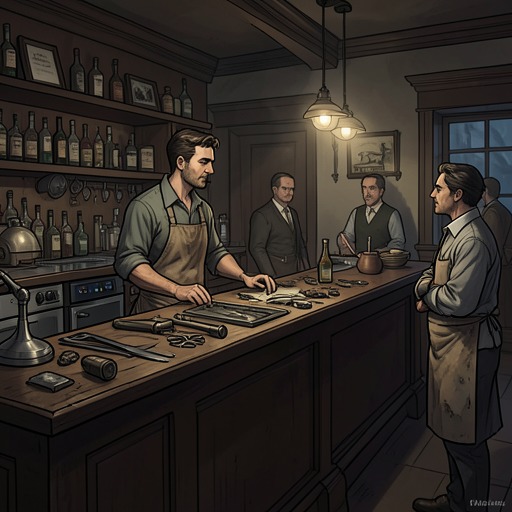
During his confrontation with Ernest, Redrick’s anger hardens into what he imagines as a punishment. He takes a brand-new, unused Itcher from his watch pocket, squeezes it a couple of times to get it working, opens the door into the bar, and quietly drops it into the spittoon. The smallness and secrecy of the gesture contrast with the scale of the disturbance he expects to unleash.
Redrick wants to stay and see what happens, but the danger to himself forces him to leave. He opens a window, climbs out into the street, and runs across the backyard. The device therefore dictates the shape of the action: Redrick can set the event in motion, but he cannot safely remain to witness its full course.
Effects and Aftermath
As Redrick runs, he hears the Itcher working at full blast. The dogs in the neighborhood begin howling and barking first; he believes they sense it before humans do. From farther away, he hears someone in the bar yelling so loudly that his ears clog. The disturbance reaches beyond the person who activated the device and into the surrounding neighborhood, while the animals’ earlier response gives the scene an unsettling measure of how broadly its effects register.
Redrick imagines the bar’s crowd breaking into different forms of distress: some people fall into deep depression, others freak out, and some panic with fear. His account makes the Itcher frightening not because its mechanism is explained, but because its effects are severe, varied, and difficult to control. He predicts that Ernest will wait a long time before his place fills again, turning the device’s immediate assault into an anticipated loss of business.
Narrative and Thematic Significance
The Itcher changes from a portable object in Redrick’s pocket into an active force that shapes where he can go, what he can witness, and what follows him out of the bar. Redrick sets it off deliberately, but the howling dogs, the cries inside, and his own need to escape make the resulting event larger than a simple act of personal control. Its material effects, rather than an account of its origin or construction, define its place in the episode.
The revenge also carries a cost and a limit. Redrick knows that Itchers give him nosebleeds and cannot stay to watch the havoc he has arranged; he runs while the device continues to act in his absence. He expects Ernest to recognize who was responsible, yet dismisses that consequence in the flush of hatred. The object thus joins Zone salvage to ordinary human conflict: a dangerous artifact becomes an instrument of retaliation, and its power is measured in the fear it spreads and the practical damage Redrick expects it to leave behind.