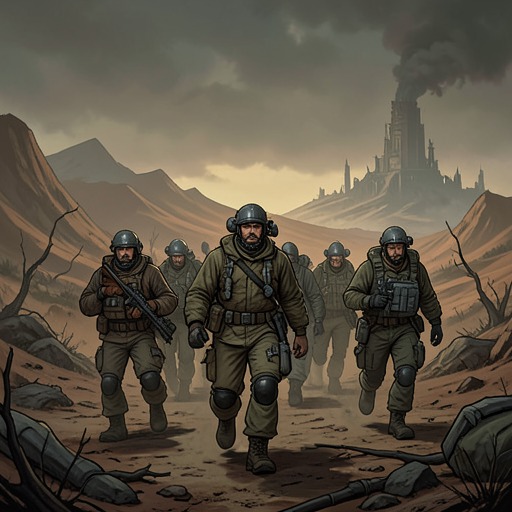
Kirill Panov
Roadside PicnicKirill Panov is a scientist whose attempt to understand the Zone’s Empty objects ends in a fatal expedition to the garage, but whose presence continues to shape Redrick Schuhart’s choices and memories. Through research notes, a posthumous report, and recollections that return at the novel’s most desperate moment, Kirill becomes both a lost friend and a lasting measure of the curiosity and hope that Redrick struggles to recover.
Identity and Scientific Work
Kirill spends almost a year intensely studying the Empty objects, trying to determine what can be learned from them. Redrick says he had been beside Kirill from the beginning, but admits that he never fully understood what Kirill hoped to discover and had not made much effort to find out. The contrast defines their different orientations: Kirill persists in asking questions of the Zone’s objects, while Redrick’s attention is more often drawn to the immediate risks and practical demands of their work.
Kirill’s research appears in the institute’s Reports, whose issues include articles on the Empty objects and photographs. Redrick later turns the pages over coffee from Guta and finds diagrams, markings, and photographs of familiar objects taken from strange angles. The work gives Kirill a presence in print after his death: careful observation has outlasted the observer, and the objects that once held his attention reach Redrick through the scientific record.
The Garage Expedition and Death
Kirill’s scientific interest leads toward the garage. In an official appeal to Laboratory Assistant Schuhart, he says that official sources have indicated an inspection there could be of great scientific value and proposes that they inspect it. The formal language gives the expedition institutional legitimacy, but it also shows how Kirill’s research carries him toward a dangerous place. The available account does not detail the full course of the expedition; its fatal outcome is made clear afterward.
Redrick learns of the death in a bar, where a companion raises a drink and tells him that Kirill Panov has died. Redrick is heavily intoxicated and at first cannot take in what he has been told. He responds as though the information concerns simply someone who has died, then drinks to the departed. The scene measures the distance between the news and its emotional arrival: Kirill’s death is stated plainly, while Redrick’s impaired reaction postpones its weight.
Posthumous Presence and Redrick’s Memory
Later, Redrick encounters Kirill again through a report titled “An Unexpected Property of the Magnetic Trap Type-77b.” Kirill’s surname is enclosed in black, and a small notice identifies him as Dr. Kirill A. Panov and records that he perished. The mourning frame and the technical title sit side by side: death has closed Kirill’s life, but the investigation continues to circulate as knowledge.
Kirill also returns in Redrick’s thoughts as an influence. When Redrick reflects on why he has come to seek the Golden Ball, he recognizes that Kirill has infected him with his own madness. The word marks the persistence of Kirill’s way of imagining possibility, even when Redrick cannot explain his purpose as a rational plan. What once appeared to Redrick as an incomprehensible fixation has become part of the desire driving him forward.
Memory at the Golden Ball
Near the Golden Ball, Redrick’s powers of thought falter. He struggles to remember, and the image of Monkey’s sullen, fur-covered face disrupts his effort to hold on to the past. Against that image, Kirill appears in memory as a “sainted man,” recalled through his quick, sure movements, his laughter, and a voice that promised marvelous places and times. Redrick’s recollection is sensory and particular: the lost friend is not reduced to a name or a death notice, but returns as motion, sound, and an expansive promise.
In the final crisis, Redrick searches his memory for words and thoughts he cannot find. He remembers that Kirill used to say something like the phrase he needs, and calls out to him inwardly. Kirill is absent, yet the remembered saying offers Redrick a possible way through his mental impasse. The novel thus brings Kirill’s influence to its sharpest point at the Golden Ball: his past speech becomes a resource in the present, even as Redrick’s fragmented recollection shows how difficult it is to retrieve.
Narrative Role and Significance
Kirill’s story is told chiefly through what remains: an official proposal, a report, the announcement of his death, and Redrick’s changing memories. These fragments make his absence structurally active. Early on, Redrick confesses that he never quite understood what Kirill was trying to learn; later, he recognizes that Kirill’s way of wanting has entered him. Scientific inquiry, personal friendship, and the desire for a better world converge in a character whose life ends before Redrick can fully understand him.
The contrast between Kirill’s published precision and Redrick’s disordered recollections gives his legacy two forms. The report preserves a specific technical investigation into Magnetic Trap Type-77b, while memory preserves a friend’s gestures, laughter, and promise. Neither form restores Kirill, but together they show why his death continues to matter: the work he leaves behind records what he studied, while Redrick’s struggle to remember reveals what that study and friendship made imaginable.