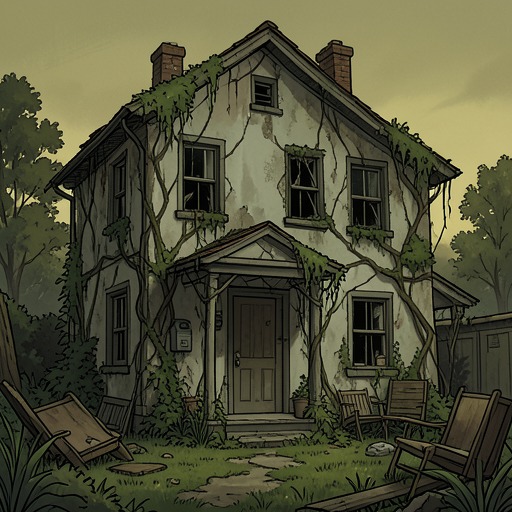
Plague Quarter
Roadside PicnicThe Plague Quarter is a residential district of Harmont whose name records a neighborhood-wide illness following the Visitation. Its houses look familiar, even merely in need of repair, but their blind-looking windows and abandoned streets preserve the catastrophe in the ordinary fabric of the town. The district stands beside the Zone, and its history links the strange territory not only to scientific investigation and dangerous expeditions but also to lasting damage among the people who lived nearby.
Setting and Appearance
During a journey through the Zone, the Plague Quarter lies to the left of the Institute, with the travelers moving along the middle of a street from pylon to pylon. The road has been unused for so long that its asphalt is cracked. The arrangement gives the district a double character: it remains part of a recognizable town, yet the route through it has become an abandoned passage into territory governed by different risks.
The houses are described as chipped and dead, but their windows are unbroken. Dirt makes the glass look blind. The buildings are not fantastical ruins; they are houses like any others, simply in need of repair. That resemblance makes the emptiness more pronounced. The narrator stresses that what distinguishes the neighborhood is not an extraordinary appearance but the absence of people. One brick house belonged to the group’s former mathematics teacher, known as The Comma, grounding the uncanny street in a specific, remembered social world.
Illness and the District’s Name
The name Plague Quarter comes from the illness that struck nearly everyone who had lived in the neighborhood. One resident was said to have run three miles without stopping in his underwear and then remained sick for a long time, losing his skin and nails. His case gives the account a concrete bodily scale: the effects were not limited to an abstract sense of danger or to the district’s deserted appearance.
Some residents died, mostly elderly people, though the narrator says there were not many deaths. He suspects that fright, rather than the plague itself, killed them. The explanation is presented as his belief, not as a settled medical account; the cause of the deaths remains uncertain even as the community remembers the illness as a shared event. The district’s name thus holds both an accepted history of sickness and an unresolved question about what that sickness did.
Wider Effects and Uncertain Causes
The effects were not confined to the Plague Quarter. People in three neighborhoods became blind, though not completely: they developed a kind of night blindness. The areas were subsequently distinguished as the First Blind Quarter, the Second Blind, and others. This naming turns bodily consequences into a map of Harmont, dividing the town according to the forms of harm its residents experienced.
The account also resists an easy explanation. People said the blindness had not been caused by an explosion, despite the apparent plausibility of such a cause. The contrast between a remembered event and the denial of a straightforward mechanism leaves the aftermath legible but not fully understood. The town can identify where particular injuries occurred and give those places names without being able to explain exactly why the injuries happened.
The Quarter Beside the Zone
The Plague Quarter’s position beside the Zone makes the district a point where daily geography and extraordinary danger meet. From the Institute, the Zone is visible just beyond thick, leaded window glass, seemingly close enough to touch; the industrial landscape beyond it appears deserted, with no living or dead people in view. The Quarter’s abandoned homes echo that absence while retaining the recognizable architecture of a neighborhood.
The district also belongs to the practical routes by which people approach or cross the Zone. A journey proceeds along its neglected street, while elsewhere the Zone’s entrance is reached by an established routine in which researchers put on special suits and cross the Institute yard. The landscape is therefore not simply a remote mystery: access is organized, and the boundary is traversed. Yet the Quarter’s history supplies a human measure of what proximity may mean. Its ruined appearance is modest; the more consequential ruin is carried by residents who became sick, lost bodily capacities, or died.
Narrative Significance
The Plague Quarter makes catastrophe visible through a contrast between ordinary housing and extraordinary aftermath. Its chipped buildings and dirty but unbroken windows suggest neglect without explaining it; the account then supplies what the streets themselves cannot show, a history of widespread sickness, bodily loss, deaths, and blindness in nearby neighborhoods. Place-names preserve the event as communal memory even where its causes remain uncertain.
The district also complicates the boundary between the Zone and the inhabited town. The Institute, the street, the Quarter, and the Zone form adjoining spaces rather than separate worlds. An expedition can pass by the Quarter on its way through dangerous territory, while the neighborhood’s history suggests that the consequences of the Visitation extend beyond the Zone’s visible edge. The place is significant not because it offers a complete explanation, but because its familiar streets bear the traces of harm that the town can name more clearly than it can account for.