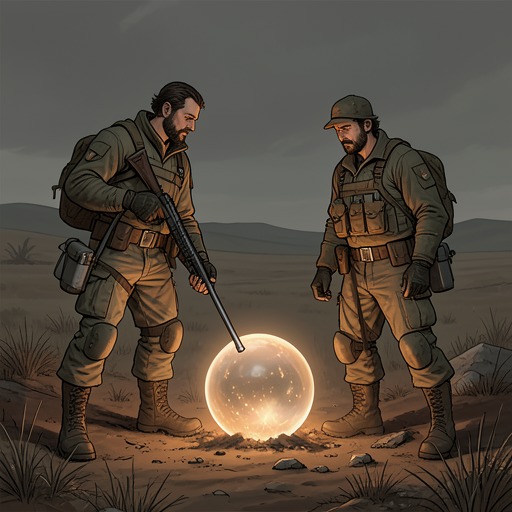
Redrick Schuhart
Roadside PicnicRedrick Schuhart’s life is measured by two stark portraits: at twenty-three, an unmarried laboratory assistant at the Harmont branch of the International Institute for Extraterrestrial Cultures; at twenty-eight, a married man without permanent work, concealed behind a gravestone as a patrol’s searchlights comb a cemetery. Between those snapshots, the Zone turns a young employee into a stalker and smuggler, and its hazards leave him carrying a porcelain container he fears could kill everyone. His final journey to the Golden Ball ends in a plea for universal happiness whose urgency is inseparable from his uncertainty about what he himself wants.
Identity and Background
At the beginning of the novel, Redrick is twenty-three and works as a laboratory assistant at the Harmont branch of the International Institute for Extraterrestrial Cultures. He is unmarried. The institutional title gives him a place on the edge of official study of the Visitors and their traces, but his first-person recollection places him in the repository after work, already thinking of leaving his laboratory suit and going to the Borscht for a drink. The transition from research room to bar introduces a recurring divide in his life: the Zone may be examined by institutions, but his own relation to it is shaped by risk, appetite, and direct experience.
Seven years later, the novel labels him twenty-eight, married, and without a permanent occupation. The biographical headings do not supply a continuous account of how he reached that condition; instead, they make the change legible through a sharp contrast. The laboratory assistant with an identifiable post has become a man whose livelihood and safety are precarious. In the cemetery scene he lies behind a gravestone, watching a road through an ash-tree branch while patrol-car searchlights sweep the grounds and periodically catch him in the eyes. The image establishes not simply a new jobless status but a life conducted under pursuit and concealment.
From the Repository to the Zone
Redrick’s first-person memory of the repository places him beside Kirill Panov on the night before the events he is recounting. He remembers that it was already evening and that, after taking off his lab suit, he could head to the Borscht. The casual plan makes the later course of his life feel close at hand: the official workplace and the drinking place sit on either side of a choice about how to spend the night, while the repository keeps him in contact with the material collected from the Zone. The memory’s ordinary details acquire weight in retrospect because they belong to the period before the full cost of his involvement has become visible.
The evidence of Redrick’s later life shows the consequences of that involvement without turning his trajectory into a simple ascent from novice to master. By twenty-eight he is married, has no permanent occupation, and is hunted by patrols. He can act with formidable nerve, but nerve does not free him from the physical and moral pressures of his work. Even when his immediate actions succeed, escape and survival leave him with further danger to manage rather than with security.
Flight and the Porcelain Container
During one desperate escape, Redrick waits for the right moment, grabs a ring, and hauls it up with all his strength. Before the opened trapdoor can fall back to the floor, he dives headfirst into the gray, cold prison of a wine cellar. The movement is abrupt and bodily: a calculated instant, a heavy pull, then a plunge into confinement. The cellar is refuge only in the limited sense that it puts a barrier between him and the danger above; its cold, imprisoning character keeps flight from looking like freedom.
A different kind of danger is concentrated in the porcelain container he carries. Redrick handles it as something at once invincible and inevitably fatal, and the nervous tic returns. He mutters accusations at himself, calling himself a snake and a scoundrel, and recognizes the scale of the possible consequence: the thing could kill them all. His twitching cheek does not ease when he holds it. The container therefore binds his professional and criminal expertise to an unbearable responsibility: the object is valuable enough to carry, but its contents make possession feel like complicity in a catastrophe.
Relationships, Memory, and Madness
The early repository recollection is explicitly shared with Kirill Panov. In the later passage, Redrick thinks that Kirill has infected him with his madness. He remembers an account of shepherds in the mountains to the northwest and understands that he has come to seek something there himself; a strange feeling, which he recognizes as not truly new, overwhelms him. The language makes influence intimate and unsettling. Kirill’s legacy is not merely a remembered conversation but a way of looking toward an impossible or irrational goal that Redrick now finds operating within himself.
The biographical heading identifies Redrick as married at twenty-eight, placing his life with Guta beyond the period of his initial laboratory work. Yet the scenes here emphasize how little ordinary stability that status guarantees. He remains subject to pursuit, dependent on dangerous work, and inwardly divided over the consequences of what he carries. Marriage marks a consequential change in his circumstances, not an escape from the Zone’s reach or from the choices his life there has produced.
The Golden Ball and the Final Appeal
At the end of the novel, Redrick is physically spent: panting in the heat, shuddering with a chill like a severe hangover, and feeling sweet chalk dust grit between his teeth. He has stopped trying to think. The bodily extremity matters because his final words do not issue from composure or considered argument; he repeats a litany as thought and speech break down under exhaustion. The earlier portrait of a laboratory assistant who planned to drink at the Borscht has darkened into a man whose body itself registers the accumulated strain of his passage through the Zone.
His appeal turns on the words he has heard and carried with him: happiness for everybody, free, with no one left unsatisfied. He insists that his soul belongs to no one and is human, then protests that what he wants cannot simply be bad. Yet he cannot name a more precise wish. The conflict is not between a fully articulated moral program and an opposing one, but between an immense demand for universal good and the failure of his exhausted mind to specify what that good requires. The phrase becomes both his last resource and the measure of his uncertainty.
Redrick’s ending gathers the contradictions established across his life. The man who entered the story with a scientific job and an ordinary plan for the evening reaches the Golden Ball without a stable occupation, pursued, physically broken, and unsure of his own desire. He still refuses to surrender the claim that his wish is human, but the repeated appeal cannot erase the danger surrounding him or guarantee that the power he seeks will answer as he intends. His journey’s decisive significance lies in that unresolved collision: a demand that everyone be made happy, voiced by a man who has reached the limit of his ability to think through what happiness means.