Redrick Schuhart’s alcoholism
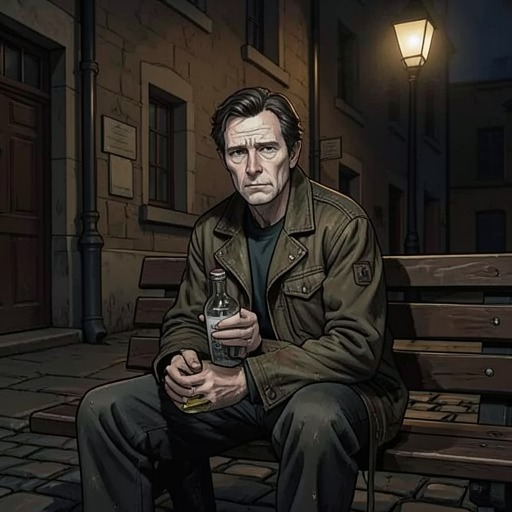
Roadside PicnicRedrick Schuhart’s alcoholism is a recurring response to pain that begins at home, in the wake of a night when Monkey screams in her bed, and follows him into the lethal expedition toward the Golden Ball. Cognac and brandy offer moments of dulling or fellowship, but they do not undo the fear and despair that make him reach for the flask; at the end, he throws one away and almost immediately forgets it.
The Night Drinking Begins
Redrick later remembers the beginning as a precise domestic scene, not as an abstract habit. He and Guta lie together listening to Monkey cry in her bed by the window. Guta takes Redrick’s hand, and he feels sweat break out on her shoulder against his. When Monkey stops crying and goes back to sleep, he waits a little longer, gets up, goes down to the kitchen, and greedily drinks half a bottle of cognac. The narration marks that night as when he started drinking.
The sequence ties the drink to helplessness and dread rather than celebration. Redrick does not describe an argument or a decision to become a drinker: after the child’s scream subsides, he leaves the shared bed for the kitchen and drinks alone. His memory makes the transition from listening to drinking immediate, while Guta’s presence in the scene underscores that the distress belongs to a family setting even as Redrick withdraws to face it by himself.
Drinking as a Response to Despair
Later, Redrick recalls going into the Zone while already in a prolonged spell of drinking. He says he was drunk then, had been drinking all week, and felt very low. His recollection moves quickly from that condition to resignation: he went, and now he is there. He asks himself why he is worrying and what he has to be afraid of. The questions do not establish that he has conquered fear; they show him trying to dismiss it while acknowledging how close it is.
The contrast between the bravado of his self-questioning and the stated low mood gives the drinking its bleak force. The week-long stretch is not presented as a cure for fear or as a source of confidence. It accompanies a decision to go into danger when Redrick feels at his lowest, and his attempt to wave away his worry sounds less like assurance than exhaustion with the need to keep worrying.
The Flask on the Expedition
During the final expedition, alcohol recurs as a material object passed between Redrick and Arthur Burbridge. After they have survived a passage through danger, Arthur says, “And me, too.” Redrick is surprised by the loudness of the boy’s voice. He takes a sip, shuts his eyes, and hands Arthur the flask. Inwardly, he registers that they have got through even this, before his thought turns to what remains to be reckoned with.
The exchange makes the flask more than a private instrument of escape. It is also something Redrick can hand across to Arthur after a shared ordeal, a small gesture of recognition between the two survivors. Yet Redrick’s closed eyes and weak relief keep the moment from becoming uncomplicated comfort. The drink accompanies a pause in the struggle, not a return to safety: the expedition continues to confront them with danger and loss.
Arthur’s response soon makes that limit plain. He speaks with meek disbelief about what they have encountered and asks how they are going to get back. Redrick does not listen. The question of return remains, but the immediate danger has overwhelmed Arthur, while Redrick’s attention has withdrawn from the boy’s words. The scene places drinking beside a stark difference in how the two endure what they have seen; it does not suggest that the flask resolves either the danger or the problem of getting home.
The Abandoned Flask
At the close, Redrick finishes the dregs of the brandy and hurls the empty flask at the ground with all his might. It bounces, flashes in the sun, and rolls away. He forgets it immediately, then sits covering his eyes. The force of the throw briefly gives the bottle the shape of an outlet for accumulated anger, but the next action is not release: Redrick turns inward, and the flask disappears from his attention.
This ending does not establish that Redrick has overcome his alcoholism. The bottle is empty, and he discards it, but the gesture brings no narrated resolution to the despair that has accompanied his drinking. From the half-bottle of cognac after Monkey’s scream to the shared flask on the expedition and the brandy thrown away at the end, alcohol recurs at thresholds of distress. Its function changes with the circumstances—from solitary retreat, to endurance, to a brief shared pause—but the pattern remains: drinking helps Redrick pass through a moment without removing what waits on the other side.