Redrick’s Wish at the Golden Ball
Roadside PicnicRedrick’s Wish at the Golden Ball is the culmination of Redrick Schuhart’s journey into the quarry: alone before the mysterious object, exhausted and unable to think clearly, he must discover what he truly wants. He begins with anger at the suffering he has endured and the wish to make others suffer in return. He ends by calling for happiness for everyone, free and without anyone left unsatisfied. The movement from revenge to universal compassion is neither easy nor triumphant; it emerges through confusion, physical collapse, and the recognition that he has no adequate words of his own.
The Open Road and the Unresolved Choice
Time passes before Redrick can gather thoughts coherent enough to confront the choice before him. The road is open, and he could go down from the quarry immediately, but he decides to wait. The pause leaves the scene suspended between escape and approach: reaching the Golden Ball has not yet produced a wish, and leaving would mean abandoning the question at its most urgent.
The delay is also a test of the methods that have served Redrick elsewhere. Bluffing, finding loopholes, and deceiving other people have no place here. The ordinary skills of a man accustomed to evasion cannot substitute for an answer to what he should ask of the Ball. The problem is not how to get something past another person; it is how to distinguish a just desire from the accumulated impulses of a damaged life.
Revenge, Family, and the Search for Words
Redrick’s first formulation is a wish for retaliation. He thinks of Monkey and of himself as her father, and wants those responsible to pay—to have their souls stolen and to suffer as he has suffered. But even as he recognizes the appeal of that impulse, he questions it. Revenge seems to be the answer, yet he cannot say what it would mean or whether it is truly what he wants.
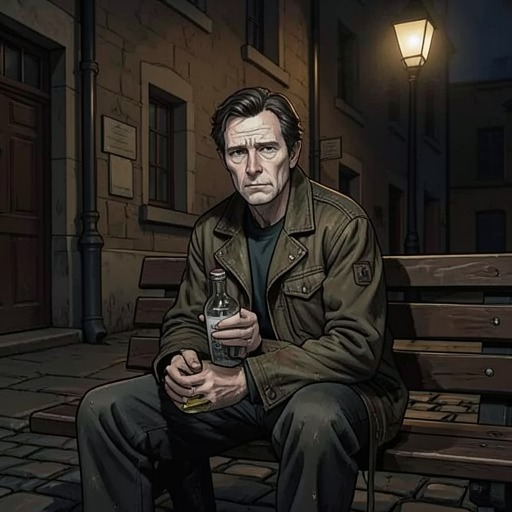
His uncertainty becomes physical and urgent. Redrick slaps his head and feels that he has never had a thought in his life. He searches his memory for Kirill Panov, who used to say something relevant, as if the words he needs might survive in the remembered voice of his dead friend. The recollection does not instantly resolve his dilemma. Instead, it exposes the distance between having language and being able to make it express a genuine wish.
The Ball, the Quarry, and the Body
The scene’s moral struggle unfolds through concrete exertion. Redrick throws his flask to the ground with all his might; it bounces, flashes in the sun, and rolls away. He forgets it almost at once. Sitting with his hands over his eyes, he tries not to reason out an answer but simply to see how things ought to be. What comes to him is a flood of faces, together with greenbacks, bottles, and bundles of loot: people and the material signs of the life he has led crowd the space where an abstract solution should be.
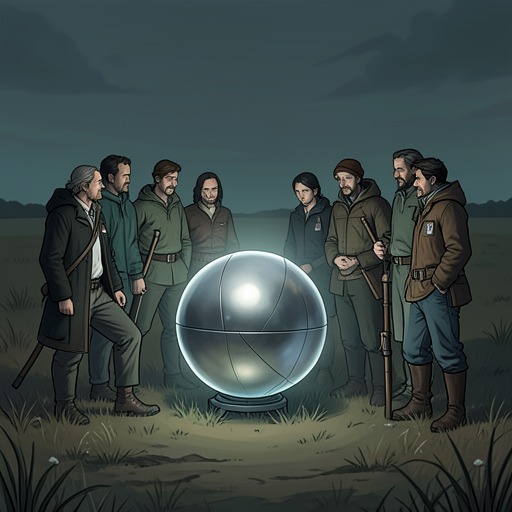
When he gets up, he brushes off his pants automatically and starts down into the quarry. The sun is broiling, red spots float before his eyes, and the terrain makes each step precarious. He lifts his feet high to avoid the splotches, sinks into rubble, and drags himself toward the dancing, winking Ball. Sweat, panting, a chill like a bad hangover, and chalk dust between his teeth make the approach an ordeal of the body as much as of the mind. He has stopped trying to reason. The wish must be found while he is exhausted, frightened, and nearly without language.
The Wish and Its Meaning
Before the Ball, Redrick repeats a litany in which he calls himself an animal and says he was never taught how to think. Yet he insists that his soul is his own and that it remains human; he has never sold it. His plea asks the Ball to look into his heart and determine what he wants, because he cannot trust himself to name it. The appeal places the burden of judgment on an all-powerful, all-knowing listener, while Redrick clings to the conviction that his deepest desire cannot be evil.
The words that finally surface are the remembered wish for happiness for everybody: free, with no one left unsatisfied. That ending reverses the revenge impulse without pretending it was never real. Redrick does not reach a polished theory of justice; he arrives at an expansive demand whose scale exceeds his ability to explain it. The scene’s decisive change is from wanting the guilty to suffer to asking that no one be excluded from happiness. The wish gathers the faces before his eyes into a single moral horizon, but the novel leaves the outcome of his appeal unresolved: what is certain is the demand he makes, not what the Ball will do.