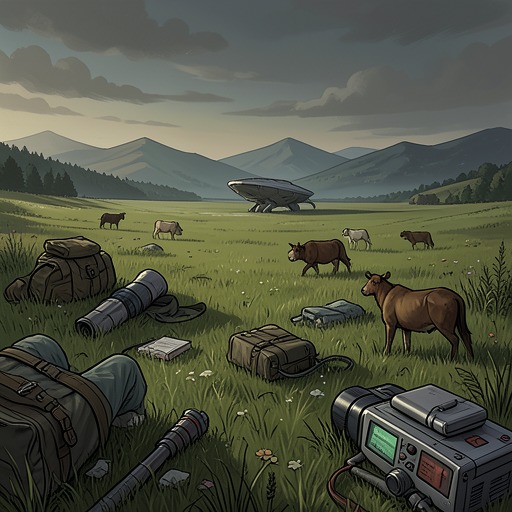
Roadside picnic
Roadside PicnicRoadside picnic names the novel’s defining analogy for the Visitation: extraterrestrials may have stopped briefly on Earth, leaving behind objects as casually as people leave litter after a picnic. The image makes the Zones legible without making their visitors comprehensible. Human beings can collect, study, regulate, and trade what was left behind, yet still confront a technology whose purposes exceed their understanding.
The Analogy and the Visitation
The analogy begins with an ordinary human scene scaled up to cosmic proportions. A group stops beside a road, spends some time in a meadow, and departs; the place they leave behind contains the residue of their visit. Applied to Earth, the comparison proposes that the extraterrestrials did not necessarily come to communicate with humanity or conduct an encounter designed around human interests. The planet may simply have been a stopping place, and the visitors’ traces may be incidental to whatever they were doing.
That proposed indifference is the analogy’s unsettling force. What looks to people like a visitation of enormous historical importance may have been no more purposeful, from the visitors’ perspective, than a picnic stop. The explanation does not solve the mystery of extraterrestrial intention; instead, it offers a way to understand why human beings might find themselves among effects without access to their cause. The remains testify that someone passed through, but they do not explain who the visitors were, what they wanted, or whether they will return.
From Litter to Zone Artifacts
The comparison turns on the contrast between the apparent triviality of discarded things and their extraordinary consequences for those who find them. In the picnic image, bottles, food baskets, transistor radios, cameras, cans, a handkerchief, a penknife, torn newspapers, and coins are ordinary remnants of human activity. The corresponding objects left in the Zones, however, are products of an utterly alien technology. Their strangeness is not merely a matter of appearance: their operation and potential resist familiar earthly logic and the reach of analytical science.
Calling such traces litter is therefore not a claim that they are worthless. It marks the difference between the visitors’ presumed scale of attention and the human meaning imposed on what remains. A discarded object can become, for its finder, a scientific problem, a source of wealth, or a danger; its casual origin does not limit its effects. The analogy lets the same artifact occupy two incompatible registers at once: a negligible remnant of the visitors’ activity and an object of immense consequence to people living with the Zones.
The novel’s account of so-so batteries makes the knowledge gap concrete. People have learned how to use them and under what circumstances they multiply through a process similar to cell division, yet practical success has not yielded a full explanation of the mechanism. The example echoes the picnic analogy’s larger distinction: finding and using an object is not the same as understanding its relation to the system that produced it. Human knowledge advances through observation and application, but an artifact’s usefulness does not guarantee that its principles have become intelligible.
No Promise of Return
When Redrick Schuhart explains the image to Richard Noonan, he asks Noonan to imagine a picnic: a car leaves the country road for a meadow; young people get out with food, bottles, radios, and cameras; then they leave their campfire remains behind. Noonan recognizes the comparison as a roadside picnic, and Redrick extends it to a picnic somewhere on a road in the cosmos. His final question is whether the visitors will come back. The analogy supplies no reassuring answer. If the stop was incidental, humanity cannot assume the visitors noticed Earth in the way people notice a destination they mean to revisit.
Noonan’s reaction emphasizes the distance between this plain account and the expectations he had brought to the subject. He shudders, asks Redrick to repeat himself, and dismisses the explanation as pseudoscience, saying he had imagined it differently. The exchange makes the analogy more than a compact explanation: it stages a clash between a desire for a purposeful, intelligible encounter and an account in which human significance may be beside the point. Redrick offers an image rather than a theory capable of proving what the visitors intended, and its simplicity unsettles precisely because it refuses to promise a return.
Institutions, Smuggling, and Partial Knowledge
The image also illuminates the human systems that grow around the Zones. Valentine Pilman describes his work with the UN Commission on Problems of the Visitation as representing the international scientific community in questions about implementing decisions on internationalizing the Zones. In broad terms, the commission helps ensure that extraterrestrial marvels found there reach the International Institute. The effort to organize, study, and control the finds is a human response to an encounter whose original purposes remain unavailable.
Those formal arrangements do not close the gap between discovery and understanding. Pilman says that materials leak from the Visitation Zones into the hands of irresponsible people and organizations, and that his colleagues deal with the results of those leaks. In another scene, Captain Quarterblad searches a briefcase and removes illicit Zone goods, among them two small empties, nine batteries, and black sprays. Objects framed as incidental remnants in the cosmic picnic analogy thus enter systems of institutional custody, policing, and illicit circulation. Their social lives are consequential even when their extraterrestrial origins are opaque.
The resulting contrast is not simply between authorized science and criminal misuse. Both depend on people trying to handle things whose full workings they do not command. The International Institute may receive the artifacts, and someone may learn to operate a so-so battery, while fundamental questions about the visitors’ technology remain unresolved. Meanwhile, leakage makes the artifacts active in the world beyond research: they move through networks of people and organizations, carrying risks and value into human hands. The roadside-picnic image holds these responses together without pretending that any of them restores the lost context of the objects.
Meaning and Limits
As an explanatory figure, Roadside picnic changes the scale of the story. It invites readers to imagine that humanity may be peripheral to the event it experiences as a defining encounter. The visitors’ traces matter because human beings encounter them, not necessarily because the visitors left them for human use. That reversal makes the Zones a setting where the desire to interpret is continually checked by evidence of an intelligence and technology that do not conform to human expectations.
The analogy remains a hypothesis and a comparison, not a demonstrated account of the visitors’ motives. It does not establish that the visitors regarded Earth as unimportant, identify what they were doing, or settle whether they might return. Its strength lies in making those limits visible. The abandoned things are enough to transform human life and provoke institutions, investigations, and black-market dealings; they are not enough to turn contact into mutual understanding. The roadside picnic therefore names both a possible explanation of the Visitation and the human predicament it leaves behind: people inherit the remains, but not the visitors’ account of what those remains mean.