Zone(Harmont)
Roadside PicnicThe Harmont Zone is the local Visitation Zone around which the town’s scientific institutions, international oversight, black-market traffic, and dangerous work of salvage have formed. Its decisive significance lies in the collision between physical proximity and radical uncertainty: the Zone can be seen from a window or entered by crossing a pavement, yet neither its objects nor its hazards are reliably understood. It is a place under observation and regulation, but not one that human knowledge or authority has mastered.
Definition and Setting
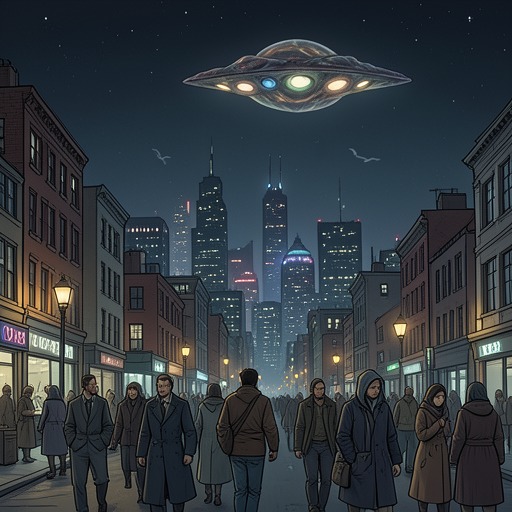
The Harmont Zone belongs to a global pattern. The six Visitation Zones lie on Earth’s surface as if they were bullet holes made by shots fired from somewhere along the Earth-Deneb line; the point in the sky from which they appear to have come is named the Pilman Radiant. The Zone is therefore both a particular territory beside Harmont and one instance of a planetary phenomenon whose origin is described through an arresting, still-unexplained image.
From a high window, the boundary appears deceptively close: beyond thick, leaded glass, the Zone seems so small it could fit in the palm. The view does not make it comprehensible. The narrator looks from the map to the actual landscape and finds the Zone immediately present, almost touchable, but still separated by a barrier. That contrast—near enough to see, yet set apart—is built into the way Harmont lives beside it.
One view of the interior resembles an industrial town emptied of its inhabitants. There are cone-shaped mounds, blast furnaces shining in the sun, and rails running past a locomotive with flatcars; a long, gray garage stands open, with trucks parked outside. The scene supplies familiar industrial forms while removing the people who ordinarily give them purpose. The Zone’s landscape can be read as recognizable infrastructure, but its apparent familiarity does not make it safe or explain what has happened there.
Access, Work, and Risk
The boundary is crossed as part of organized expeditions, not casual exploration. Before entering, a team puts on special suits, and the narrator carries a bag of nuts and bolts in a hip pocket as they walk across the institute yard toward the entrance. The procedure is public enough to be seen as a display of scientific heroism, yet the equipment and preparations also mark the crossing as a practical response to danger. The Zone is adjacent to the institution, but entry remains a hazardous threshold.
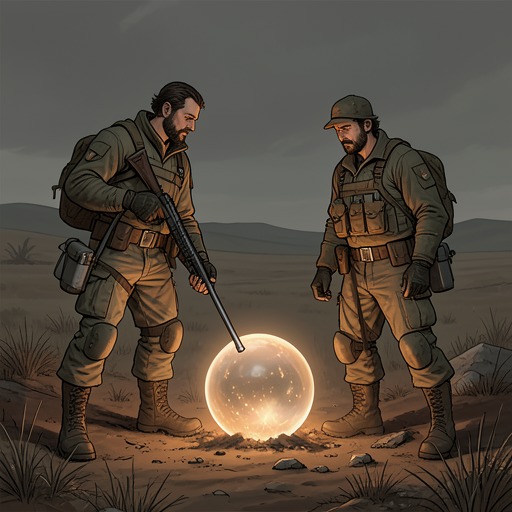
A boot serves as a tool for testing the ground ahead. In one approach, it inches across the last stretch of human earth; as its shadow falls over the bramble and the threshold is crossed, the narrator feels a chill. The sensation recurs on entry, and the narrator cannot tell whether it is a greeting from the Zone or a stalker’s nerves. This uncertainty turns the crossing into more than a change of location: even a bodily response cannot be confidently assigned either to an external force or to fear.
The Zone’s dangers demand improvised techniques rather than secure rules. A stalker directs a companion to move the boot slowly toward a nut and stop two feet away, then throws another nut and insists that its movement be watched. The companion asks whether the aim is to find graviconcentrates; the stalker answers that the search is for whatever ought to be sought. The exchange shows how exploration depends on careful observation while remaining unable to guarantee that observers know what they are looking for. A name or hypothesis may guide attention, but it does not amount to mastery.
Institutions and Competing Uses
The Zone is subject to international arrangements as well as local practice. A Canadian consultant to the UN Commission on Problems of the Visitation explains that his commission work concerns the internationalization of the Zones: its members represent the international scientific community when UN decisions are implemented and help ensure that extraterrestrial marvels found there reach the International Institute. He distinguishes this administrative role from the study of extraterrestrial cultures. The distinction makes the Zone a governed resource, but also shows that responsibility is divided among institutions rather than held by a single authority.
That official framework does not stop material from leaving the Zones. The commission’s representative describes a steady leak of materials into the hands of irresponsible persons and organizations, adding that his colleagues deal with the consequences of those leaks. In Harmont, the local word for stalkers refers to thieves who risk their lives entering the Zone to take whatever they can lay hands on; the work has become a profession. Scientific custody and illicit salvage thus arise from the same landscape, but approach its objects through different systems of access, value, and risk.
The gap between discovery and understanding remains visible even after an artifact has been taken into human use. Researchers have learned how to use the long-lasting batteries called so-so's and have observed circumstances in which they multiply through a process resembling cell division, yet they still cannot make one. Familiarity with operation has not yielded an explanation of the object’s relation to the world around it. The Zone’s materials can be classified, studied, and circulated without becoming fully intelligible.
The Zone in the Town’s Life
The Zone is not an isolated wilderness beyond the scope of ordinary life. Its proximity organizes the work of the institute, the authority of international oversight, and the profession of those who enter illegally. A vehicle fitted with three searchlights continues scanning a cemetery’s rundown graves and rusty, lopsided crosses for two hours while its motor throbs steadily. The search places the Zone’s uncanny geography in relation to a familiar urban margin, where surveillance and waiting become part of the landscape.
Its boundary also shapes movement through Harmont. After evading Captain Quarterblad, Redrick approaches his own garage from the side of a radio and electronics store and waits among ragged lilac bushes while workmen load a van with television sets. Ordinary shops, work crews, and domestic routes exist alongside the Zone’s illicit economy and its pursuit by the authorities. The town is not simply divided into a safe interior and a dangerous exterior: people, goods, and police action move through spaces that connect them.
Narrative Significance
The Zone’s most persistent effect is to make proximity look like knowledge. From behind a window it seems miniature; at its edge a boot can cross the last human ground; inside, ordinary tools and industrial forms coexist with hazards that must be tested one movement at a time. Each perspective offers a different scale, but none resolves the mystery. The territory is visible, mapped, and repeatedly entered, while its governing principles remain obscure.
That unresolved condition drives both institutional and personal action. International bodies seek to control the circulation of finds, scientists try to study them, and stalkers risk their lives to retrieve them; yet even the researchers’ practical understanding of an artifact may stop short of knowing how it works. The Harmont Zone therefore functions not merely as a storehouse of strange objects, but as a pressure point where human systems of naming, expertise, law, and livelihood encounter what they cannot fully contain.