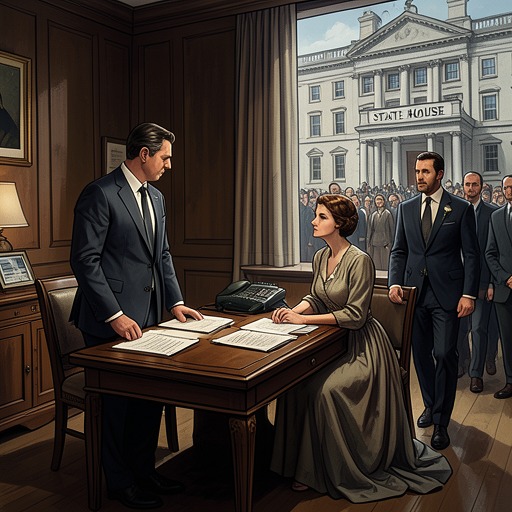
Rachel Weinberg
Robert B. Parker's WonderlandRachel Weinberg is Rick Weinberg’s wife of forty years and, ultimately, the person revealed to have arranged his murder. Her introduction at a restaurant presents her as part of Rick’s polished business world; after his death, the investigation sees her perform grief in public and then uncovers her role in drawing him out alone. The contrast makes her both a bereaved spouse in the visible aftermath and a concealed agent in the crime.
Identity and Introduction
Rachel first appears at dinner with Rick and Spenser at the Capital Grille. She remains seated to shake Spenser’s hand, while Rick greets Susan Silverman with a broad smile and a kiss on the hand. The small difference in their manners helps establish the scene’s carefully social atmosphere: drinks are ordered, menus studied, and Rick treats the gathering as a reunion among old friends. Rachel is introduced as his wife, present within his public life, though the conversation soon turns to Rick’s explanation that the attack by hired men was not his idea and would not happen again.
The marriage’s duration becomes explicit after Rick’s death. Rachel says she and Rick had been together for forty years, a fact that gives her repeated expressions of shock a concrete history. Her grief is not presented only as a general response to loss: she recalls the scale of the shared life, while the investigation gradually asks whether that long intimacy also gave her the means to bring Rick into danger.
The Widow in the Hotel
In the early morning at the Four Seasons Hotel Boston, Rachel sits with Lewis Blanchard, Commander Healy, and a state police officer as they discuss Rick’s disappearance from his room. She asks whether anyone saw him leave. Blanchard, red-eyed and visibly aged by the night, has no witness to offer; Commander Healy says the hotel’s surveillance footage is being collected. The scene is restrained and procedural, but Rachel’s question focuses attention on the gap at the center of the case: Rick left, and the people responsible for watching him cannot account for how.
Rachel’s appearance and behavior give the aftermath a sharper, less settled texture. She wears a pink Chanel tracksuit and large black sunglasses; her bleached hair is knotted into a bun, and her hands rest on the gold handle of an oversized black bag. The glasses obscure whether she is still crying. She looks paler than she did at the earlier meeting, yet drinks a large glass of fifty-year-old Macallan as if it were water. Her phone, she says, is buzzing with investors asking where the company stands and whether Rick may have acted on his own before being killed. Grief and corporate pressure occupy the same conversation; neither displaces the other.
Blanchard supplies a specific account of the last time he saw Rick: at ten, Rick ordered vanilla ice cream through room service; Blanchard checked that everything was all right, received little response, said good night, and went to sleep in the adjoining room. He adds that Rick did not take chances and that Blanchard was expected to accompany him even for a trip to the lobby for gum. That account makes Rick’s unaccompanied departure especially difficult to explain. Rachel’s questions and statements sit beside the failure of the usual safeguards, without yet revealing why they failed.
Grief, Marriage, and Company Succession
Later, in Rick’s hotel suite, Rachel and Blanchard sit opposite each other amid flowers, sympathy cards, and a fruit basket set on the baby grand piano. Rachel smokes despite the hotel rules, while Blanchard sits forward with his hands laced and his gaze on the floor. When Spenser asks about Rick’s departure, she says the police told her no one had called the room. The setting is a furnished, private suite, but the investigation has entered it: a uniformed officer remains in the bedroom, and the room’s objects of condolence share space with police scrutiny.
Rachel again returns to the length of the marriage, saying they had been married forty years. On another occasion she says she cannot stand what has happened, then rises shakily and has to be helped toward the bedroom by Blanchard. Spenser compares her to an old boxer, battered but still upright. The image registers her physical wavering without making it proof of innocence or guilt; at this point, the visible evidence is a woman in acute distress, and the truth behind Rick’s death remains unresolved.
The company’s succession arrangements add a separate dimension to the investigation. Rachel had voted with the board on Jemma Fraser’s promotion, and the board had insisted on a clear line of succession at Weinberg Entertainment. The fact that Rachel participated in that vote places her inside the company’s formal decision-making, even as investors press for answers after Rick’s death. It does not by itself establish why she acted as she did, but it makes clear that the murder investigation unfolds alongside questions of corporate control.
Exposure and Narrative Role
The decisive change comes when Spenser tells Blanchard that Rick got past him that night because Rick had been told to come alone. Spenser identifies Rachel as the person who drew Rick out and says she paid to have him killed. Blanchard responds with disbelief. This revelation recasts the earlier hotel scenes: Rachel had asked who saw Rick leave, discussed the missing surveillance record, and spoken of investors and the company’s position while the central fact—her own role in arranging his death—remained hidden from those questioning her.
Very early one morning, Spenser and Commander Healy watch Brian Lundquist interview Rachel at 1010 Commonwealth Avenue. The interview has already lasted more than two hours and is ugly to watch; Rachel begins indignant, and her manner turns to rage. The change marks the last supplied glimpse of her in the investigation, not a reported confession or a stated legal outcome. The account confirms her role in the murder plot and shows the interview’s emotional escalation, but does not establish a conviction or describe what follows.
Rachel’s narrative importance lies in the distance between the roles she occupies. She is Rick’s long-time wife, a participant in the board’s succession decision, the visibly shaken woman among the flowers and condolence cards, and the person Spenser identifies as having arranged the fatal meeting. The book lets those identities accumulate before the revelation joins them. Her grief remains part of the scene, but it can no longer be read as the whole explanation of her conduct.