Rick Weinberg
Robert B. Parker's WonderlandRick Weinberg is a casino entrepreneur whose drive to secure land for a proposed Massachusetts casino makes him both a powerful dealmaker and the victim at the center of a murder investigation. His acquisition of an elusive property in Revere is followed in less than twenty-four hours by his killing; the inquiry into that sequence exposes political-payment networks and, eventually, the role of his wife, Rachel Weinberg, in arranging his death.
Identity and Background
Wayne Cosgrove identifies Weinberg’s outfit as the front-runner among prospective casino developers. He describes Weinberg as having a stake in Las Vegas and explains that Weinberg’s father had been a Philadelphia bookie who ran bingo parlors. The family history places Weinberg’s business ambitions in a gambling world that spans older, informal operations and the newer push to establish casinos through legislation and licensing.
Weinberg had worked for years to bring casinos to Massachusetts. Casino companies spent heavily to influence legislation, Wayne explains, in the hope of winning a license if the law passed; securing land in Revere would give a prospective applicant an important advantage. Weinberg’s efforts therefore joined two kinds of leverage: political access and control of a scarce, strategically valuable site. The property was not simply another development holding but a crucial piece of his casino plan.
Business Ambition and Public Conduct
Weinberg’s pursuit of the property brings him into contact with Spenser, first as an adversary in a dispute involving intimidation and hired men, and later as a negotiating counterpart. At a dinner at the Capital Grille, Weinberg introduces Rachel as his wife and meets Susan Silverman. His manner is socially assured: he smiles, kisses Susan’s hand, and waits through the ordering of drinks before turning to the earlier violence. He tells Spenser that the intimidation was not his idea, attributes it to someone working for him who had gone too far, and says it will not happen again. The exchange does not erase the violence surrounding the property, but it shows Weinberg attempting to separate his business objective from the conduct of the people acting in its service.
That distinction becomes harder to maintain as the casino project comes under scrutiny. Weinberg’s land acquisition succeeds, securing a valuable site for his proposed development, but the achievement lasts less than a day before he is killed. The timing makes the deal itself an immediate line of inquiry: investigators know the property has changed hands, but initially do not know who killed Weinberg or why. They suspect a connection to organized crime in Boston or Las Vegas, leaving open whether the murder arose from the casino contest, its political arrangements, or another conflict.
Political Money and the Casino Network
The investigation into Weinberg’s political donations reveals several layers of financial influence, but the evidence does not make every payment equally clear. His official contributions include money given in smaller amounts to senators, congressmen, and local officials in Revere. Wayne then traces nearly half a million dollars from Envolve Development, described as Weinberg’s front, to a super-PAC run by the brother of Joseph G. Perotti. Because super-PAC donors must be publicly disclosed, the connection offers investigators a route from a corporate intermediary toward a politically influential figure.
Further records appear more damaging. Wayne says that the documents show payments going directly to Perotti, some legal and most not, while cautioning that the investigators do not yet know whether the material is genuine. He also points out that two companies making the payments belong to Gino Fish. These details connect Weinberg’s casino project to a wider network of developers, political influence, and organized-crime interests, but they do not, by themselves, establish that Weinberg personally directed every payment or that every allegation in the records is proven. The distinction between a disclosed donation, a suspicious financial route, and an alleged payoff matters: the trail sharpens the investigation without immediately resolving it.
Murder and Investigation
Weinberg’s death is revealed in pieces. Investigators initially have only his head. The rest of his body is later found floating near the Tea Party Museum, where schoolchildren see it. The discovery makes the killing public and grotesque, while the separate recovery of his remains underscores how deliberately the crime has disrupted the ordinary work of identifying what happened and reconstructing the victim’s final movements.
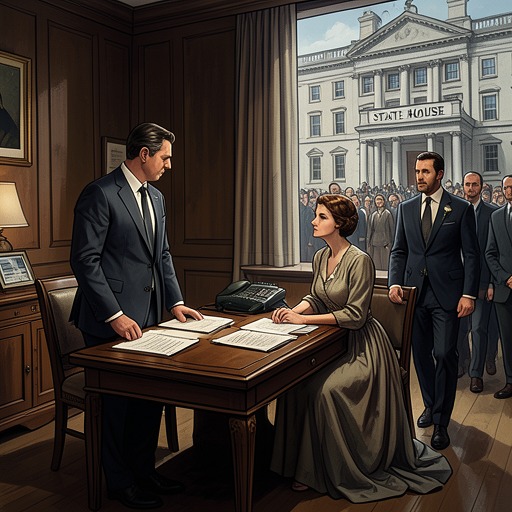
Rachel’s reaction gives the homicide a personal dimension. At the Four Seasons Hotel Boston, she sits with Lewis Blanchard, police, and a state trooper as dawn spreads across the Public Garden; while the officers drink coffee, Rachel and Blanchard drink whiskey. Later, speaking with Spenser, she says that she and Rick had been married for forty years and expresses shock. She also reports that the police found no call to their room, a detail relevant to the question of why Rick left in the middle of the night. Her words initially present a long marriage interrupted by a sudden and unexplained departure, rather than a clear explanation for his death.
The investigation ultimately overturns that appearance. Spenser tells Blanchard that Rick was instructed to come alone and that Rachel was the one who drew him out; he says she paid to have Rick killed. Blanchard responds with shock. The revelation reframes the apparent vulnerability of Weinberg’s final journey: the danger did not come only from the casino rivalry or the criminal networks surrounding it. The person who directed him toward the fatal meeting was his wife.
Narrative Role and Significance
Weinberg is characterized less through private reflection than through the expanding consequences of his deals. His ambition first appears as a concrete contest for land; the murder then makes that achievement a possible motive, and the financial records widen the story into questions of licensing, political access, and concealed payments. His success in securing the property is both the culmination of years of casino development work and the point immediately preceding his death.
The investigation also complicates the distinction Weinberg tries to draw between himself and the men working for him. His assurance to Spenser that the intimidation was someone else’s excess sits beside a business environment in which property, political influence, and criminal associations overlap. Yet the narrative preserves uncertainty about the financial evidence instead of treating every lead as proof. The eventual disclosure of Rachel’s role supplies a different and more intimate answer to the murder: the man who had navigated public power and violent business conflict was betrayed by the person closest to him.