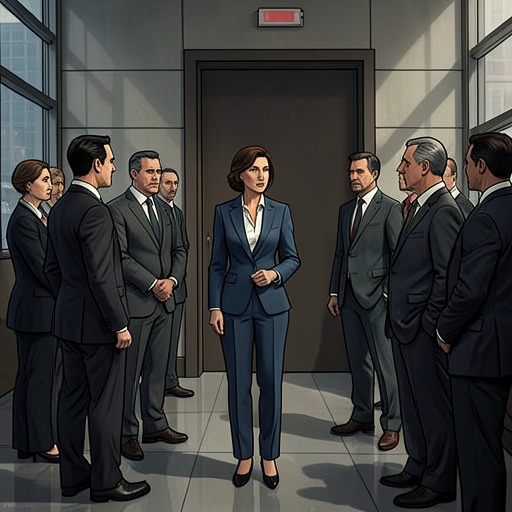
Legal restaurant at Copley Place
Robert B. Parker's WonderlandThe Legal restaurant at Copley Place is a late-night public setting where danger and investigation meet: Jemma Fraser turns to it for safety after recognizing the men who came for Rick Weinberg, while conversations there help bring the political financing behind the casino-license contest into sharper focus.
Setting and Use
When Jemma calls in fear, Spenser directs her to the bar at Legal, reasoning that it will stay open late and that nobody will make a move there. He then crosses Copley Place alone, passing familiar clothing stores before reaching the restaurant. Legal is open, with a scattering of patrons, most gathered at the bar. Jemma is seated at the far-left corner near the kitchen, a position that leaves her in a public room but apart from its main crowd.
The place’s ordinary restaurant bustle provides a contrast to the threat following her. A gray-haired man in a black suit leans over Jemma with a sharp leer and talks about biking, kayaking, and outdoor training as Spenser approaches. A bartender sets a martini in front of her. The scene makes the bar a practical refuge, not an impregnable one: Jemma is frightened, and the stranger’s attention gives Spenser immediate cause to assess the people around her.
Jemma Fraser’s Account
At Legal, Jemma identifies the men waiting for her as the same men who came for Rick. She tells Spenser that Rick had visited her room earlier, drunk, shortly after dinner—perhaps around nine o’clock—but she does not know when he left the hotel or where he went. The conversation links her immediate danger to the unresolved circumstances around Rick’s death, while its setting lets Spenser question her in a public place rather than leave her alone with the threat.
The exchange also gives the restaurant a role in the investigation’s human stakes. Jemma asks Spenser to hurry, and he has already considered the help he lacks: Hawk is out of town, Zebulon Sixkill is not at full strength, and Vinnie Morris is not on his side. Legal becomes the place where he acts on his own assessment that keeping Jemma among other patrons is safer than letting her remain exposed elsewhere.
Casino Politics at the Table
Legal is also associated with Spenser’s discussions with Wayne Cosgrove about the money and influence surrounding casino licenses. In one exchange, Spenser asks how a company secures a license. The conversation places land acquisition and political lobbying in the same frame: casino companies spend heavily to promote legislation and hope to win a license if the law passes, while securing land in Revere would be a major step. The question remains part of a larger investigation into how commercial access to a scarce license is pursued.
In a later meeting over food and drinks, Wayne describes a contrast between the expected campaign contributions and less transparent channels. Rick Weinberg’s official contributions included payments of a few thousand dollars to politicians and local figures. Wayne then reports that, through Envolve Development, Weinberg appears to have given nearly half a million dollars to a super-PAC run by the brother of Joseph G. Perrotti. The amount and route sharpen the inquiry, but the conversation does not treat the donation alone as proof of a crime.
Wayne’s papers raise a more direct allegation: they appear to show payments going to Perrotti, some legal and most not. He cautions that proving what the records mean is another matter and that their contents could be false. He also points out that two companies making the payments belong to Gino Fish. Legal’s role in these exchanges is therefore not merely as a place to eat; it is a setting where Spenser and Wayne compare records, distinguish allegation from proof, and identify a possible connection between casino lobbying and concealed payments.
Narrative Significance
The restaurant’s two functions are closely related. Its public bar gives Jemma a temporary place to seek protection, while its tables host the careful, provisional work of following money through political and business networks. In both cases, the apparent normality of a restaurant—patrons, drinks, and conversation—sits beside danger or corruption without dispelling either. Legal is a useful point of contact in the investigation precisely because people can meet there, speak, and be observed, even as the evidence they discuss remains incomplete.