Awakening of the Gneiss Stone
Rock Falls, Everyone DiesThe Awakening of the Gneiss Stone is the decisive origin event of the narrative: a stray spell from a battle high above the clouds awakens a small gneiss pebble, giving consciousness to something that had previously existed only as part of the mountain’s silent material world. From that instant, the stone can think, want, question its condition, and respond to the systems and conflicts surrounding it; the story’s later cycles of violence, growth, destruction, and renewal all begin with this shift from inert object to aspiring protagonist.
The Mountaintop Battle
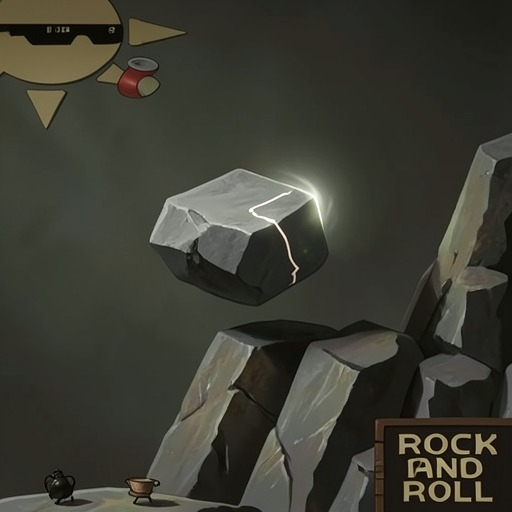
The awakening takes place during a grand confrontation between an unnamed hero and an unnamed villain on a violently shaking mountaintop. Their opposing magical attacks establish a conventional heroic scene, but the narrative quickly redirects attention away from the combatants. The battle’s apparent centrality is undercut when one of the hero’s stray spells strikes a pebble nearby, making the collateral impact more consequential than the duel itself.
The setting gives the event a sharp contrast between spectacle and neglect. Above the clouds, the hero and villain perform the familiar contest of light against darkness, while below their attention, a small stone endures the disturbance. The battle is therefore both the physical cause of the awakening and a structural decoy: what appears to be a story about famous humanlike opponents becomes the origin story of a protagonist that neither fighter recognizes.
From Stone to Consciousness
Before the spell, the awakened object is described as a pleasant-looking gneiss stone, more accurately a pebble of the sort a child might carry away because of its shape and coloring. It spends its existence as stones ordinarily do, remaining still and minding its own business. Its only apparent condition is prolonged, comfortable silence, with no recorded thought, intention, or personal history.
The stray spell changes that condition. The pebble suddenly notices the noise of the nearby battle and wishes for peace and quiet, then recognizes the strangeness of that wish. It asks, in effect, how it could have wanted anything when it had never before possessed thoughts. Its attempt to search its own mind finds only a long duration of silent waiting on the mountaintop, making consciousness arrive not as the recovery of a forgotten identity but as an abrupt creation of inner life.
This new awareness is not presented as an uncomplicated gift. The stone immediately understands the burden of eternity spent waiting in one place and wishes to return to the relaxing state it had enjoyed before becoming aware. The value shift is from effortless stillness to uncomfortable self-consciousness: existence has become richer because it can be experienced, but also more troubling because it can now be judged.
The System and the First Desire
As the newly conscious pebble tries to quiet its mind, it notices a small gray screen hovering in front of it. The screen was not part of its previous existence, so the awakening produces not only private thought but access to an external interface. The stone’s consciousness is immediately placed in relation to a system that can display information, assign objectives, and impose a framework of progression.
The first decisive desire follows soon afterward. The stone does not want merely to remain aware; it wants to become the best of all stones. That ambition gives direction to the otherwise passive condition of a pebble and converts awakening into the beginning of a quest. A new screen then appears with the assignment “Tutorial Quest Assigned” and the objective “Roll out.” The command is modest and almost absurdly literal, but it transforms the stone’s existence: movement, rather than mere endurance, becomes the first test of its agency.
The tutorial assignment also establishes the peculiar relationship between the stone and the system. The stone has been awakened by uncontrolled magic, yet its future is immediately organized through a rule-bound interface. Its consciousness is therefore born at the intersection of accidental force and programmed instruction. The event does not simply animate a rock; it places material existence inside a progression structure that will repeatedly challenge, reward, and constrain the new protagonist.
Immediate Consequences and Expanding Agency
The stone’s awakening changes the meaning of every later interaction. Once it can think and pursue improvement, being picked up, thrown, or used as a weapon is no longer merely physical treatment. On a battlefield, goblins notice that the rock is unusual and try to seize it because enchanted tools are beyond their means; the object that once escaped notice becomes an attractive and mysterious resource. Its apparent specialness is recognized externally only after the stone has begun to recognize itself internally.
The same pattern recurs across the larger narrative. A Bone Core panics when an intruder refuses to stop in the Bone Zone, a dragon grabs the stone with its tail because it needs a weapon against thieves, and a sensor alert later registers an object approaching at rapid speed. Each episode places the stone in a network of creatures, institutions, weapons, gravity, and systems that react to its material presence. The awakening makes those reactions narratively legible because the stone can now experience them as obstacles, opportunities, and stages in its own development.
The event also supplies the story’s recurring contrast between inherited heroic form and nonhuman agency. The mountaintop battle is repeated at several later thresholds, including the openings of “A Quarry to Settle” and “The World Ends With Rock,” while the stone’s own trajectory moves through dungeon conflict, dragon encounters, ascension, planetary destruction, and genesis. The repeated battle frame suggests that the old heroic script continues to replay, but the awakening has already shifted the story’s center from the figures who cast the spells to the thing that receives their unintended consequence.
Narrative Significance
The awakening functions as both a transformation and a reversal of narrative expectations. A conventional fantasy opening presents a hero and villain whose clash appears destined to determine the world. Here, the decisive consequence belongs to the pebble struck by accident. The event therefore decentralizes the humanlike combatants and grants causal importance to a seemingly negligible object.
Its consequences extend to the story’s ending and renewal. Deep beneath a planet, the rock later waits for a quest prompt, while an older stone eventually transfers the quest onward to a young hero and watches to see what the new quest will produce. That later transfer depends on the same possibility first opened by the awakening: a stone can possess intention, manipulate systems, pursue advancement, and participate in a continuing heroic cycle. The initial spell does not merely wake a pebble; it starts a chain in which stone becomes actor, competitor, weapon, survivor, world-maker, and source of another beginning.