Bone Zone dungeon clearing
Rock Falls, Everyone DiesBone Zone dungeon clearing is the campaign in which [Unnamed] transforms the Bone Zone from a hostile dungeon into a sequence of targets, using its own mass, velocity, heat, and newly acquired skills rather than a conventional weapon. What begins with a boulder landing on a dead goblin ends with the dungeon’s Bone Core cracking apart under the relentless force of physics, leaving the system to announce that the Bone Zone has been cleared.
Background and Entry
The clearing begins after the rock has grown beyond its original pebble state and enters the dungeon as an increasingly formidable boulder. Its arrival is immediately violent: it lands with a splat on a dead goblin, gains a level, and receives a new skill. The dead goblin is therefore not merely collateral damage. It is the first visible sign that the dungeon’s inhabitants can serve as experience-bearing obstacles, and the rock quickly interprets the dungeon through that game-like logic.
The dungeon is governed by a Bone Core, which recognizes that the intruder is not behaving like an ordinary attacker. Deep inside the mountain, the Bone Core panics because the invader simply refuses to stop. Its alarm gives the clearing a second perspective: the dungeon is not an inert setting but an organized defensive system, with a core capable of fear, monsters positioned as barriers, and a necromancer overseeing a lair. The rock’s persistence destabilizes that entire arrangement.
Assault Through Movement
Once inside, [Unnamed] begins doing what its nature makes possible: rolling. The dungeon floor is smooth, steep, and easier to traverse than the rough mountainside, so the rock gently pushes itself onto the slope and lets gravity become an ally. Skeletons hesitate when the approaching projectile comes into view, then turn back toward the corridor, but they cannot accelerate quickly enough to escape a rolling stone.
The rock supplements gravity with a new mobility skill. Near the skeletons, it attaches an ethereal thread to the ceiling and swings upward, turning the dungeon’s vertical space into part of its attack route. Later, it uses heat and velocity together, blasting forward at a slight upward angle with the maximum heat available at its level. The result is a cannonball that needs no gunpowder, only its own movement. It crashes into one skeleton, then the next, and then all of them, triggering the system notification that Collide has activated.
This method makes the clearing cumulative rather than tactical in the conventional sense. Each obstacle is absorbed into a chain of speed, impact, experience, and further capability. The dungeon’s defenses attempt to impose pauses and barriers, while the rock treats every barrier as another surface from which motion can continue.
The Necromancer’s Lair
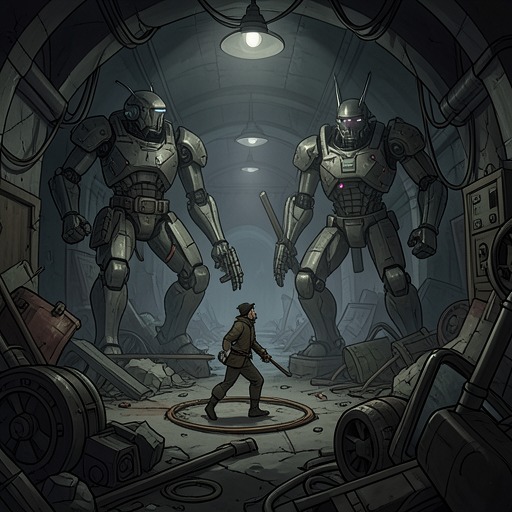
After the rock decides to pass through a wall, it converts 10 K into energy and launches itself at the obstruction. The wall proves to be a magical illusion rather than a true limit, and the rock breaks through into a vast room. There it encounters a hulking flesh monstrosity, with a goblin in dark robes seated atop its head and barking commands.
The goblin necromancer is unprepared for the form of the invasion. He wonders who could have thrown a rock so deeply into the dungeon and where the invader he had been warned about might be. His mistake is to treat the stone as an object delivered by someone else. By the time he notices that it is nearly 200 degrees warmer than it should be, the rock is already close enough to attack.
[Unnamed] uses as much energy as permitted and pounces into the flesh monstrosity. Collide activates again, dealing 305 damage in a calculated impact. The rock then slams into the goblin necromancer himself, sending both the stone and its victim into the outer wall. The second collision deals 200 damage to Great Necromancer Grogg. The goblin is crushed between the rock and the hard place, while the golem dissolves completely. The episode thus removes both the necromancer’s command structure and the monster that embodied his physical defense.
Destruction of the Bone Core
The dungeon’s final resistance is the Bone Core and the bone horror guarding it. The Bone Core watches the intruder approach at extraordinary speed, expecting the impact to be vertical. At the last moment, however, [Unnamed] shifts its movement so that its vertical speed transfers into horizontal motion in one smooth rotation. The rock blasts into the bone horror and smashes it into pieces instantly.
The maneuver confounds the Bone Core’s understanding of the attack. It tries to interpret the movement as a Double Jump followed by a forward slash, but neither description fits what the stone has actually done. The rock’s combat style therefore exceeds the dungeon’s familiar categories: it is not a swordsman, not a conventional projectile, and not an adventurer carrying an enchanted tool. It is a conscious mass exploiting momentum.
The final attack is absolute. The rock flies at the dungeon core, and the Bone Core has no meaningful opportunity to resist. The damage itself becomes irrelevant when the core meets the relentless forces of physics: it cracks and falls apart into shards of glittering light. With the core destroyed, the dungeon’s organizing center disappears rather than merely losing a battle.
Result and Significance
The system immediately confirms the outcome with the notification, “Dungeon: The Bone Zone Cleared!” and awards bonus experience. The clearing therefore has both a material and a procedural conclusion. The monsters, necromancer, golem, bone horror, and core are defeated in sequence, while the interface translates that destruction into a formal state change and reward.
The event also establishes a recurring pattern in [Unnamed]’s development. A goblin first notices that the rock is special, but the dungeon’s defenders learn the same fact only when ordinary assumptions fail: the stone moves without being thrown, turns stored heat into propulsion, uses skills associated with game combat, and converts the dungeon itself into an instrument of attack. The Bone Zone is cleared not through superior equipment or institutional authority, but through the rock’s ability to make physics function as its weapon and experience as its reason to keep moving.