Destruction of Planet Dirt
Rock Falls, Everyone DiesThe Destruction of Planet Dirt is the catastrophic culmination of [Unnamed]’s long acceleration and the decisive turning point between the world it inhabited and the world created in its aftermath. A Class 10 Doomsday Meteor is announced as a future threat to Planet Dirt, but when the impact finally approaches, every scale of defense fails: magic, dragons, heroes, villains, and the planet’s collective institutions can only delay or reshape the catastrophe. The collision destroys both Novice Bard Rihito and Planet Dirt, while leaving [Unnamed] alive, moving at a reduced velocity, and forced to confront loss, error, and the possibility of creation after destruction.
Warning and the Failure of Preparation
The disaster is framed first as an official threat rather than an unforeseeable accident. The Galactic Defender system reports that a Class 10 Doomsday Meteor will hit Planet Dirt in 230 years and offers bonus experience for stopping it. The warning turns planetary survival into a quest objective, joining defense, reward, and progression within the same system that has governed [Unnamed]’s development. By the time the impact becomes immediate, however, the earlier notice has not produced a solution capable of matching the meteor’s scale.
The planet is not defenseless in any simple sense. The city below the mountain is accustomed to dealing with dragons overhead and possesses established defenses; it is also the place from which heroes come. Yet the approaching body exceeds the assumptions built into those defenses. The invasion language used elsewhere by the system reduces danger to a count of one invader and an average level of six, while the meteor warning identifies a Class 10 threat. This contrast makes the planetary destruction an escalation from local, legible crises into a danger that administrative categories can announce but cannot adequately govern.
The Final Hour
When the emergency broadcast announces that the world will end in 60 minutes and warns of meteor showers, the catastrophe enters its final, compressed phase. Across the world, citizens panic, scream, cry, flee, and hide, while [Unnamed] does only one thing: it keeps accelerating. Its body is enormous and heavy, so its acceleration is gradual rather than spectacular, but that slowness becomes part of its inevitability. Once its velocity reaches 108304.0 m/s, the meteor is no longer merely approaching; it is a momentum that the planet must somehow absorb or redirect.
The world’s mages gather in a hastily arranged remote conference and initially argue over who will receive the glory of saving the world. Practical necessity eventually prevails. The newly elected Supreme Grand Magus of a city marked by a jade statue is chosen because he has foretold the landing zone and because there is no time for another plan. Through remote connections and ancient treasures, all the mana of the world is sent to him. Atop his tower, he channels that power through his body and casts Supreme Greater Anti Gravity Grand Magic, an immense collective attempt to make the rock go away.
The spell fails to provide salvation. Its failure is not simply a shortage of magical strength; it exposes the mismatch between a planetary institution and an object whose mass and motion have become the governing facts of the scene. Magic can gather the world’s energy at one point, but it cannot erase the consequences of the meteor’s accumulated movement. The defense system has concentrated power without escaping the physical conditions that power must confront.
Every Defense Collapses
A great Dragon, described as one of the last of its species and the mightiest among them, makes a final attempt. It gathers the roiling heat in its lungs and fires a beam of magma at the meteor. The blast shatters the sky, yet it fails because [Unnamed] does not obey the expected laws of temperature. Instead of being destroyed, the rock is heated and converts that heat into additional movement. The Dragon recognizes that its attack has only hastened the end and retreats to its cave, weary of the world and prepared to sleep through its destruction.
With only two minutes remaining, a hero and a villain stand together atop a mountain after combining their techniques. The hero can see the otherwise invisible stone because he is a Hero and can always see the enemy. He raises a grand sword and sends every available technique against [Unnamed]. The attack cuts through 1000 meters of rock, but [Unnamed] has 9000 meters remaining and rapidly repairs the damage with Qi while Diamond Skin protects its surface. The hero collapses in despair, and the villain silently waits beside him.
The combined failure establishes the event’s central reversal. The world’s mightiest figures cannot stop the meteor, and even apparent success would not restore safety. If the rock were blasted into pieces, those pieces would still fall. If magic sent it upward, a ceaseless meteor shower would follow. The meteor would eventually return, larger than before. Destruction has become structurally unavoidable: every proposed defense either fails outright or preserves the catastrophe in another form.
Music, Impact, and Loss
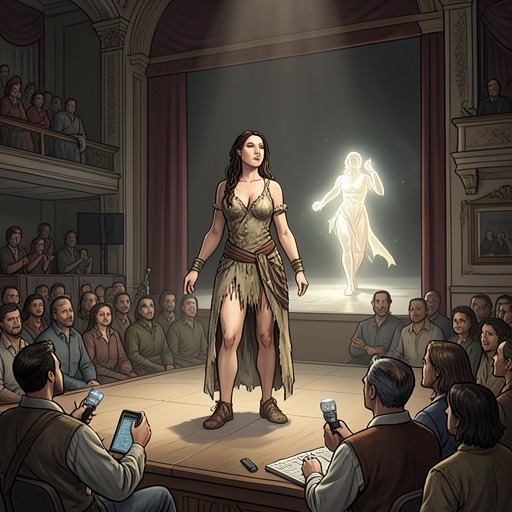
Against this machinery of panic and failed resistance, Novice Bard Rihito provides the event’s brief counterforce. [Unnamed] has finally acquired the senses needed to hear music. It does not understand humans or directly perceive the Bard as a person; instead, it sees the jade statue associated with its dreams reaching toward it and understands that the statue is singing for the rock, welcoming it. The music resonates through [Unnamed]’s domain, and everyone hears it.
The song changes the meaning of the final minutes. As Rihito looks upward at the imminent destruction with glowing eyes, [Unnamed] experiences beauty and wants to hear more. The hero’s sorrow drains away, allowing him to stand beside the villain; together they hold hands and face the end. The music briefly creates a common emotional field in a world otherwise divided among institutions, species, moral opponents, and frightened citizens. It does not stop the impact, but it gives the approaching destruction a form of recognition that force could not produce.
At altitude zero, the quest begins resolving. [Unnamed] deals 14959787069100 * 108304.2 * 1.2 / 4 = 486062331206766100 damage to Novice Bard Rihito and Planet Dirt. Its new velocity becomes 6000 m/s, and splash damage spreads to ERROR_OVERLOAD entities. The impact therefore has two immediate victims named together by the system: the individual whose music awakened [Unnamed]’s understanding of beauty, and the planet that had been its home. The numerical interface renders the collision as damage and calculation, while the surrounding narration makes clear that the calculation is also a death and a world-ending event.
The music stops. [Unnamed] understands loss for the first time because the song does not return, no matter how intently it listens. What remains is the brutal symphony of destruction and then silence. Numbers continue to rise, preserving the system’s progression even as the emotional meaning of progression has been shattered. The impact is thus both an accomplishment in the language of the quest and an irreversible deprivation in [Unnamed]’s emerging inner life.
Aftermath and the New World
The destruction does not conclude cleanly. The final error appears while the newly forged planet shakes, and the quest remains unresolved. [Unnamed] cannot accept that result, because the collision has not delivered the completion its system promised. After trying and failing again, it finds it easier to accept the unresolved quest as a permanent irritation. Waiting becomes easier when hope has been abandoned, but the loss of Rihito remains distinct from the unresolved status of the task.
The aftermath also preserves [Unnamed]’s development rather than ending it. It has lost the music and the completed quest, yet it still possesses levels and statistics and has become the biggest rock of all. The same progression logic that accompanied the apocalypse continues beyond Planet Dirt’s destruction, turning survival into a strange continuation rather than a victory. The meteor’s devastation therefore creates a new condition of existence: [Unnamed] remains, but its former world, its first experience of beauty, and its expectation that a quest should resolve have all been destroyed.
Later, the newly formed planet stirs as [Unnamed] continues its dance. Rings spin around it in a pattern that feels faintly rhythmic, echoing the song that remains in its mind. The remembered music changes into something new, and [Unnamed] begins to wonder whether it might create beauty rather than merely receive it. Looking over the mountain it carved, it recognizes a clumsy, beginner’s form of artistry. Destruction consequently becomes the precondition for a tentative creative awakening: Planet Dirt is gone, but from its ruin comes a world in which [Unnamed] can move from impact toward making.
Narrative Significance
The event joins planetary disaster to an epistemic and emotional transformation. Earlier, [Unnamed] becomes eligible for the Cultivator subclass through five hundred years of apparent stillness, and later it casts its senses outward to recognize that the world below is itself simply a very large rock. The destruction of Planet Dirt extends that altered perspective to its logical extreme. A planet is no longer an unquestioned setting around the stone; it becomes another material body in the path of the stone’s momentum, vulnerable to the same forces that once defined [Unnamed]’s own existence.
The event also reverses conventional heroic expectations. The city has defenses, the mages pool the world’s mana, the Dragon attacks, and the hero and villain unite, yet none of these efforts can prevent the collision. Their failure is not made meaningless: the music allows the hero and villain to face the end together, while Rihito’s song gives [Unnamed] its first apprehension of beauty. The catastrophe defeats power but briefly produces solidarity and recognition.
Finally, the destruction is not presented as a terminal void. The impact kills Rihito, destroys Planet Dirt, halts the song, and leaves the quest in error, but it also forges a new planet and opens the possibility that [Unnamed] can create beauty of its own. The world ends with rock, but the rock does not end with the world. It continues through numbers, grief, motion, and an unfinished attempt to turn the violence of impact into the beginning of art.