Dragon
Rock Falls, Everyone DiesDragon is a powerful but repeatedly outmatched presence whose relationship with the Rolling Stone begins in domestic accident and ends amid planetary catastrophe. It discovers the stone in a cavern, treats it as part of a new lair, later mistakes its cultivation for ordinary geology, and finally throws it as a weapon against intruders. That casual gesture turns Dragon from owner and observer into an unwitting participant in the chain of events that carries the stone from dungeon nuisance to world-ending meteor.
Identity and Introduction
Dragon enters the story after a five-hundred-year interval in which very little seems to happen to the resting stone. A tremor passes through the mountain, and Dragon crawls into the cavern, examining the mana-reinforced walls of the bottommost chamber before gently patting the attractive rock there. The chamber appears suitable as a lair, so Dragon claims it as a new home and gives the stone an unexpected roommate. The scene establishes Dragon through possession and appraisal: it recognizes a secure space, values the cavern’s construction, and accepts the stone because the stone looks like an ordinary, useful part of the environment.
The arrangement is founded on an asymmetry of knowledge. The Rolling Stone has developed beyond what Dragon can perceive, while Dragon sees only a familiar object in its own chamber. When a cultivation breakthrough occurs beside its head, Dragon wakes despite being unable to sleep through the surrounding energy. It looks at the stone and finds merely a rock, with no visible cultivation in it. The contrast is central to Dragon’s characterization: its senses and power are formidable, but the stone’s true nature remains concealed by its unremarkable appearance.
Lair, Hoard, and the Accidental Weapon
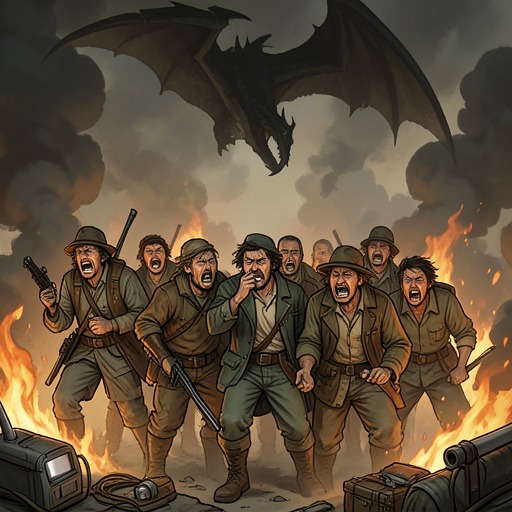
Dragon’s first decisive action toward the stone comes from anger rather than insight. Its nostrils flare with fire, it roars “THIEVES!”, and its tail lashes out to seize the stone. Dragon needs a weapon because adventurers have repeatedly entered its lair to covet its golden hoard, and it has not thrown stones at such pests for years. The gesture is therefore practical and habitual. Dragon does not choose the stone because it understands its exceptional abilities; it chooses the nearest convenient projectile.
With the stone in its grasp, Dragon spreads its wings, leaves the cavern, climbs the long pit, and flies upward. The stone’s later path is thus initiated by Dragon’s ordinary response to trespass. The event also reframes Dragon’s treasure chamber as a node in the story’s material economy. Adventurers seek magical tools and gold, Dragon guards the hoard, and the stone is converted from geological object into improvised weapon. Yet the conversion does not give Dragon control over what follows. Its authority over the lair ends where the stone’s hidden agency begins.
Methodical Pursuit and Comic Misjudgment
After the stone’s violence has exceeded anything Dragon expected, Dragon attempts to understand the result through procedure. It dives toward the mountain again after surveying the peaks and determining that neither the hero nor the demon could have been responsible for the theft that prompted its investigation. The narrative presents this descent as pest control performed with the methodical thoroughness of a maid cleaning a dusty library: Dragon starts at the top and works downward. Its immense body and aerial movement are treated with both grandeur and comic precision, especially when it closes its wings and becomes an aerodynamic missile while still holding the stone.
The mismatch between Dragon’s care and the stone’s indifference produces the character’s major comic pattern. Dragon investigates causes, checks possible culprits, and returns to practical concerns, while the stone continues to generate consequences beyond Dragon’s model of the world. When a single throw destroys all the adventurers, Dragon blinks in disbelief. It remembers the old proverb about those who cast the first stone eventually regretting it, but cannot reconcile that inherited wisdom with the result of one ordinary toss. Dragon has defeated its enemies without intending to unleash anything extraordinary, and its confusion is intensified when the crushed bodies are found empty of the magical tools Dragon hoped to recover. Even victory has failed to restore the expected reward.
From Roommate to Witness of Catastrophe
Dragon’s role expands when the scale of the stone’s trajectory expands. At the end of the world, an ancient Dragon emerges from its cave, weary and conscious of a mark of fate associated with disaster. It had retreated to the mountain because interference by a Dragon is believed to bring catastrophe, and now it looks upward at the greatest catastrophe of all: the approaching rock. Dragon does not understand precisely how it contributed to the disaster, but it senses that it played a part, turning its earlier throw into a source of retrospective dread.
Despite exhaustion and the knowledge that the situation may already be hopeless, Dragon makes one final attempt to act. Described as one of the last of its species and certainly among the mightiest, it gathers heat in its lungs and fires a bright beam of magma at the meteor. The attack fails because the rock does not obey ordinary temperature limits; the blast shatters the sky around it but only heats the rock further. Dragon’s power is therefore not denied in a simple contest of strength. Its strongest elemental response becomes fuel for the object it seeks to stop, converting resistance into acceleration toward destruction.
Narrative Function and Significance
Dragon anchors the story’s repeated mountain-top and cavern imagery while linking its fantasy layers to its cosmic ones. The recurring scenes of heroes and villains preparing for battle are initially adjacent to Dragon’s lair, where Dragon’s thrown stone becomes a force neither conventional combatants nor legendary power can contain. Later, the same stone is treated as a meteor whose impact threatens an entire world. Dragon’s movement from lair keeper to accidental launcher to failed defender mirrors the narrative’s enlargement of scale: what begins as a dispute over intruders and treasure becomes a problem involving planets and extinction.
The character also embodies the limits of human and monster-centered expectations. Goblins notice that the stone is special, the Bone Core panics because the intruder will not stop, and the stone’s own abilities continue to develop, yet Dragon repeatedly encounters the object through practical categories: wall decoration, roommate, projectile, pest-control tool, and target. Its blindness is not stupidity so much as a consequence of the stone’s disguise and of a world that assumes agency belongs to visibly living or magically marked beings. Dragon’s failure to recognize the stone makes its later influence more powerful: the most consequential act in its arc is performed casually, before it knows what it has set in motion.
At the story’s far end, the old Dragon’s response to the end of the world is not triumph but fatigue and responsibility. It sees the disaster, admits through its weariness that it has somehow participated in it, and still tries to intervene. That final effort cannot reverse the stone’s course, but it preserves Dragon as more than a gag about a monster losing its treasure. Dragon is an accidental mentor, threshold guardian, adversary, witness, and failed corrective force: the creature that gives the Rolling Stone its first great launch, watches ordinary explanations collapse around it, and remains present when the consequences reach the scale of a dying world.