Genesis of the new world
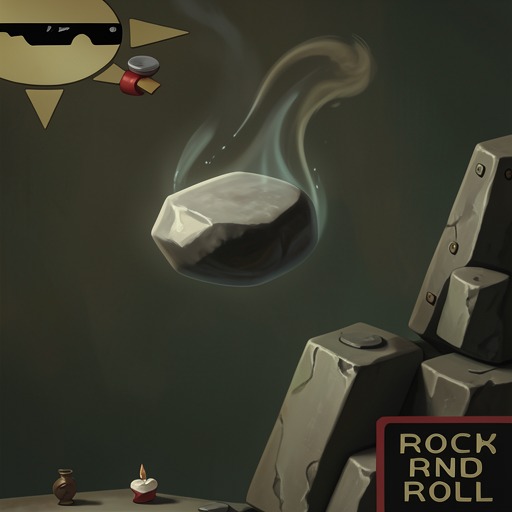
Rock Falls, Everyone DiesGenesis of the new world is the culmination of the rock’s long passage from inert stone to conscious planetary creator. After surviving the collapse of its former world and becoming a level 12 Planet through planetary fusion, it does not merely occupy a new body: it learns to shape an entire world, turning shattered matter, gravity, music, plants, animals, and living people into an evolving work of art.
From Destruction to a New Beginning
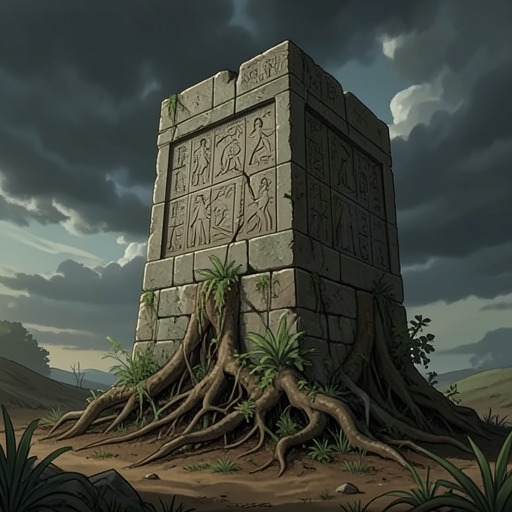
The creative process begins amid devastation. The rock sits deep beneath the earth at the center of the new planet, waiting for the system to resolve the quest that has governed so much of its existence. Before creation can begin, it tries to restore what it remembers. Using Create Mountain and Sculpt Earth, it raises a new mountain from the shattered ground and copies the mountain whose slopes it once knew intimately. The act is both practical and memorial: the rock remembers flying over that mountain, rolling down it in an instant, and waiting there for hundreds of years. By reconstructing it, the newly powerful Planet gives physical form to a landscape that had become part of its identity.
This reconstruction does not immediately settle the system’s unresolved demands, but it establishes the central pattern of the new world. The rock cannot simply recover the past. It can reproduce a remembered mountain, yet the world around it has already changed beyond restoration. Genesis therefore becomes an act of transformation rather than a return: the old landscape serves as a point of memory from which a different planet will grow.
Gravity, Rings, and the Discovery of Beauty
Once the field of crushed rock around the planet gradually settles and the hellfire ends, the rock watches the debris circle in slow gravitational patterns. That observation awakens a memory of an earlier sensory experience. Experimentally, it reaches into the familiar tapestry of gravity and begins arranging the orbiting stones. The fragments gather into three recognizable rings, which spin and dance around the planet.
The rings are the first sign that the rock’s power can produce more than survival or destruction. Their movement becomes almost rhythmic, as though they are following a song that still exists in the rock’s mind. As the dance continues, that remembered song changes into something new. The planet realizes that it may be capable of creating beauty rather than merely recognizing it. The mountain it has carved begins to appear as a clumsy but genuine form of artistry, an early work by a creator still learning what creation means.
The rings also give the new world a visible structure and a musical instrument. Their patterns respond to melodies that will emerge later, linking the planet’s orbital mechanics to its developing life. Gravity is no longer only a force that governs motion or a weapon represented by the Gravity Launcher. In the Genesis process, it becomes a medium through which the rock composes.
Learning to Make a Living World
The rock begins creating slowly, over eons and millennia. Its first attempts at plant life are misshapen forms resembling melted candlesticks, but repeated experimentation and leveling gradually turn crude construction into deliberate skill. It eventually sculpts trees from gemstones, giving them emerald leaves that ring in the wind like chimes. It then raises mountains for the trees and shapes the peaks so that wind passes through them at the right angles before striking the gemlike foliage.
The resulting landscape produces music. The trees play upon the wind, while the three rings continue their increasingly intricate movement above them. Yet the rock recognizes that instrumental sound alone is incomplete. The world needs singing, and singing requires people. This decision marks a further expansion of the creative project: the planet will not remain a beautiful arrangement of matter but will become a living community capable of adding its own voices.
To form that community, the rock turns to Natural Selection and Origin of Species. Its design is influenced by the jade beauty it remembers and wishes to recover, though the first beings it produces do not immediately resemble the ideal in its mind. It draws veins of jade from its own substance and sculpts them into people, then imbues those forms with life. The first jade figures rise as small, rough, cragged shapes. Through guidance and gradual change, they evolve and begin sculpting themselves into forms the rock had never imagined.
The people polish their jade skin until it gleams in the sun and fashion their hair from fine gemstones. They become a united people because the rock does not think in terms of men and women or the distinctions between them. More importantly, they do not need to be taught how to inhabit the world. Seeing the mountains, forests, lakes, and living materials around them, they begin to sing on their own. Creation thus exceeds its creator’s exact design: the rock supplies matter, life, and direction, but the inhabitants develop forms and songs beyond what it could have foreseen.
The Jade Planet as a Finished Yet Continuing Work
Slowly, the Planet fills with people, animals, plants, mountains, lakes, and forests. Its songs multiply, and the Planet listens to them all, turning the rings around the world in response to each tune. The new world contains conflict and war, but even its warriors sing as they charge into battle. Violence has not vanished; instead, it has been absorbed into a larger aesthetic and social order in which every part of life contributes to the planet’s sound.
The rock feels content with what it has made. The beauty is not as startling as the first flame of beauty that once transformed its understanding, because first discovery cannot be repeated. Nevertheless, the jade, gem, and stone world satisfies a different desire: it is a sustained creation, not a momentary revelation. The rock has built a planet that can generate beauty continuously through its inhabitants, landscapes, orbital rings, and songs.
Genesis also completes the rock’s philosophical movement toward the recognition that everything is fundamentally rock, differing only in scale and power. The planet, its mountains, its gemstone trees, its jade people, and the stones turning in orbit are not separate from the rock’s identity so much as extensions of the same material truth. The former pebble becomes a creator without abandoning its nature; it enlarges the meaning of being stone until stone includes a world.
Narrative Significance
The Genesis of the new world reverses the repeated pattern of destruction that has shaped the rock’s journey. The story opens and repeatedly returns to the image of a mountaintop where a hero and villain prepare for battle, but the rock’s ultimate achievement is not another attack. It is the patient construction of a world after catastrophe. Its long cultivation, its discovery of planetary scale, and its eventual mastery of gravity lead not to a final weapon but to creative responsibility.
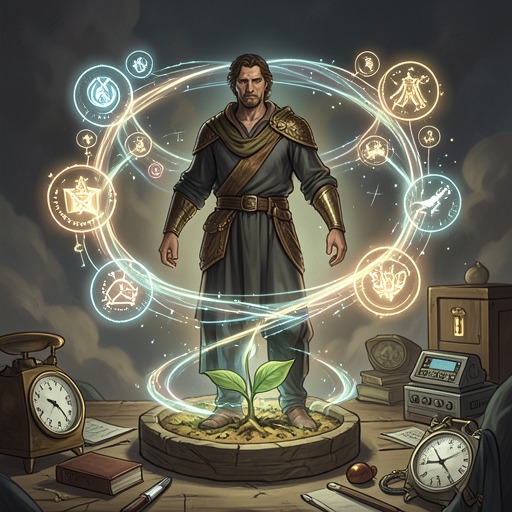
The process also gives the rock a new relationship with time. Earlier, remaining motionless for five hundred years qualifies it for the Cultivator subclass; later, ages and millennia become the duration in which crude experiments mature into gemstone forests, living jade people, and complex music. Stillness and patience, once mistaken for inactivity, become the foundation of creation. The same stone-like endurance that allowed the rock to survive becomes the discipline through which it learns.
By the end, the rock is no longer merely trying to level up, escape manipulation, or become the strongest entity in existence. It seeks to become the most beautiful Planet of all. That goal transforms power into craft. The new world is therefore both an ending and a beginning: the conclusion of the rock’s ascent through increasingly vast forms, and the opening of an ongoing creative age in which it can continue experimenting, learning, and making beauty across immense stretches of time.