Isekai Office
Rock Falls, Everyone DiesThe Isekai Office is the administrative institution that governs the passage of heroes into other worlds and assigns them the quests meant to structure their new lives. Its decisive significance lies in the contrast between bureaucratic procedure and cosmic consequence: a contract handled at a desk can send a hero toward demon lords, while a brief interruption in office routine can reveal that the destination world has been annihilated and remade.
Institutional Function
The office is identified indirectly through the contract governing the hero’s assignment. Demon Lord Diablos states that the Isekai Office contracted the white-clad hero for one demon lord, establishing that the institution does not merely provide transportation but defines the scope of heroic labor. The contract is limited: the hero was engaged for one demon lord rather than for the salvation of an entire world. That narrow administrative obligation helps explain the hero’s indifference after the battle, even as the defeated enemy threatens resurrection after 666 years and predicts humanity’s doom.
The office also handles requests for special advantages. When Jerome Smith arrives, he asks Solara for a powerful cheat skill, arguing that his contract requires him to defeat three demon lords without giving him additional boons. His complaint presents reincarnation as a negotiated service with explicit terms, while Solara’s response shows that benefits are not automatically granted. The office therefore operates through eligibility, paperwork, and contractual circumstances rather than through a simple moral distinction between deserving heroes and undeserving ones.
Solara’s Workplace
Solara, the minor goddess of heroes, is shown at her shift in the Isekai Office, barely two hours into the day and already wanting a second cup of divine ambrosia, also known as coffee. She sits behind a desk facing newly arrived applicants, giving the institution an ordinary workplace atmosphere despite its supernatural jurisdiction. Her tiredness, irritation, and need to maintain professional bearing make the office feel less like a temple than a crowded service counter staffed by an overworked administrator.
Her handling of Jerome Smith illustrates the office’s procedural character. After listening to his request, Solara retrieves a paper slip from the cabinet beneath her desk and reads out his circumstances, using the document to test whether his situation justifies granting boons. The paper is an instrument of institutional memory and authority: Jerome’s personal appeal is measured against a written record. Solara’s patience is strained, but the process remains formal until an alarm reaches her senses and abruptly supersedes the interview.
Crisis and Administrative Reach
The alarm sends Solara away from the desk before Jerome Smith can finish speaking. She activates Divine Grand Teleportation That Goes A Really Big Distance and travels to Planet Dirt, demonstrating that the Isekai Office’s jurisdiction extends across worlds and that its personnel can respond directly to planetary emergencies. The transition is immediate: a routine discussion about a cheat skill becomes an investigation into a catastrophe.
At Planet Dirt, Solara discovers that the entire planet has been destroyed, even though she had been there only two days earlier. Her divine senses find no ordinary survivor. Instead, they reach the planet’s center, where something immense and powerful is silently expanding and assimilating the shell of the ruined world around itself. The office’s intervention thus encounters a phenomenon that exceeds the categories of its paperwork: what had been a scheduled destination has become a burning, shattered landscape surrounding a new planetary being.
Solara tries to restore administrative order through conversation. She asks whether the new entity is in charge and reminds it that a hero is scheduled to be sent there, with at least three demon lords required as opponents. Her concern is not only survival or explanation; it is the disruption of the institutional timetable. The world has been destroyed too completely to supply the adversaries demanded by the contract, and the silent entity offers no cooperation. Solara finally threatens to leave it in place while arranging a time-acceleration field, hoping that demon lords might exist there within a few hundred thousand years. Her frustration exposes the absurd scale mismatch at the heart of the office: cosmic destruction is treated as a scheduling problem because the heroic system must still be made to function.
New Arrivals and Recurring Openings
After Solara returns to the office, she expects to deal with the consequences of the planetary disaster and the missing Jerome Smith. Instead, a nervous new arrival approaches her desk. Solara straightens herself into a semblance of professional, godly bearing and asks for the girl’s name. The girl answers, Rihito. This encounter shows the office continuing its intake process even after the destruction of one of its assigned worlds. New arrivals do not wait for the previous crisis to be resolved; the queue of destinies continues.
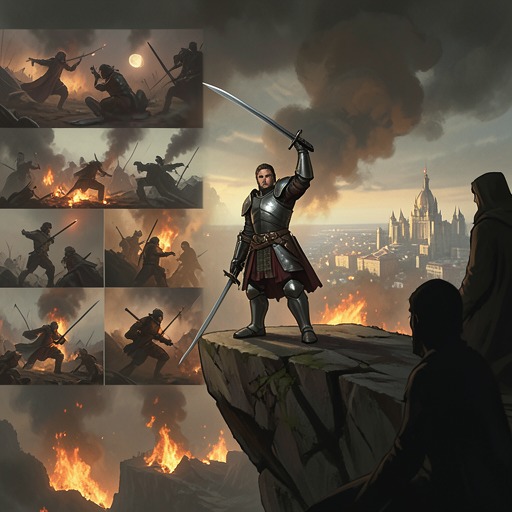
The office is also associated with the story’s repeated ceremonial opening. Several major chapters begin with the same image of a hero and a villain preparing for or engaging in a grand battle on a mountaintop above the clouds. The repetition appears in the opening chapter, in A Quarry to Settle, in The World Ends With Rock, and again in the epilogues. Although the office is not physically present in every recurrence, its contracts and scheduling logic provide the institutional background for the repeated hero-versus-villain pattern. The mountain battle becomes a ritual template that the office repeatedly feeds with new arrivals, new opponents, and new administrative expectations.
Bureaucracy Against Creation
The Isekai Office’s most revealing appearance occurs after destruction has already given way to creation. Solara arrives expecting Planet Dirt and finds a new planet forming around the silent central entity instead. Her questions about what happened receive no answer, while her practical demands for a hero and three demon lords remain unanswered as well. The institution can transport personnel and assign narrative roles, but it cannot compel the new world to preserve the old categories.
This limitation becomes especially striking beside the office’s earlier contractual authority. It can specify that one hero must defeat one demon lord, or that another must confront three, yet it has no ready procedure for a world whose central power has destroyed its predecessor and begun assimilating the remains into a new planetary body. The office represents an attempt to turn mythic violence, reincarnation, and world-making into manageable administration. The recurring alarms and errors elsewhere in the story reinforce the same tension: systems issue prompts, safeguards, and damage calculations, but the forces they regulate repeatedly exceed their definitions.
As a location, the Isekai Office therefore frames the narrative from behind the scenes. It is where heroic stories are contracted before they become adventures, where personal appeals are reduced to documents, and where divine employees attempt to preserve schedules after reality has broken them. Its desks and counters stand opposite the mountain, the destroyed planet, and the newly forming world; together, those spaces show how a supposedly orderly heroic system is continually overtaken by rock, energy, catastrophe, and creation.